Showing posts with label Free Trade. Show all posts

Sunday, November 16, 2008

Illogical Protectionism

Today's Sunday Times economist's column is well worth a read. Here's an important observation,
The President when introducing the Budget said the cesses and increases in several import duties were to encourage local production of these commodities or substitutes for them, as is the case of milk, sugar, wheat and maize imports. The economic logic is that higher prices for these goods would raise domestic prices for them or substitutes and be an incentive for domestic production. Therefore the increase in prices is needed for this incentive effect. However the Minister of Consumer Affairs and other government parliamentarians are saying these increases in duties would not raise prices.The Minister of Consumer Affairs, an Economics teacher is on the contrary taking steps to control prices of these commodities. If prices do not rise then there is no way in which the measures taken by the budget are incentives for domestic production.
The whole thing here.

Logic was never a strong point of the present administration. Import substitution, which the administration's economic strategy is based on, will give the results it has always given -- higher prices, fewer choices, less quality of life and eventually, a resounding victory for the opposition.

Sunday, October 19, 2008

Cris Lingle on Globalization & Culture

About an year ago, I helped arrange a lecture by Christopher Lingle on Globalization and Culture. It's now up on youtube.


Among other things, Cris predicts an impending crash in China. He correctly called the last Asian crisis before it happened, so I'm thinking there's something to it. I think most of his work is based on Austrian Trade Cycle theory. I could be wrong. Here's part 2 of the talk. The wobbly camera work is mostly my bad. If you want more, here's a writeup I did based on the talk.

Sunday, August 24, 2008

Why we should listen to economists

Scot Adams makes the case. (yes, he's the guy who created Dilbert, but he majored in economics in college and nowadays runs a stellar blog). Scott writes,
If a weather expert tells you what the weather will be on a specific day next year, you can safely ignore him. If he tells you a hurricane is heading your way, it's a good idea to get out of the way, even if the storm ends up turning. That's playing the odds.

Likewise, if an economist tries to tell you where the stock market will be in a year, you can safely ignore that. But if he tells you a gas tax holiday is an unambiguously bad idea, that's worth listening to, especially if economists on both sides of the aisle agree.

If you think it is okay to ignore economists because they are so often wrong, you're looking at the wrong questions. Economists are generally wrong with complicated models but right about concepts. For example, they know that additional domestic drilling won't make much of a dent in the energy problem. And they know that free trade is generally good for all economies. (You can argue with my examples, but the point is that some things are generally known by economists while not being understood by the general public.) [link]
There's much more in his blog. Scott is also funding a survey of what some 500 economists think about some economic policies of the two candidates running for the American presidency. The results will be interesting.

As Scott finds in his survey, most economists are moderate Democrats. But also the kind who likes things like free trade, and in general freer markets than your average democrat. Jagdish Bhagwati, perhaps the one of the world's most staunchest free trade economists is a registered democrat and an Obama supporter from the start, although he disagreed with Obama's populist NAFTA bashing.

My general observation is that if you have a liberal/cosmopolitan upbringing and eventually learn economics, you tend to be more sympathetic to policy proposals and ideas of classical liberalism (i.e. support more individual freedom and freer markets) or as Scott says in the current American political language, be more socially liberal and economically conservative.

Saturday, June 28, 2008

Drew Carey on Free Trade

Drew Carey in another installment of his series at Reason.tv takes a swing at the U.S. protectionists' (Obama-types) fear mongering over NAFTA.


Something that's rarely understood by protectionist all over the world is that the biggest source of "job losses" is technology, not free trade agreements. The emergence of Digital Cameras have dented the guys who sell films. small-time Christmas/Vesak-card vendors are feeling the pinch because of SMS. Does this mean these technologies need to be banned, discouraged or taxed away at least until "everyone adjusts"? Protectionist usually don't say stuff like that.

In all economic activity, whether you buy this soap over that one, or go to KFC instead of McDonald's, you create winners and losers. Should you be fined for picking one over the other? Free Trade (or international trade) just allows you to do this across a political border. There's nothing special about international trade, that isn't also true about domestic trade, except for the fact that governments have introduced barriers. I agree with those who say, that the source of much of protectionist opposition to free trade comes from the fact that in international trade, the trading partner is a "foreigner".

If you haven't already, go See the video. It's drew carey! (I love that end bit)

Related Link :Tyler Cowen : This Global Show must go on

P.S : Now that the primaries are over, Obama is a "pro-growth, free-market guy". Heh.

Monday, March 17, 2008

Greg Mankiw on Free Trade

Mankiw writing for the New York Times,
NO issue divides economists and mere Muggles more than the debate over globalization and international trade. Where the high priests of the dismal science see opportunity through the magic of the market’s invisible hand, Joe Sixpack sees a threat to his livelihood. This gap in perspective grows especially wide whenever the economy experiences short-run difficulties, as it is now. By all indications, the issue could come to dominate the presidential campaign.

Economists are, overwhelmingly, free traders. A 2006 poll of Ph.D. members of the American Economic Association found that 87.5 percent agreed that “the U.S. should eliminate remaining tariffs and other barriers to trade.”

The benefits from an open world trading system are standard fare in introductory economics courses. In my freshman course at Harvard, we start studying the topic in the second week, and we return to issues of globalization throughout the year. The basic lessons can be traced back to Adam Smith of the 18th century and David Ricardo of the 19th century: Trade between two countries creates winners and losers, but it leaves both nations with greater overall prosperity. [link]

Ok, a few things: First, isn't it a pity when most policy-makers remain ignorant to one of the fundamental lessons taught by people like Smith as early as the 18th century?

Secondly, Mankiw rocks. I highly recommend his textbook for anyone interested in learning about economics. It should be the standard textbook book in intro-econ courses.

Thirdly, the rest of Mankiw's article confirms much of what I said about Obama. He's bad on Trade. Do read the whole thing.

Monday, February 25, 2008

Unfair Trade

Adam Smith Institute has it's latest report Unfair Trade, Out today. From the ASI Blog:
Fairtrade is a nice idea, and it is great that so many consumers want to help the poor in the developing world. But it is important that we ask whether Fairtrade really helps. After all, 'Fairtrade' does not mean anyone who gives better terms to third-world farmers. It is a particular brand, which competes with other ethical schemes and charities for people's money.

There are a number of inconvenient truths about Fairtrade. Indeed, on closer inspection it may not be that fair at all. It only offers a very small number of farmers a higher fixed price for their goods. Given the way markets work, these higher prices come at the expense of many other farmers, who – unable to qualify for Fairtrade certification – are left even worse off.

More importantly, the Fairtrade scheme does not aid economic development. It sustains uncompetitive farmers on their land, holding back diversification, mechanization and moves up the value chain. In doing so it denies future generations the chance of a better life. [link]

Download the Report here

Friday, February 22, 2008

“The Cost of Free Trade”

Recently the Island carried an article with the same title where the writer (a Kath Noble) goes on to explain the implications of the Indo-Lanka Free Trade Agreement (FTA). Now, I have seen worse articles on trade and economics in the Sri Lankan press, but it’s precisely the more reasonable guise of the article which makes it's errors more plausible.

Do read it in its entirety
. The following are the relevant excerpts where I think she (or he) has got it wrong.

[..]Trade between the two countries [India and Sri Lanka] has increased at least four-fold, and it is now worth well over $2 billion. India had cut its tariffs on Sri Lankan goods by 2003, and Sri Lanka is due to do away with all remaining taxes on Indian imports during 2008. Free trade has triumphed, apparently.
Unfortunately, the story isn’t so simple. Taking a closer look at what has happened in practice would prompt even the most ardent believer to question the undoubtedly beguiling theory of free trade
First of all, what pass these days as Free Trade Agreements, are not really “Free Trade” agreements. If they were, then that would require only a couple of pages long document with a place to sign. FTAs usually run into the hundreds of papers, precisely because the FTAs come with all sort of conditions and clauses on which products can be imported, the tariff levels, etc. They should be more accurately called Freer/Managed trade agreements. This makes them poor benchmarks to test the “theory of Free trade”, which can be done better by looking at say, domestic trade within a country where tariffs and other restrictions do not exist. There’s absolutely nothing special about International Trade that’s also not true about domestic trade, except for the fact that people have imposed barriers on International trade.

Now, I’ve met and seen many economists (ardent free-market kind) who think of FTAs, WTO, etc as being disruptive to real free trade. I think they have a point, which everyone should hear more often, but I support FTAs because they are the only politically feasible way of getting to a point where there are no (or virtually no) restrictions on trade.

The writer continues..
[..] Free trade is supposed to be about each country focusing on the goods that it can produce most efficiently, and then selling them to others and using the proceeds to buy whatever else it needs on a level playing field. However, this is clearly not the reality. [..]
Clearly not the reality? I wonder why. Her article certainly doesn’t offer a clue.

Perhaps she’s confused with what comparative advantage is, which according to some Economists is the most misunderstood concept in economics, here’s Brad Delong’s explanation:
“"Comparative advantage" holds that we should export not those commodities that we can make more efficiently than people in other countries can make them, but those commodities that we can make most efficiently relative to the efficiency with which we make the average good or service.” (Do read the whole thing)
But one has to keep in mind when we talk about trade between “two countries” we are really talking about people in those countries and comparative advantage is very much a reality. For example, if I’m the world’s greatest cricketer and also the world’s finest clerk. The law of comparative advantage says that I should play my Cricket instead of being a clerk although I do both better than anyone else on the planet. I do what I do best relative to whatever else I do and not just do everything I can do better than others. It works much the same way for aggregates of people...like countries.

The Writer then goes into a lengthy explanation of fate of the vegetable oil industry, supposedly Sri Lanka’s major export under the FTA:

[..]Sri Lanka has been importing crude palm oil from Malaysia, putting it through a rather simple chemical process, and then exporting the end result as hydrogenated vegetable oil to India. Indian products have been undercut only because the Sri Lankan government has been imposing very little duty on crude palm oil, while India has been taxing such imports heavily.

[..]Indian manufacturers were understandably upset[..]and they began pressing the Indian government to protect them. India decided to forget the free trade agreement and simply put a stop to Sri Lankan imports. Factories stood idle for months while negotiations were underway to find a compromise solution, and everybody was relieved when the Indian government agreed to restart the trade with a fixed ceiling [..].

In fact, the dispute didn’t end there. The Indian government faced further demands from its industrialists, and it finally decided to reduce its import tariff on crude palm oil at the end of 2007. Sri Lankan products rather abruptly became no cheaper than those made in India.
[..]Sri Lankan workers are hardly going to celebrate having temporarily stolen a few jobs from their probably no better off Indian counterparts. Sri Lankan leaders will have to start worrying about the trade deficit again.

There are indeed great risks in export-dependant industries. Shift in policy can have major repercussions, especially on industries operating on negotiated policy advantages alone created by the particular trade agreement. I know a few economists who are very critical of export-led development. They criticize the strategy of “East Asian tigers” and china as being prone to bubbles and sudden shocks when the demand for their goods suddenly drops.

I’m puzzled though as to why “Sri Lankan leaders have to start worrying about the trade deficit”. Trade deficits (like the good people at Cafe Hayek often points out) are no longer a relevant statistic to “worry about”. I for example, have an increasing trade deficit with the Island Newspaper. I buy their product without ever having sold them anything. But to suggest that I’m somehow loosing out from this transaction is quite silly.

The writer then goes on to explain the plight of the pepper farmers in Kerala. The infamous problem of Farmer suicides, etc. She suggests that “Sri Lanka should be ashamed” if more and more pepper is exported to India.

Now as Nitin Pai and others have pointed out, there are major structural issues in India (some of which are common to Sri Lanka as well) which leads to the unfortunate plight Indian farmer’s face. It’s a sector where the market has not being allowed to properly operate. There are price controls, subsidies, lack of property rights, government interventions in the credit market and interventions and overall perverse incentives created by government policy (The increase of compensation for widows of suicides for example) Blaming this situation on the Free Trade Agreement is hardly prudent.

The writer concludes with some cautionary advice to India’s Minister of Commerce of the upcoming Comprehensive Economic Partnership which is bound to bring closer trade-ties, saying there is a cost to free trade.

Nobody denies there is a “cost” to trade, when two people trade a third can loose out. This is true for domestic trade as well as international, what free trade does is allows producers to increase their market potential and consumers to increase their range of choices by having access to cheaper goods at lower prices. It increases wealth in people and therefore countries. But there will be cost to some people, the writer will have to realize you can’t have the cake and eat it too.

Related Links : The Island Article, Paul Krugman on comparative advantage, Cris Lingle's lecture, Jagdish Bhagwati and more at Deaned on free trade.

Monday, February 18, 2008

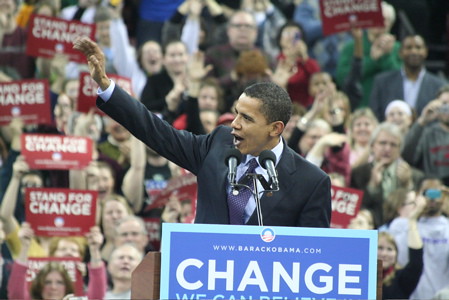
Why not Obama

Lots of people like Barack Obama. He’s now the frontrunner for the democratic nomination, and if he does get it, He’ll be hard to beat for McCain. He’s articulate, charismatic and black. This appeals to a lot of people, not just in the U.S. but it seems around the world and here in Sri Lanka. The 20-somethings I meet often are captivated by his persona, excited about his message of “Hope” and “Change” and optimistic about the prospect of an Obama Presidency.

Obama has been celebrated as a Liberal Reagan – the great communicator of the American Left (which btw, is not so ‘left’ compared to say, Sri Lanka). People have written essays claiming he’s a left-libertarian, a Civil-Libertarian, a principled guy, a generation’s hope, yada yada. He has lot of independents supporting him, and even some conservatives. That’s all great. What’s going for Obama is that he’s the new kid on the block, so he doesn’t have a lot of baggage. Couple this with the kind of romance that people have developed for him, it makes people want to cherry-pick facts and project him as whoever they want to. As others have noted, Obama as of now is whatever people want him to be. Infatuation can do that to people.

There was a time not so long ago I was idealistic enough for this kind of blind romance, but those days are gone. This romance is unhealthy, because it stops you from actually examining the issues.

Let’s take foreign policy. Now I oppose the Iraq war, and I agree with the fundamentals of his withdrawal plan. But Obama’s position on the Iraq isn’t necessarily principled as some would like it to be, it’s just populist. His call for a troop withdrawal in Iraq is not coming from a principled non-interventionist position, based on his assessment of ground realities or from a fundamental change in the way U.S. approaches foreign policy, it’s coming from an assessment of voter sentiment.

My biggest beef with Obama of course, is with his economics, I’m not going to talk much about specific U.S. domestic policy issues, but it’s safe to say that Obama offers no “change” from the standard liberal democrat rhetoric, except Obama’s whole game is based on rhetoric.

Where Obama suck is trade, his “fair trade” plan would not only have free-traders worried (that’s basically most economists on the planet – including Obama’s own advisors.) but his “Fair Trade” plan to protect American jobs and Open foreign markets will have Oxfam-type- Do-gooder Fair Traders scratching their heads. Obama wants to talk to Chaves, but wants to renegotiate NAFTA. In other words he wants to talk to their oil-dictator while screwing over the people of Latin America.

Having civil liberties for Americans doesn’t really matter for the rest of us, but trade and foreign policy, those are heavy impact areas. It’s time some of us stop being swept away by Obama speeches and really look into what policies Obama’s advocating. If you agree – if you think protecting American jobs at our cost is a good thing – fine enough. But otherwise, it’s time to stop being in love and grow up.

Thursday, January 17, 2008

How much would the Nano cost us?

That's the car, not the iPod. For the uninitiated, the Indian motor company Tata recently unveiled the "Nano" the world's cheapest car priced at a low-low figure of Rs.100,000 (INR). (That works out to about $2,500 and Rs.275,000 LKR).

This is great news of course both for Tata and the hundreds of thousands of Indians who would now be able to afford an automobile. I don't find the car overly 'saxy' as some Indians do, but it looks all right and I'm sure there are many people who'd like to have one.

The enthusiasm for the Nano is not shared by the elitist greens however, for the adherents of the Church-of-Gore it's some sort of a carbon-crime machine. never mind the fact that that the Nano surpasses not only Indian regulatory standards but also the strict European emission standards.

Personally I don't know if I'd want the Nano for myself, but it could be an awesome little Taxi Car. small size, fuel efficiency with the possibility 4 or 5 passengers should be perfect for running a little taxi business. I can totally see that happening.

The question is how much would it cost to import one? It's a question I asked from a few vehicle importers, they don't really know yet. The Sri Lankan import duties on vehicles are insane ranging up to 300% of the initial value. The importers think it might go into about at least Rs.500,000 with the relative low taxes for allowed for Indian vehicles.

There goes cheap-taxis I can't believe the tolerance level of Sri Lankans when it comes to import duties, what's the logic anyway? the government is protecting the Micro guy? I'd think cheaper vehicles for the countries citizens might have been more important than the Micro-Car's bank balance, apparently not.

It's some how justifiable that Sri Lankans pay multiple times as taxes for the same vehicle as the Americans do. Insane is an understatement.

Cultural Globalization

Tyler Cowen has an interesting piece on the topic over at Mint. The article pretty much echoes what Cris Lingle had to say at a forum I was involved in late last year. The backlash against cultural globalization is inevitable and understandable. A group of people in every society have certain attachments to what they perceive as “their culture” and whenever those traits are seen to be disappearing rapidly; there will be a backlash from some quarters. Cris called this a “Clash of Generations”, he saw it as a battle between young people who want to change things around while the generations before wanting to keep things the way they are. That’s probably true, although I could show few young people who’d viscously defend what they call the “Sri Lankan Culture”.

This backlash, as Tyler argues is healthy as it keeps things in check, as long as one keeps a sense of perspective. It’s perspective that’s unfortunately missing from those who oppose this inevitability.

Cultural globalization is made to be seen as something which comes only from “them to us” and in most cases simply put down to “Americanization”. This clearly is not the case. First of all when “it” does indeed comes from “them to us”, it doesn’t arrive pre-packaged, in fact its always localized, after all (contrary to what left-wing conspiracy theorists may tell you) the “west” is not out to colonize everywhere else, they (and by they, I mean those companies) are just here to make some revenue for themselves. The only way they can do that is to give us something we’d want to have. Tyler notices this when he says,
..some of the chains such as McDonald’s bend towards local taste with curry and tikka and lamb burger. Going out to eat is often more for the air conditioning than for the food.
I can think of many more examples, but most striking perhaps is what I encountered in Bangalore where I found a KFC restaurant with a vegetarian section. That’s right. Kentucky Fried Chicken has a pure vegetarian section. In Sri Lanka too the KFC’s, McDonald’s sells their version of Kottu. Not to mention the many Chinese restaurants serving what’s probably closer to local food than Chinese.

Tyler also speaks about the flip side,
In my home town of Fairfax, Virginia, it is now easier to get a good dosa than a good hamburger, but it still feels like America, albeit a different America than that of 1953.
Tyler of course doesn’t worry much about this, but there are people in the U.S. who especially in light of the emerging population patterns, issues of identity will become an emerging topic in U.S. politics. I’d say everyone should appreciate humanity and just take a chill pill, cultural globalization is inevitable, but it certainly won’t be Americanization nor one-way traffic. Sri Lankans are more likely to wear Kurthas and sing Baila than to flip burgers while listening to dirty rap.

Read Tyler Cowen’s article and Chris Lingle’s talk.

Wednesday, January 16, 2008

Get it right on free trade

Cafe Hayek points me to a nice op-ed on Free Trade on the NYTimes, Here's some relevant excerpts,

I doubt there’s a human being on earth who hasn’t benefited from the opportunity to trade freely with his neighbors. Imagine what your life would be like if you had to grow your own food, make your own clothes and rely on your grandmother’s home remedies for health care. Access to a trained physician might reduce the demand for grandma’s home remedies, but — especially at her age — she’s still got plenty of reason to be thankful for having a doctor.

Some people suggest, however, that it makes sense to isolate the moral effects of a single new trading opportunity or free trade agreement. Surely we have fellow citizens who are hurt by those agreements, at least in the limited sense that they’d be better off in a world where trade flourishes, except in this one instance. What do we owe those fellow citizens?

One way to think about that is to ask what your moral instincts tell you in analogous situations. Suppose, after years of buying shampoo at your local pharmacy, you discover you can order the same shampoo for less money on the Web. Do you have an obligation to compensate your pharmacist? If you move to a cheaper apartment, should you compensate your landlord? When you eat at McDonald’s, should you compensate the owners of the diner next door? Public policy should not be designed to advance moral instincts that we all reject every day of our lives. [..]

For many decades, schoolyard bullying has been a profitable occupation. All across America, bullies have built up skills so they can take advantage of that opportunity. If we toughen the rules to make bullying unprofitable, must we compensate the bullies?

Bullying and protectionism have a lot in common. They both use force (either directly or through the power of the law) to enrich someone else at your involuntary expense. If you’re forced to pay $20 an hour to an American for goods you could have bought from a Mexican for $5 an hour, you’re being extorted. When a free trade agreement allows you to buy from the Mexican after all, rejoice in your liberation. [link] (emphasis mine)
The full article is worth a read and true for any economy in the world.

Opposition to free trade is not a current topic in the political discourse in Sri Lanka, partly because the politicians have much better things to talk about. In fact Sri Lankan politics has recently degenerated into just partisan finger-pointing instead of actual discussion on politics.

Even when some of these issues became relevant around the 2004 election, the anti-trade arguments rested obscure anti-westism bordering on economic nationalism, which needless to say, is a whole lot of nonsense.

Friday, December 28, 2007

SEZs for Sri Lanka?

I was in India when the Nandigram incidents took place, it was around March and I was traveling all over North India. At the centre of the disputew were land acquisitions meant for a Special Economic Zone(SEZ), initiated by the West Bengal State Government (controlled by the Communist Party of India - Marxist, no less) for a chemical hub by a private company. The SEZ required the acquisition of 14,000 acres (57 km²) of land mostly from Nandigram. On this particular day (March 14, 2007) there was a standoff between policemen (some of whom were CPI(M) cadres in police uniform) and the villagers, ultimately resulting in 14 people being killed from police gunfire.

My work in India required me to be away from the TV most of the time, but I did manage to catch glimpses of the unfolding story and ever since I've kept a close-eye on news about SEZs.

Now, "Export Processing Zones" is hardly anything new , even Sri Lanka has what’s known as Free Trade Zones (FTZs). They are basically a designated area where the trade barriers are relaxed – tariffs lowered, duty slashed, etc. The area generally benefits from good infrastructure and what’s called an 'enabling environment' to promote exports and attract Foreign Direct Investment.

However SEZs, experimented quite extensively in India, China and elsewhere is a bit of a different animal. First of all they tend to be huge. Shenzhen – China’s first SEZ – spreads over a land area of about 334 km², that’s roughly about 9 times the city of Colombo. India, which now has approved nearly 400 SEZs in all of its states, has allowed for sites the size of 50km² for SEZs . So I repeat, they are HUGE, often covering the size of modern day cities. SEZs, like Free Trade Zones have relaxed trade rules, except they are more relaxed...much more relaxed. SEZs in India have been declared "foreign territory" for purposes of trade, duties and tariffs. They are exempt from customs, excise, service, Sales and local taxes. Most of them are run by private companies, including some foreign-owned ones. They have duty concessions on some imports, relaxed labor laws and the state government provides such services as electricity and water. I've seen some of them, they do look really pretty. So much so that Sri Lankan companies such as Brandix have invested in some of them.

On paper SEZs looks perfect - it would increase employment, help exports, encourage investment and provide a way for companies to escape illogical tariffs and taxes imposed on them and step into the world of free enteprise. Everything is great, except for the fact that setting up a SEZ involves land acquisitions, often forced on people not willing to move out from their property. This is where it gets messy, forcible land acquisitions creates a whole host of problems - displacement, inadequate compensation, loss of livelihood for the people involved to mention a few.

These issues have made SEZs a subject of much criticism from across the political spectrum. For the people on the left, this is part of the latest Capitalist conspiracy to satisfy their greedy lust for money at the expense of the poor. For the people to the right, its a violation of private property rights (see Shruti Rajgopalan's excellent critique here)- the one thing that's so critical to the effective function of the free-market system, that people like Hernando De Soto have written books about it.

Being a student of the subject I have met many people falling into both these camps, with one the one unified conclusion - SEZs are just bad. Except of course many people I've not met, including the Times of India columnist, Swaminathan Aiyar who has argued (here and elsewhere) that SEZs could be good thing, if handled properly. He recommends leaving the residential areas intact when developing the SEZs, and making affected people equity holders of the new projects, making the villagers landlords and companies their tenants. Quite a transformation.

Although, I'd principally defend property rights, I can back Aiyar's suggestions. So can the model be replicated in Sri Lanka ? Absolutely. Especially for a president, who like to harp on development and seems to want (genuinely or not I don't know) to develop both the South (primarily Hambantota) and the Eastern province, SEZs should definitely be a development tool which needs to be explored. Both provinces have natural ports and certainly the Eastern province can use a bit of accelerated growth.

Personally, I'd prefer Free Economic Zones, that is large designated areas with much like the rules of SEZs but not necessarily a privately managed chunk of land, a Hong-Kong experiment of sorts. Designated SEZs can still exist, of course. The East (in a world where a degree of rule of law is established) would be a perfect candidate for something like this. Trincomalee port can be made into a privately owned freeport. But now I'm just taking it a bit too far.. or is it?

Related Articles :