Showing posts with label inflation. Show all posts

Sunday, October 05, 2008

We need the Rs.200 note

The Rs.200 note. Whatever happened to it? (Pic by PVGM)

Seen any 50 cents recently? (coins, not the rapper) I haven't either. They probably don't mint it anymore. If they did, that would be a subsidy for the guys who mint coins because the metal required to mint the coin would cost more than 50 cents. Like it's cousins 25 cents, 10 cents and 1 cent, 50 cents is dead.

That's what inflation will do eventually to all coins and notes under the fiat currency system we have. That's no big deal so long as inflation is moderate, but when you have inflation at about 30%, like we have, one small but irritating cost of inflation will be carrying costs.

Now that Rs.100 is worth piss, we have to carry more money to make up for it. So we have end up carrying more higher denominated notes (500s, 1000s) and less lower denominated ones (100s, 50s). This means when I try to pay my Tuk-Tuk fellow, or my AC-Bus guy, often times I end up having just 500 or 1000 notes and not enough 100s, and those chaps never have enough change. This becomes just plain inconvenient and on occasion a source of great annoyance. We need a note in between 100 and 500.

I think the government should re-introduce that Rs.200 note that we had in circulation for some time in a much more durable form than the plasticky-version we had earlier. That should help with the situation.

More on inflation at Deaned.

Saturday, September 13, 2008

Seminar on Austrian economics

Foundation for Economic Education has put up podcasts of its seminar on Austrian Economics. Sri Lankans might find the two podcasts on monetary equilibrium and costs of inflation interesting. You'd need some background in economics and at least some familiarity with the Austrian school to fully appreciate it. The cost of inflation lecture might still be useful for anyone given the current circumstances.

Austrian theory is certainly not mainstream econ, but it has informed the mainstream throughout the last century. Austrian monetary theory in particular, is probably more valid here, in developing countries where central banks truly do suck, like the Austrians like to think.

Non-economists, especially those not trained in the neoclassical mainstream would probably find Austrian econ easier to appreciate and understand. There's no hunt for the elusive equilibrium, there's no emphasis demand curves (austrians think it's more like a demand fog than a curve), no assumptions about perfect competition. It's logical and commonsensical, until your probably get a sense where the austrians are taking it. I wouldn't do away the Friedmanites just yet, but If you want to give it a go, Mises.org have excellent resources on the subject. 

For daily doses of Austrian econ, both the Mises blog and even more so the Austrianeconomists blogs are highly recommended.  

Updated. 

Saturday, July 05, 2008

Don't tell Cabraal

Apparently the German government is doing Zimbabweans a favor by stopping the Munich-based company which provides the 'high quality' paper for the Zimbabwean central bank to print it's bank notes which helps create the countries' million percent inflation. The WSJ has more.

Incidentally, it's the same company behind the Germany's own hyperinflation in the 1920s. With such an impressive record and with Sri Lankan inflation hovering at around 30% (modified index rate), no doubt the company is looking at Sri Lanka as it's next big client.

Much more at Marginal Revolution including a pointer to a very relevant paper by Greg Mankiw for the Sri Lankan context.

p.s. -- for the unintiated, Cabraal is Sri Lanka's governer for the central bank. More on inflation at Deaned.

Wednesday, June 11, 2008

Ajay Shah on Sri Lanka's inflation

A few days ago Ajay Shah, of whom I refer to a lot on this blog, has yet another excellent piece on inflation. Given his experience in Indian monetary policy, I asked him what he thought of high inflation in Sri Lanka and repeated claims by the Central Bank of Sri Lanka they are not responsible for it. Inflation hovers around 25% according to a newer CPI(N) index which among other things, excludes alcohol due to moral reasons. The old Index, which is no longer published, should indicate a rate well above 30%, which is the highest inflation I have lived through.

Anyways, here's what Ajay had to say replying to my question on his blog, which I'm reproducing here in full :
Deane, I don't know a lot about Sri Lanka. I can see a few problems, though.

From 1/1/02 onwards, LKR depreciation has averaged 2.2% per year. This doesn't sound very good, at a time when inflation has been high. Could this be setting the stage for trouble in the form of a speculative attack and a large depreciation?

When inflation is at 25%, why should citizens hold currency notes or nominal bank deposits? What is the trigger at which dollarisation (or rupeeisation) takes off? When that happens, LKR money supply to GDP will drop, the revenue potential of the inflation tax will go down, and the government will then have to set about building a better fiscal system. But along the way, on this route, things could get very painful.

Either in such a crisis, or ideally before it, the government would have to evaluate a monetary policy reform. This involves rewriting the core legislation governing the central bank, and getting it going afresh. One possibility is to run a currency board - though a currency board to the Indian rupee might make more sense to the extent that Indian GDP probably has a higher correlation with Sri Lankan GDP when compared with the correlation against US GDP.

Are intellectuals in Sri Lanka thinking about these things? They should be. It's better to think through these things ahead of time. Crises are good times to do economic reform - provided fully articulated and well thought out reforms proposals are at hand and can be pressed into service. Else, crises can lead to all sorts of wonky ideas getting used.

I'm totally unsympathetic when central bankers make excuses about inflation not being in their control. Look around the world: There are a lot of countries, all of which are facing the same shocks, but inflation hasn't crossed 5% in lots of them.

There are two kinds of blunders taking place. One class of blunders is the intellectual one - of people who haven't properly figured out monetary economics being placed in roles of running central banks. The other kind of blunder is that of institutional design - of a central bank that is not properly structured to focus on the task of inflation. [link | comments section. we have seen this movie before, Ajay Shah June 7, 2008]
A few notes,
  1. The question of why there wouldn't be market-led dollarization in high inflation is something I've thought about earlier. See my comments and LBO's fussbudget's thoughts here. What Ajay is saying is something like people holding less of Sri Lankan Rupees and more of some other stuff, like foreign currencies, which will make government financing debt through printing money less productive for the government, so they'll have to cut expenditure. But reaching to this level would mean enduring a very very painful period, which I'm hopeful we will manage to avoid. In Zimbabwe, where there's hyperinflation, there's a parallel black market trading in US dollars and other foreign currencies which is keeping the economy there still alive.

  2. Most Sri Lankan economists I've met have long being advocates of Central Bank independence. Some have articulated the need for institutional reform by way of going for a currency board or inflation targeting (discussed towards the end in this post). But most economists seem to be publicly mum on the issue possibly because they don't want to spoil the relationship they have with the Central Bank. I'm just speculating here, but this can be a real possibility given there aren't a lot of think tanks in Sri Lanka with economists in their payroll. I will discuss more CB reform later, although I have said many times it would be impossible to make significant reforms without first firing Cabraal (president's buddy) as governor of the Central Bank.

  3. As we all know the Central Bank of Sri Lanka thinks inflation is a petroleum phenomenon. Unfortunately however, they don't quite articulate this theory very well, they should at least have produced a paper on this by now. Further, CBSL and it's governor have dismissed comparisons with other regional inflation rates as being incomplete because of the different ways in which the rates are being measured. While that is certainly true, you cannot possibly account for 20% point difference between Sri Lanka's inflation and say, Singapore's or India's for that matter in the differences of measurement. India in particular, should have similar consumption pattern to that of Sri Lanka.

  4. Although there are some NeoKeynesians who still believe in cost-push inflation (Joe Sitglitz for example), not even Stiglitz will come to the CB's rescue as the Central Bank has managed to sustain high inflation for a long period of time, whereas Sitglitz beef with Milton's monetarism has to do with inflation at low levels. Bottom line is I know of no credible economist (even if stiglitz qualifies as being credible), who's willing to argue that high levels of inflation for a longer period of time is possible without significant growth of the money supply.

  5. Thankfully the central bankers in Sri Lanka seems to be realizing this, although we haven't seen the effects of this recent (reported) monetary tightening reflected in the index just yet. Meanwhile, governor Cabraal keeps on harping that "core inflation" isn't all that high, although that too is about 9.6%.

  6. My revised thoughts on the best institutional reform for Central Banks coming up soon.

Monday, June 02, 2008

Privatize the CPC!

Finally some sense on Sri Lanka's idiotic energy policy. Muttukrishna Sarvananthan from the Point Pedro Institute says the needful. Here's a quote from an LBO report:

"Sri Lankan consumers of petroleum products are not only paying for the rise in international prices," Sarvanandan said.

"They are also paying for the bloated bureaucracy, corruption and wastages at the Ceylon Petroleum Corporation. Privatisation of the CPC is long overdue. " [link]

While we are at it, add to the shopping list the Sri Lanka Transportation Board, Railways and the Ceylon Electricity Board. All making billions of rupees in losses. The last couple of paragraphs of the LBO report is rather telling,
Dallas Alahapperuma revealed last week that the state-run Sri Lanka Transport Board lost 4.0 billion rupees last year, and had 37,000 employees and had 6,000 excess employees at least.

Meanwhile private buses ran at a profit. The state rail service had 17,000 employees, lost 8.5 billion rupees.

Last year Sri Lanka Railways charged ordinary citizens 50 cents a passenger kilometre while state workers were charged only 5 cents a passenger kilometre. Rail workers were charged only 3 cents. [link]

Do read the whole thing. It beats me why Sri Lankans don't seem understand that at the end of the day someone will have to foot the bill of all those billions of rupees worth of losses from state-enterprises and subsidies, that someone is you, the tax payer. and when your government is so populist that it doesn't want to raise taxes to match this enormous spending, the bills come home another way -- it's called inflation.

Related, The Biggest Big Government

Sunday, May 25, 2008

Making sense on Inflation

Ajay Shah points me to this article on this economist article on Inflation on emerging economies, arguing it bare resembles to the great inflation of developed countries in the 1970s. With inflation of about 25% in Sri Lanka and with the Central Bank more or less claiming that inflation is a petroleum/agricultural phenomenon (as opposed to monetary) it's an article well worth a read.

Here's a few key paragraphs,

Many policymakers in emerging economies argue that serious monetary tightening is not warranted: higher inflation, they say, is due solely to spikes in food and energy prices, caused by temporary supply shocks and speculation. Higher interest rates cannot call forth more pigs or grain. They expect inflation to ease later this year as higher prices prompt an increase in supply (food prices have started to edge down over the past month) and as sharp rises in commodity prices drop out of year-on-year comparisons.

Yes, food inflation is likely to slow later this year; but that does not mean rising headline inflation can be ignored. The synchronised jump in global food prices suggests that there is more to the story than disruptions to supply. Prices are also rising partly because loose monetary conditions in emerging economies have boosted domestic demand. These economies have accounted for over 90% of the increase in global consumption of oil and metals since 2002 and for 80% of the rise in demand for grain. This partly reflects long-term structural forces, but it is also the product of a money-fuelled cyclical boom. Peter Morgan, of HSBC, says that the initial shock to food prices may have come from the supply side, but the strength of income and money growth helps to validate higher prices. Were monetary conditions tighter, rises in food prices might be offset by declines elsewhere, keeping inflation under control. [..]

According to conventional wisdom, the monetary-policy mistakes that caused the Great Inflation are much less likely today because central banks are independent of politicians. But unlike the Federal Reserve and the European Central Bank (ECB), many central banks in emerging economies (notably China, India and Russia) are not fully independent. In another echo of the 1970s, they often face intense political pressure to hold rates low to boost growth and jobs.

Emerging economies are also in danger of repeating the blunder of central bankers in the rich world in the 1970s: they focus on core inflation as a reason for holding interest rates below the headline inflation rate. But negative real interest rates then further boost demand, while rising inflation expectations trigger bigger pay claims. Unless central banks tighten their grip soon, inflationary expectations could surge. [link]

"Core Inflation" has recently become a pet-word for Central Bank Governor, Ajit Nivard Cabraal, and forget "fully independence", Cabraal was one of the key campaign figures in the incumbent president's election in 2005 before being appointed as the Governor of the CB.

So if anyone's serious about CB Independence, then Cabraal needs to be fired. That's a pipe dream, at least until Mahinda Rajapakse remains the president.

Thursday, May 01, 2008

What's Up With Food?


As you probably know, the world's food prices are soaring. So far I've come across two basic explanations which I find reasonable for the hike in food and commodity prices.
  • Increased demand, constrained supply.

    This one is straight from your basic Econ 101 textbook. The increase in demand is attributed to the high growth rates in China and India, the newly richer Indians and Chinese demand more food. The supply hasn't kept up with demand hence the rice in food prices.

    The reasons for the supply constraints are attributed to the use of agricultural land for bio fuels (ethanol in the U.S. for example). This is yet another example of how climate change hysteria and resulting policy is actually doing more harm than the climatic effects of the supposed phenomena (I call it Al-flation).

    Second reason (See Tyler Cowen's excellent piece in the New York Times) there isn't enough international trade in foodstuff and the everywhere in the world there's a plethora of government interventions in the agriculture markets distorting price signals which stops produces from effectively responding to the increased demand.

    Also the resulting panicky situation from high food prices creates even more government intervention like putting in place price controls like in Sri Lanka and banning export of rice in India all of which destroys incentives for increased production.

  • It's created by loose monetary policy.

    This time the culprit is the U.S. Federal Reserve. The explanation is the monetary expansion in the U.S. via lower interest rates is causing higher inflation and a weaker dollar. Most commodities (including agricultural commodities) are priced in dollars, and when the dollar weakens the prices of commodities in terms of dollars go up. This also invites speculation of future declines driving up the prices further. See this chart from WSJ for example,

    The chart shows rapid increase in the price of oil in terms of dollars relative to euros since September 2007, about the time the US Fed started it's loose monetary policy practices. The hike in oil prices in terms of euros is fairly moderate, like the WSJ says, "had the dollar merely retained the same purchasing power as the euro, today's price of oil would be below $70 a barrel"

    Add to this picture that some developing countries (like Sri Lanka and India) partially pegs it's currency to the U.S. dollar basically importing U.S. inflation in addition to creating it's own inflation by printing money to finance government expenditure at home, we have a hike in almost all prices including that of agricultural commodities.
What is the true story? I think a bit (or a lot) of both. Sri Lanka being a net food importer is directly seeing the impact of these increases. The poor in particular who spend most of their earnings on foodstuff are really feeling the pinch. This is on top of more than 20% inflation even without food prices factored in (food inflation stands at about 34%) due to loose monetary policy by the central bank as a result of financing unsustainable government spending.

A pertinent question to ask is whether the high price of rice in particular, which didn't have much interaction with the global markets until recently be explained by generally high inflation alone. General inflation is probably the driving factor, but somehow I don't think captures the complete picture. It's possible there is an increased demand locally for rice due to people abandoning close substitutes like bread given the high price of wheat.

Now I'd love to see some numbers supporting that, something which is unfortunately sorely lacking in Sri Lankan media.

Related articles on food prices:

Saturday, April 19, 2008

Inflation for Dummies.Take 2

Mises Institute blog recently had an interesting piece by Henry Hazlitt on "everything you need to know about inflation". Here's a key excerpt:

The word "inflation" originally applied solely to the quantity of money. It meant that the volume of money was inflated, blown up, overextended. It is not mere pedantry to insist that the word should be used only in its original meaning. To use it to mean "a rise in prices" is to deflect attention away from the real cause of inflation and the real cure for it.

Let us see what happens under inflation, and why it happens. When the supply of money is increased, people have more money to offer for goods. If the supply of goods does not increase — or does not increase as much as the supply of money — then the prices of goods will go up. Each individual dollar becomes less valuable because there are more dollars. Therefore more of them will be offered against, say, a pair of shoes or a hundred bushels of wheat than before. A "price" is an exchange ratio between a dollar and a unit of goods. When people have more dollars, they value each dollar less. Goods then rise in price, not because goods are scarcer than before, but because dollars are more abundant. [link]

Do read the whole thing. Hazlitt is the author of the extremely useful book Economics in One Lesson, which is a great introduction for economics for anyone. He's also the author of many other books found free on the Mises Institute site.

It's interesting how more and more economists keep giving pseudo-Austrian analysis on the current financial crisis in the U.S. and the problem of inflation. In a recent column Fuss-Budget of Lanka Business Online does much the same. Are we all Austrians now?

Economists in the Austrian School generally advocate a return to the gold standard, or a free-banking system , or 100% reserve banking (a currency board arrangement, etc) to tackle the problem of inflation and the creation of "bubbles resulting from malinvestment.

Related, my own version of Inflation for Dummies.

Wednesday, April 09, 2008

Starving Billionaires

With the rate of inflation at 100,000% that's the state of affairs in Zimbabwe. Recently, the Zimbabwean reserve bank put out a $50 Million currency note. I wonder if the Zimbabwean central bankers are pushing "cost-push" theories like their Sri Lankan counterparts. "Oil is expensive you see, you'll have to pay 16 Million for that bread". Now with the 50 Million note , at least carrying cash will be easier. Just ask this littler chap.

The country has a black market for US Dollars, a (black)market-led dollarization of sorts. Something I think should be allowed to happen elsewhere, legally.

There might now be hope so, here's what Morgan Tsvangirai, the man who should be Zimbabwe's next president said recently in a WSJ article:
Today, Zimbabwe ranks last out of the 141 countries surveyed by the Fraser Institute's Economic Freedom in the World report. According to 2007 World Bank estimates, it takes 96 days to start a business in Zimbabwe. It takes only two days in Australia. Waiting for necessary licenses takes 952 days in Zimbabwe, but only 34 days in South Korea. Registering property in Zimbabwe costs an astonishing 25% of the property's value. In the United States, it costs only 0.5%. [link]
At least someone there gets it. Hope might be short lived though, power transfers from dictators are never smooth.

[bank note link via reason, WSJ quote via division of labor]

Saturday, March 29, 2008

Inflation for Dummies

The theory of oil-induced inflation

For the Background of this post, do read my last one. This post is a result of the many frustrating times I spent listening government politicians, the media, and most other people attributing the causes of inflation to increasing of prices in the world market, in particular spiraling Oil prices.

The fundamental argument of Oil-induced inflation, was summarized in a recent editorial in the Daily Mirror:
Obviously, it is the inexorable skyrocketing of the oil prices in the world market – over which the government has no control - that have the ripple effect on prices of all goods and services. Increased fuel prices have its inevitable impact on electricity prices. The combined effect of price hikes in these two items, fuel and power, impact on all activities ranging from transport to production of various consumer items of food. The inevitable result is phenomenal increase in prices. [link : DailyMirror Editorial, March 21, 2008]
The argument is elegantly simple. Oil prices rise. All goods are transported using vehicles, which uses oil, costs go up, so does the prices. It seems so reasonable, that the theory has many adherents. So much so, the Central Bankers in Sri Lanka (who now presides over an embarrassing 20% rate of inflation) help perpetuate this theory.

Now, I'm a great fan of peer education. So in my last post, I promised a sort of a for dummies-by-dummies guide on inflation. Looking back now, that was a silly promise to give. You can probably write a book on the subject. So what follows is a basic debunking of the oil-induced inflation myth, it's not unfortunately a complete dummies guide. But I will try to be as elaborate as possible.

The explanations may come across as being overly simplistic, and grossly inadequate. I accept both these charges. This is after all a dummies guide, and a blog post at that.

That thing called money.

As I discussed in my earlier post, Money has no value all by itself. It's just pieces of paper, what gives it value is that people use money to buy goods and services and because of that, there is a demand and therefore a value attached to it. Money also has a different value, than the number that's printed on it.

For example, like I said in my last post, I have a 20 Rupee Indian Note in my pocket. As you know, there is less acceptance (demand) for Indian rupees here in Sri Lanka, than in India. So the 20 Indian Rupee note I have is significantly less valuable here than it would be in India.

It's also true that what was a Rs.20 now in Sri Lanka is significantly less valuable than a Rs.20 in say, 1970.

First lesson in understanding inflation is perhaps realizing that money has different value attached to it than what's printed on the currency notes and thinking of inflation in terms of value of money rather than the prices of goods.

Do-It-Yourself Inflation experiment.

Literally speaking, printing money is quite simple. In Sri Lanka, it's printed in a factory (which I think is) in Biyagama. The Central Bank of a country has the control of much money is in the system, now that is not so simple to explain, but you'll have to trust me on that one. The point is, when I say "Printing Money" it doesn't mean literally printing notes, it refers to any way the Central Bank use to increase the money supply. Whenever you hear the phrases like , The Central bank has purchased Treasury Bills, the CB has lowered interest rates, it means the Central bank has put more money into to the system by increasing the money in circulation, expanding access to credit, so on. So in short, "money printing" is not just printing notes, it's any form of expansion of "money" in the system. Money, as you know, exists in many forms other than notes (credit, etc.) (updated - HT: ddm)

So, how is any of this relevant to inflation? Well, inflation is created by excessive money printing, which in turn is controlled by the central blank. So to put it bluntly, the Central Bank creates inflation. It's as simple as that.

Now, if you haven't heard of this before, this might come across as something between hallucinatory and laughable. So let me run through this thought-experiment I've developed.

Imagine that you are in grade 7. You and a friend of yours (let's call him Tom) want this really cool key-tag I have. I'm a cheeky little you-know-what, that I will only give it to the highest bidder. You have Rs.80 in your pocket, Tom has Rs.90. I start calling for bids at Rs.40. Both of you really like this key-tag.

The bidding starts: Tom starts biding at 50, You raise it to 60. Tom in turn raises the bid to 70. Now, you are in bit of a soup - you have only 10 Rupees left, but you really need Rs.5 of that to go home. If you don't use that 5 you'll have to walk your way home, and your mom would be very very annoyed. This Rs.5 is really valuable to you right now, so after thinking it over, you decide the to raise your bid to Rs. 75. Leaving Tom with Rs.15, to outbid you. But at this moment, there's a little twist in our tale.

Enter: The counterfeiter. Now (for no real reason, totally randomly) let's call this counterfeiter, Cabraal. Now Cabraal has this really cool laser printer which can print currency notes and he wants to test out some of his newly-printed stuff. So he walks over to you, and takes you to the side and hands you what appears to be two bills of Rs.10 notes, he says he's just helping out and everything is cool.

Suddenly, that Rs.5 you had with you doesn't seem too important anymore. The bidding starts again, Tom raises the bid to 80, you bid at 85. Again Tom retaliates by raising the bid to Rs.90, you raise the bid to Rs.95 and poor old Tom, not having the money to out-bid you, looses out and you get to buy the key-tag at Rs.95.

Think again as to what actually happened. The key-tag which would have sold at possibly Rs.80 (and a maximum of Rs.90 - all the money Tom had) was sold at Rs.95. The price increased simply because more money was injected into the process by counterfeiter Cabraal.

This is kind of what happens in our economy, when The Central Bank prints too much money without an increase in productive activity in the economy, all prices go up. This is inflation. It's a result of too much money chasing too few goods, we would eventually attach a smaller value to money and spend more of it, so prices 'sky rocket'.

In fact, most classical economists explicitly defined inflation as the growth of the money supply rather than the overall increase of prices.

Price of a particular item, like Oil, or Soap can increase (or decrease) due to all sorts of reasons and this may indeed contribute in recording a overall higher (or lower, with all other things being equal) value in the Consumer Price Index (which is used to measure inflation nowadays), but this is not the 'cause' of inflation. In fact general price increases are a result of inflation rather than it's cause.

So Why do they get it so wrong ?

If controlling inflation is so easy, Why do Central Banks like that of Sri Lanka and Zimbabwe get it so horribly wrong? Surely, Governor Cabraal and Co. know basic monetary economics? I certainly hope so. But the reason why certain central banks fail to control inflation is that governments (especially like ours) see printing money as a way to pay for their spending.

When you have a massive government set up like in Sri Lanka (100+ ministers and the obscenely large public sector), with a war, failing state enterprises and all other wasteful spending to finance, you end up having to tax, borrow when that's not enough - print money. This is why inflation is high in Sri Lanka.

But wait, why is this inflation thing so bad?

It might seem obvious, but it's a surprisingly good question. If prices of all things rise, then prices of whatever I sell must also be higher, so what's the big deal with inflation? Are we really worrying over nothing? Well, not exactly.

First of all, Inflation is a tax on everyone who holds money. Either in your wallet or a bank (savings/fixed deposit) account which pays less interest than the rate of inflation (which is the case in Sri Lanka). Every cent that you have in your bank and in your pocket right now is melting away as you read this. If you had Rs.100 in your savings account at 5% annual interest rate, and the annual inflation is 24% (pdf link) your Rs.100 at the end of the year is worth only Rs.81. You are literally being robbed of nearly 20% of your money.

Secondly, Incomes doesn't always keep up with the pace of inflation. So your purchasing power goes down. People with fixed incomes like pensioners are seeing their purchasing power plummet.

Thirdly, what makes free-market capitalism work is it's price system. Prices act as signal to producers, consumers and all actors of the market on what to buy, where to invest and how to allocate resources. High Inflation distorts this price signal (with an injection of money without productive activity) resulting in mal-investment, miss-allocation of resource and generally wrong economic decisions.

Additionally, inflation leads to an arbitrary distribution of wealth. When the Central Bank increases the money supply by say, lowering the interest on credit, those who get their hands on the credit first, generally benefit and those who don't, looses out. (Think of Tom in our thought-experiment)

Finally, high inflation creates uncertainty. If inflation is difficult to predict and volatile (a symptom of high inflation) that discourage productive economic activity. For example, a money lender may be reluctant to lend his money because he cannot predict if the interest he charges would be sufficient in face of volatile inflation.

Hmm, but can't the oil theory be also true?

The theory "Cost-Push" inflation, the idea that inflation is as a result of rising cost of things such as oil, was in fact quite a mainstream idea, about 30 years ago. Before Milton Friedman and others showed that inflation is always and everywhere a monetary phenomenon.

Without going into a theoretical argument on why this is not the case, let's say this hypothesis is true. Oil is the cause of (or the main contributor to) inflation.

What should we see? Surely,

1) All oil producing countries should have relatively low inflation. and,
2) All countries mostly importing their oil should have relatively higher inflation.

But none of these propositions are true. Iran, Russia and Venezuela three of the largest Oil producers have significantly higher inflation with Iran and Venezuela having close to 20% of inflation, much like Sri Lanka. On the other hand, countries which imports most (or all) of their oil consumption like New Zealand, Japan and Hong Kong are among the countries with lowest inflation.

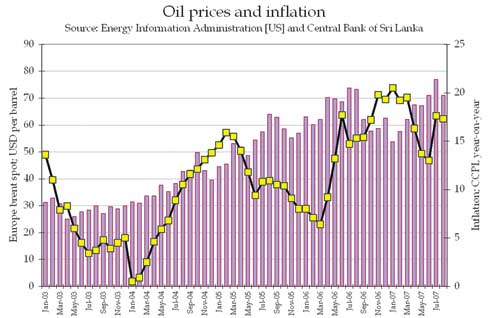
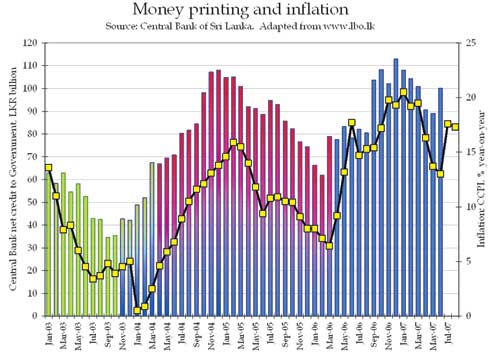
If that isn't proof enough, this graph from LBO/FT, showing the correlation between money printing and inflation and lack of a correlation between inflation and oil prices should really settle it.

So what can be done about this?

Sri Lankan economists offer two basic solutions. Both of which has to do with Central Bank Independence.

I'd say all solutions must include firing Ajith Nivard Cabraal from his post as governor of the Central Bank. If you are serious about Central Bank's independence you simply can't have the President's former campaign manager at it's helm.

The two dominant views on institutional reforms to central banking in Sri Lanka are the following:
  1. Bring in inflation-targeting legislation. This involves the parliament passing a law which mandates the Central Bank to stick to a particular level of inflation (say from 1-3%). Countries like New Zealand, Australia, Canada and Great Britain have enacted such legislation and it has proven to be relatively successful. Harsha De Silva, the well-known Sri Lankan economist is an advocate of this type of reform.

  2. A Currency Board arrangement. This involves pegging the SL rupee against a hard currency such as the US Dollar, which allows Sri Lanka to basically import the pegged currencies' inflation rate, in the case of the USD this would be 4% as opposed to the current 20+% inflation rate. Hong Kong has this type of arrangement with the US Dollar. LBO's Fuss-Budget and international monetary expert, Steve Hanke have recommended Sri Lanka follow a currency board, which we had till 1950 with relatively low inflation.
I tend to side with Fuss and Hanke although in the U.S. too there are renewed calls to keep inflation in check, by guys like my friend Ron Paul and others, especially from the Austrian School of Economics. Austrians happen to think that the U.S. should be on a gold standard, where the value of the U.S. dollar is by a commodity such as gold.

That's it for the dummies guide. It's been considerably longer than I wanted it to be, but I don't have time for a shorter post, hence the longer one. I Hope this has been helpful, I wish some of our politicians and newspaper editors can have a look at the actual causes of inflation rather than ranting on false, long-debunked theories.

Recommended Links :
The author is a student of economics and far from a monetary expert, the blog nor the author will take responsibility for any riots, profit/losses or a great depression which might trigger as a result of this post. Endorsements, criticisms and comments are welcome.

Wednesday, March 26, 2008

My Socialist Experiment

When I was growing up, this idea that 'our country was poor' puzzled me. How can we be poor I thought, the government print the money don't they? So how can they have all the money and still be poor? After days of thinking over this, I came to the conclusion that perhaps printing money costs, about the same amount of money that's being printed. That is for example, it costs the value of Rs.10 to print a Ten Rupee note. I remember asking my dad if this was the case, he said no, money is just paper he told me. I Can't remember if I followed up on the question, but I'm pretty sure he did not satisfactorily answer my questions.

This is about the time I invented my own version of socialism (I was really very young, honestly.) Deanist-Socialism was simple. Under my plan, every citizen in the country will receive a fixed amount of money at the end of every month courtesy the government. That way, there's no real need to work and we can live happily ever after.

I can't quite remember what I did with my theory, but finding answers to why oh why governments didn't just print money and distribute lead me to many realizations. First among them - not many people understand 'money'. For a long time, I didn't either.

So in my quest to understand this thing called money better, I began reading by coincidence (now this is much much later) the likes of Friedman, Rothbard, Mises and (eventually) the likes of Mankiw, Cowen and other contemporary practitioners. Having gone through all of this, I feel like I have the basics covered. But seeing media reports, listening to local politicians and even what some of our Central Bankers say, it seems many doesn't even have these basics covered.

So in the near future, (possibly tomorrow, I'm sleepy now) this blog will have Inflation for Dummies by dummies post to dispel some of the myths that's being perpetuated when talking about Cost of Living and particularly inflation in Sri Lanka.

But first, a few more of those realizations..

#2) Wealth is not Money. If it were, my little socialist experiment would have worked, to make it's people more wealthy, all a government has to do was print money and distribute them. Wealth, put it bluntly, is stuff or things we value (some of which could be money) and can be defined as the productive capacity of the economy.

But why doesn't governments do this? why don't they just print the money and distribute? The answer, is to do with the value of money.

#3) Paper-money has no intrinsic value. It's just paper. Turns out dad was right, the kind of money we use is just paper (fiat money). The only reason why you would accept it in exchange for payment for something is because we have the confidence that in the future, some other person would take it to exchange with something we value. If anyone doesn't think they can exchange this paper for something valuable in the future, they would not accept it.

For example, right now, I have with me a 20 Rupee Indian-Note in my purse, signed by a few friends and given to me as a souvenir. In India, this would have bought be breakfast. But here, in Sri Lanka, this would buy me nothing. The Indian rupee has (almost) no value here. (unless at a money-exchanger) The value of money, like any thing else is determined by the forces of it's supply and demand.

Realizing these two things, and the notion of value of money is perhaps the key to understanding inflation.

Monday, February 25, 2008

Raponomics

Greg Mankiw's 10 principles of economics, The Rap Version :


What can I say, just Awesome. I don't know about #7, but WTF. For anyone feeling really bored, here's the original version:
  1. People face tradeoffs
  2. The cost of something is what you give up to get it
  3. Rational people think at the margin
  4. People respond to incentives
  5. Trade can make everyone better off
  6. Markets are usually a good way to organize economic activity
  7. Governments can sometimes improve market outcomes
  8. A country’s standard of living depends on its ability to produce goods and services
  9. Prices rise when the government prints too much money
  10. Society faces a short-run tradeoff between inflation and unemployment.

Monday, February 04, 2008

Steve Hanke on Slaying Sri Lanka's inflation

He argues for a return to a currency board regim . CATO has the article here. Also covered by LBO.