Friday, February 22, 2008

“The Cost of Free Trade”

Recently the Island carried an article with the same title where the writer (a Kath Noble) goes on to explain the implications of the Indo-Lanka Free Trade Agreement (FTA). Now, I have seen worse articles on trade and economics in the Sri Lankan press, but it’s precisely the more reasonable guise of the article which makes it's errors more plausible.

Do read it in its entirety
. The following are the relevant excerpts where I think she (or he) has got it wrong.

[..]Trade between the two countries [India and Sri Lanka] has increased at least four-fold, and it is now worth well over $2 billion. India had cut its tariffs on Sri Lankan goods by 2003, and Sri Lanka is due to do away with all remaining taxes on Indian imports during 2008. Free trade has triumphed, apparently.
Unfortunately, the story isn’t so simple. Taking a closer look at what has happened in practice would prompt even the most ardent believer to question the undoubtedly beguiling theory of free trade
First of all, what pass these days as Free Trade Agreements, are not really “Free Trade” agreements. If they were, then that would require only a couple of pages long document with a place to sign. FTAs usually run into the hundreds of papers, precisely because the FTAs come with all sort of conditions and clauses on which products can be imported, the tariff levels, etc. They should be more accurately called Freer/Managed trade agreements. This makes them poor benchmarks to test the “theory of Free trade”, which can be done better by looking at say, domestic trade within a country where tariffs and other restrictions do not exist. There’s absolutely nothing special about International Trade that’s also not true about domestic trade, except for the fact that people have imposed barriers on International trade.

Now, I’ve met and seen many economists (ardent free-market kind) who think of FTAs, WTO, etc as being disruptive to real free trade. I think they have a point, which everyone should hear more often, but I support FTAs because they are the only politically feasible way of getting to a point where there are no (or virtually no) restrictions on trade.

The writer continues..
[..] Free trade is supposed to be about each country focusing on the goods that it can produce most efficiently, and then selling them to others and using the proceeds to buy whatever else it needs on a level playing field. However, this is clearly not the reality. [..]
Clearly not the reality? I wonder why. Her article certainly doesn’t offer a clue.

Perhaps she’s confused with what comparative advantage is, which according to some Economists is the most misunderstood concept in economics, here’s Brad Delong’s explanation:
“"Comparative advantage" holds that we should export not those commodities that we can make more efficiently than people in other countries can make them, but those commodities that we can make most efficiently relative to the efficiency with which we make the average good or service.” (Do read the whole thing)
But one has to keep in mind when we talk about trade between “two countries” we are really talking about people in those countries and comparative advantage is very much a reality. For example, if I’m the world’s greatest cricketer and also the world’s finest clerk. The law of comparative advantage says that I should play my Cricket instead of being a clerk although I do both better than anyone else on the planet. I do what I do best relative to whatever else I do and not just do everything I can do better than others. It works much the same way for aggregates of people...like countries.

The Writer then goes into a lengthy explanation of fate of the vegetable oil industry, supposedly Sri Lanka’s major export under the FTA:

[..]Sri Lanka has been importing crude palm oil from Malaysia, putting it through a rather simple chemical process, and then exporting the end result as hydrogenated vegetable oil to India. Indian products have been undercut only because the Sri Lankan government has been imposing very little duty on crude palm oil, while India has been taxing such imports heavily.

[..]Indian manufacturers were understandably upset[..]and they began pressing the Indian government to protect them. India decided to forget the free trade agreement and simply put a stop to Sri Lankan imports. Factories stood idle for months while negotiations were underway to find a compromise solution, and everybody was relieved when the Indian government agreed to restart the trade with a fixed ceiling [..].

In fact, the dispute didn’t end there. The Indian government faced further demands from its industrialists, and it finally decided to reduce its import tariff on crude palm oil at the end of 2007. Sri Lankan products rather abruptly became no cheaper than those made in India.
[..]Sri Lankan workers are hardly going to celebrate having temporarily stolen a few jobs from their probably no better off Indian counterparts. Sri Lankan leaders will have to start worrying about the trade deficit again.

There are indeed great risks in export-dependant industries. Shift in policy can have major repercussions, especially on industries operating on negotiated policy advantages alone created by the particular trade agreement. I know a few economists who are very critical of export-led development. They criticize the strategy of “East Asian tigers” and china as being prone to bubbles and sudden shocks when the demand for their goods suddenly drops.

I’m puzzled though as to why “Sri Lankan leaders have to start worrying about the trade deficit”. Trade deficits (like the good people at Cafe Hayek often points out) are no longer a relevant statistic to “worry about”. I for example, have an increasing trade deficit with the Island Newspaper. I buy their product without ever having sold them anything. But to suggest that I’m somehow loosing out from this transaction is quite silly.

The writer then goes on to explain the plight of the pepper farmers in Kerala. The infamous problem of Farmer suicides, etc. She suggests that “Sri Lanka should be ashamed” if more and more pepper is exported to India.

Now as Nitin Pai and others have pointed out, there are major structural issues in India (some of which are common to Sri Lanka as well) which leads to the unfortunate plight Indian farmer’s face. It’s a sector where the market has not being allowed to properly operate. There are price controls, subsidies, lack of property rights, government interventions in the credit market and interventions and overall perverse incentives created by government policy (The increase of compensation for widows of suicides for example) Blaming this situation on the Free Trade Agreement is hardly prudent.

The writer concludes with some cautionary advice to India’s Minister of Commerce of the upcoming Comprehensive Economic Partnership which is bound to bring closer trade-ties, saying there is a cost to free trade.

Nobody denies there is a “cost” to trade, when two people trade a third can loose out. This is true for domestic trade as well as international, what free trade does is allows producers to increase their market potential and consumers to increase their range of choices by having access to cheaper goods at lower prices. It increases wealth in people and therefore countries. But there will be cost to some people, the writer will have to realize you can’t have the cake and eat it too.

Related Links : The Island Article, Paul Krugman on comparative advantage, Cris Lingle's lecture, Jagdish Bhagwati and more at Deaned on free trade.

Tuesday, February 19, 2008

Inflation and Booze

This is what a Sri Lankan Government official had to say about not including alcohol and tobacco from the new consumer price index:

Sri Lanka's statistics officials said alcohol and tobacco had been dropped from the index because of a government policy against the use of intoxicants known as 'matherter thither.'

The head of price indices at the statistics office, D C A Gunewardene said each country may have to make their own decision and the dropped category was small.

"There is a policy called 'matherter thither', so we did not include it," Gunewardene said. [link]

Sigh. I need a drink..

Monday, February 18, 2008

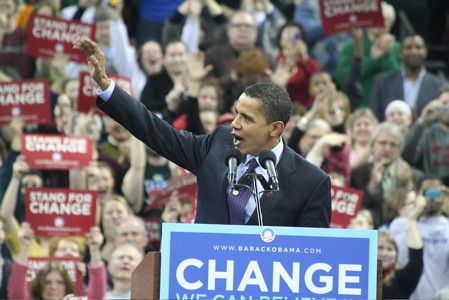
Why not Obama

Lots of people like Barack Obama. He’s now the frontrunner for the democratic nomination, and if he does get it, He’ll be hard to beat for McCain. He’s articulate, charismatic and black. This appeals to a lot of people, not just in the U.S. but it seems around the world and here in Sri Lanka. The 20-somethings I meet often are captivated by his persona, excited about his message of “Hope” and “Change” and optimistic about the prospect of an Obama Presidency.

Obama has been celebrated as a Liberal Reagan – the great communicator of the American Left (which btw, is not so ‘left’ compared to say, Sri Lanka). People have written essays claiming he’s a left-libertarian, a Civil-Libertarian, a principled guy, a generation’s hope, yada yada. He has lot of independents supporting him, and even some conservatives. That’s all great. What’s going for Obama is that he’s the new kid on the block, so he doesn’t have a lot of baggage. Couple this with the kind of romance that people have developed for him, it makes people want to cherry-pick facts and project him as whoever they want to. As others have noted, Obama as of now is whatever people want him to be. Infatuation can do that to people.

There was a time not so long ago I was idealistic enough for this kind of blind romance, but those days are gone. This romance is unhealthy, because it stops you from actually examining the issues.

Let’s take foreign policy. Now I oppose the Iraq war, and I agree with the fundamentals of his withdrawal plan. But Obama’s position on the Iraq isn’t necessarily principled as some would like it to be, it’s just populist. His call for a troop withdrawal in Iraq is not coming from a principled non-interventionist position, based on his assessment of ground realities or from a fundamental change in the way U.S. approaches foreign policy, it’s coming from an assessment of voter sentiment.

My biggest beef with Obama of course, is with his economics, I’m not going to talk much about specific U.S. domestic policy issues, but it’s safe to say that Obama offers no “change” from the standard liberal democrat rhetoric, except Obama’s whole game is based on rhetoric.

Where Obama suck is trade, his “fair trade” plan would not only have free-traders worried (that’s basically most economists on the planet – including Obama’s own advisors.) but his “Fair Trade” plan to protect American jobs and Open foreign markets will have Oxfam-type- Do-gooder Fair Traders scratching their heads. Obama wants to talk to Chaves, but wants to renegotiate NAFTA. In other words he wants to talk to their oil-dictator while screwing over the people of Latin America.

Having civil liberties for Americans doesn’t really matter for the rest of us, but trade and foreign policy, those are heavy impact areas. It’s time some of us stop being swept away by Obama speeches and really look into what policies Obama’s advocating. If you agree – if you think protecting American jobs at our cost is a good thing – fine enough. But otherwise, it’s time to stop being in love and grow up.

Sunday, February 17, 2008

End of Chávez

It seems, like others who try to follow his ideology in a democratic set up, Hugo Chávez's run of popularity is slowly coming to an end. According to The Economist, during the last 5 years of the Chávez presidency, the proportion of households below the poverty line increased by 11 percent, despite the increased "social spending". It's a sad day for Sri Lankan quasi-socialists, who used to sing his praises. Micheal Moynihan has more to say at Reason.

Saturday, February 16, 2008

Competing currencies: putting the Central Bank out of business.

The Inflation in Sri Lanka is now at about 20%, and the Central Bank expects the figures to remain at 16% to 20% at least for the first half of 2008. It’s getting so unprecedented now, that it’s receiving some attention from international monetary experts. Over in the U.S. too they have problems with their currencies, the Dollar is loosing value against other currencies at record levels.

So the question is when certain currencies under performs say the SL Rupee or the Zimbabwean Dollar, why wouldn’t the market choose other currency instead? (Economists call this dollarization – replacing a countries currency with currency from another country – e.g. US Dollars) While the Central Bank may have the monopoly authority to print money in Sri Lanka, what stops the market from choosing foreign currencies? Why wouldn’t for example, retailers in Colombo declare, they “now accept Euros, Dollars and Pounds for transactions" and consumers follow suit. After all, most retailers support multiple types of credit cards and modes of payment, why not different currencies? It’s a question I put to FussBudget of LBO, who’s possibly one of the few Sri Lankan economists who’s taking the issue of Inflation head on. Here’s his response:

Deane,
Good one ! It is legal tender laws that bar you from accepting for payment or keeping foreign currency with you. You are barred from even keeping dollars with you. These exchange control rules were a little relaxed last year. But still you have to deal in Sri Lanka currency and keeping large quantities of foreign currency is still illegal.

Foreign exchange is subject to exchange control as well as customs laws here, and the govt could not only confiscate them and land you in jail but also fine you 300 percent.

By allowing NRFC accounts Sri Lanka slightly relaxed the monopoly on savings in local currency some time ago.

When people keep dollar notes, keep travellers cheques without changing and NRFC accounts it chips away at the note issuing monopoly of a government. (Notes - reserve money - deposits - M2). The liking for foreign currency and the distrust of the local currency is due to the loose monetary policy of the central bank.

However with tighter monetary policy since 1995, when the Central Bank changed from a pure inflationary money printer to something that at least tried to keep inflation in check we have seen a slight change in the situation and confidence increasing in the local currency.

As you know at one time the US banned citizens from holding gold through legal tender laws.

Deane, your friend Ron Paul is asking for competitive currencies inside the US. In the US though gold is no longer illegal to hold, it is still taxed when traded. This makes it less easy to challenge the dollar monopoly.

At the moment we have a 100 percent reserve backed currency. That means if govt wants, they can dollarize Sri Lanka tomorrow and eliminate high inflation.

While the Euro is obviously the best currency to dollarize to keep inflation as low as possible, for purposes of exports it may be better to dollarize with US dollars to prevent a big shock to the industrial sector.

As you know a currency board is also the same as dollarizing in a practical sense - except that we will have notes of a different colour.

If you followed Yugoslavia, there was dollarization with the German mark, when hyperinflation struck. Then you had the situation of currency boards, Euro union etc.
Here the debate about monetary reform has been muted until now. With Steve Hanke also getting into the picture now the 60 years of deception practised by the central bank on the poor of this country is also getting chipped away. [Link to comment. The Links, emphasis in the quote are mine]
Well, whad’ya know, I’m a criminal. Hopefully none of the custom’s chaps read this blog. I have from recently actually kept some of my savings in foreign currencies instead of Rupees.

I knew there was probably a truck-load of regulation preventing a market-led dollarization from ever happening (in any country, really) but I didn't know the exact provisions in Sri Lanka.

FussBudget’s (who’s real identity I do not know) reference to Ron Paul is an exchange we had before and a few days ago Ron Paul – whom I backed for U.S. president – made a speech in the house floor asking congress to consider the concept of “competing currencies” . Here is a relevant excerpt:

At this country's founding, there was no government controlled national currency. While the Constitution established the Congressional power of minting coins, it was not until 1792 that the US Mint was formally established. In the meantime, Americans made do with foreign silver and gold coins. Even after the Mint's operations got underway, foreign coins continued to circulate within the United States, and did so for several decades.

On the desk in my office I have a sign that says: “Don't steal – the government hates competition.” Indeed, any power a government arrogates to itself, it is loathe to give back to the people. Just as we have gone from a constitutionally-instituted national defense consisting of a limited army and navy bolstered by militias and letters of marque and reprisal, we have moved from a system of competing currencies to a government-instituted banking cartel that monopolizes the issuance of currency. In order to introduce a system of competing currencies, there are three steps that must be taken to produce a legal climate favorable to competition. [link] (Emphasis mine)
None of this will probably happen for a very long time. But I’m glad the debate has started.

Friday, February 15, 2008

Crack Tax

Recently, the Reason's Hit&Run reported that over in Tennessee,U.S. they collect taxes on illegal substances (drugs, moonshine, etc.) apparently the revenue department has vowed they will not share info with the cops as long as the drug dealers pay up taxes. Now if that wasn't WTF enough, The NY Post reports this :
A prominent Democratic Queens assemblyman yesterday warned that Gov. Spitzer's proposed tax on illegal drugs - dubbed the "crack tax" by critics - could unfairly impact the drug dealers themselves.

Assemblyman Jeffrion Aubry told Spitzer Tax Commissioner Robert Megna during a legislative budget hearing that requiring drug users and dealers to pay state sales tax on their illegal stash is an undue burden since they already face fines and possible forfeiture of property and money.

"This component adds another financial hardship on people who don't have a lot of money," Aubry said.

Aubry, chairman of the Assembly Corrections Committee, added that the plan could "create another class of individual who can't escape the process and has to go back out and sell drugs."

Said Megna, "It is not our intent to burden certain portions of the population." [link]
I mean, I couldn't agree more. All drug dealers need our love and protection.

Thursday, February 14, 2008

Cochin and Liberty Pt2.

Continued from Part 1..

I finally get to the place I have to be, it turns out to be a Catholic place, where they have space for conferences and stuff. In fact Cochin has a lot of Christianness , the place has been colonized by the Portuguese and the Dutch before the English, the same transition of colonial power that occurred in Sri Lanka. The more I see of Cochin, the more it reminded me of Negombo – the lagoon, the weather, churches, boats and tamed-development.

I was here for a Seminar on Liberty and Society by Centre for Civil Society (CCS), a libertarian-leaning think-tank I’ve come to associate. The seminar was excellent. I highly recommend it to anyone with an interest in public policy. There were a lot of interesting speakers/sessions at the seminar, I’m tempted to blog about most of them, but that seems too laborious. Maybe I’ll write about some later.

Most of the fellows attending the seminar are from Kerala itself, but there were quite a few from other cities like Bangalore and Hyderabad. The people were naturally quite curious there was a chap “all the way from Sri Lanka”. I tried explaining to them that “really, it’s not that far” and that people who flew from Delhi actually came a greater distance. But all that didn’t stick, I had come from a different country and it’s a big deal. Someone asked me whether I took the boat, since Sri Lanka is so close by. I said no and made an Eelam joke.. didn't quite work out.

But coming back to the topic, there were few local Keralites who spoke about the fate of Liberalism in “God’s own country”. One of them was Babu Joseph, a former socialist turned-classical liberal after he joined Swatantra Party from Youth Congress feeling disillusioned by Nehru’s policies and Congress’ nepotism. Joseph was an articulate guy who knew how to use humor to good effect. He went on to talk among other things, about the lack of opportunity in Kerala which drives many enterprising people out of the state.

From the outset, Kerala is an odd place to talk about Liberty. For much of its existence it has been under Communist rule and by looking at the current political alliances competing for power, Keralites have a choice between two left-leaning coalitions. But thankfully there is some liberalization that is taking place, the Cochin Airport I mentioned in the earlier post, is actually run by a Private firm with the partnership of the state. Education (including higher ed.) is provided by private colleges with state university acting as an accreditation body. Some Marxism, this. These are the days I wonder whether Sri Lanka is the more commie country.

Cochin seems to have got everything that Colombo has, except I’d say it’s a lot less vibrant. I didn’t hear of any especially intriguing night life, although I did manage to check out a few nice restaurants. They have a few shopping malls, filled with the usual suspects, the Nike's, McDonald’s, Barista’s. We hung out at this place by the Marine Drive, which is a nice place. Later a few of us hired a boat go see around the Cochin.

Cochin has nice sight-seeing spots, there’s Fort Kochi with the fish market where they do ‘Chinese Fishing’. There’s a church where Vasco da Gama is supposedly buried, there’s a synagogue, an old Palace, Interesting stuff. Going to all this places in a boat makes it more fun, but boats aren’t just for tourists here it’s used as a means of public transport. It bugs me Sri Lanka being an Island and Colombo being a port city we don’t have a ferry service to anywhere. Where ever I’ve been to port cities, the folks there seem to make use of ferries. Just beats me why we can’t. It would personally cut down my daily traveling time by at least 45 minutes. I don’t think it would be that expensive.

The seminar timings didn’t allow me to go out a lot, so there’s probably a side of Cochin I missed. But booze here is too expensive. Apparently the state of Kerala has the highest per capita consumption of Alcohol in India, so the government plays the moral card to increase taxes. This is one of the many similarities Kerala has with Sri Lanka, which includes it’s highest suicide rate, literacy, how people look and even food (if you thought Kavum was something exclusively Sri Lankan, I’ve got news for you).

Cochin was good but my journey isn’t over, so I and a friend of mine took the train in the evening – next-stop Bangalore.

Wednesday, February 13, 2008

What i want for Valentine's

A USB Rocket launcher!. To take on um.. Terrorists. See it in action Here, Here and Here and if you really love me you could get me one of these helicopter thingies.. to shoot at. Otherwise I'll just have to shoot cats...after i deal with the terrorists.

[via Indiauncut]

Child Soldiers are allowed..

In the Appu Army. Kamone Malli, Kamone!

Photo via Cricinfo, they have the story here.

Sunday, February 10, 2008

Cochin and Liberty

It was such a sudden decision to pay a visit, one of those “F-it! I’m going” moments. So I dropped off a few emails, had a Facebook wall-to-wall conversation, picked up my bags and off I went. The b4Ur27 thing from SriLankan is still on, so you can gets a return ticket to Cochin for about 12,000 LKR including Taxes. I was planning returning from elsewhere, so my ticket was a bit more.

After about an hour’s flight I arrived in Cochin sometime in the morning, The Cochin airport is quite nice, having seen the one in Bangalore, (which frankly looks like the fort railway station) I’m pleasantly surprised. They seem to have got everything in order, a nice duty free section, mobile service providers, money exchangers..the works. I approach the money exchange guys and they put on an animated show calling to their booth, it’s as if I entered the Sunday Pola (market), I grin to myself – I’ve arrived in India.

The most depressing thing about traveling to India these days is the exchange rate. The Sri Lankan Rupee is one of the few currencies in the world which is actually falling against the dollar. When I first traveled to India sometime in 2006, I could get 1 INR for about 2.2 LKR. Now I have to give 2.8 LKR to get the same rupee, so every time I spend cash I keep multiplying it by 3, India is no longer a cheap place for Sri Lankans. The cause is of course those morons at the Central Bank print too much money to finance Mahinda’s spending habits; and no, having one of his buddies as the head of the CB doesn’t help either – at least for the rest of us. I’m increasingly of the view that we should abolish the central bank (or radically reform it), more on that later.. some other day.

Anyway, after reminding myself a few impolite details about Mrs. Cabraal(snr) I made my way outside the airport building. I was late for the seminar I was here for and the taxi fare from the AirPort service didn’t sound reasonable so I was looking for an ‘Auto’ (that’s a tuk-tuk for the rest of you) There doesn’t seem to be a whole lot outside, but I manage to catch one autowallah (3-wheeler buggers) roaming around the premises. I tell him the location I want to get to and he breaks into a long monologue in what I presume to be in Malayalam, the local language. I have two options, one is to confess I’m a Sri Lankan, speak to him in English and pay the premium for foreigners.. or speak in my picked-up Hindi and make him think I’m from up north. I go for the latter and to my relief, his Hindi is not that good either. This works to my advantage as I manage negotiate a decent fare, and get in the black and yellow Tuk-tuk.

Soon we are in a slightly bumpy road with a lot of greenery either side, people were right – Kerala is a lot like Sri Lanka. The autowallah tries to pull me into a conversation on what I’m doing in Cochin and where I come from, after trying my best to keep up with the little Hindi I know, I finally confess I’m from Sri Lanka. He asks me whether I know Tamil, I tell him I don’t. He asks me how I know Hindi, I tell him “Bollywood” which is only partially true. Come to think of it, it is rather embarrassing I can understand/utter Hindi better than I can speak Tamil. In my defense, they didn’t teach us Tamil in School, and when they finally figured out they should in about grade 9, I couldn’t be bothered. Hindi on the other hand is naturally closer to Sinhalese, it’s of the same Indo-Aryan roots and we’ve got a lot of common or very similar words and phrases. Plus of course there’s Bollywood and unlike Kollywood- the south Indian version, they make good movies. So that, and the fact that I seem to visit India often and the few English words they use when speaking in Hindi, I can pretty much understand or at the very least get a general idea of what they are talking about when somebody speaks in Hindi. This doesn’t quite work for Tamil.

We approach the city and the Cochin traffic makes me talk less and look around more. The place look like a busy section in the outskirts of Colombo, lots of people, dust, tuk-tuks and at one point I see one bearded politician-bugger dressed in white in front of a picture of a modern train. I could have been home. The only difference seems to be random cut-outs of (I presume to be) Malayalam actors, kind of fat fellows in silly looking pants and sunglasses with fair women. I pass by some communist graffiti and I’m reminded that Kerala is governed CPI(M) and I’m actually in commie country.

The drive is taking about an hour now and I’m fast getting bored when I suddenly spot we are passing the place I’m supposed to get down, I yell Rukoh Rukoh!! (Stop!) .. I’ve made it.

End of Part 1... Continued in Part 2

Monday, February 04, 2008

Steve Hanke on Slaying Sri Lanka's inflation

He argues for a return to a currency board regim . CATO has the article here. Also covered by LBO.

Tuesday, January 22, 2008

Good intentions, Bad outcomes

Most people judge policy with intentions rather than outcomes.

So Samurdhi (the Sri Lankan hand-out scheme) is good because it's designed to give money to the poor, never mind the fact that the beneficiaries are partisans of the ruling party and it doesn't have the faintest of hope of eradicating poverty, fertilizer subsidies are considered good because it's stated aim to help the farmer, never mind the fact that most never actually receive the subsidies and distorts the market signals which clearly urge them to go into a more profitable venture. The list goes on.

Steven Levitt and Dubner, the Authors of the infamous Freakonomics, examines the law of Unintended consequences in the New York Times Magazine. a preview note from the Freakonomics blog is here.

Saturday, January 19, 2008

Markets in Everything

Tyler' Cowen's "Markets in everything" posts are now compiled into its own website. An awesome read.

Friday, January 18, 2008

Democracy, so long as you're socialist.

All politicians in India have to be socialists. I don't mean it in a cynical kind of way, they actually have to. The Indian constitution gives you all the democracy you want, as long as you pledge allegiance to socialism.

It's a fascinating little story, something I've been following ever since I've known about it about an year ago, now the matter has been finally brought to the Indian Supreme court's attention. Barun Mitra relates the story. Ajay Shah has more.

I wonder what the situation is in Sri Lanka, it could be the case that's actually similar. The preamble to the Sri Lankan constitution too mentions a Socialism as something which constitutes the country, although I don't know whether the Sri Lankan political parties need to take an oath in it's name.

Thursday, January 17, 2008

on Musharraf

I sort of like the guy. I've read his biography, and I think I can see where he's coming from. I mean so what' if he's a dictator, that's better than a dictator pretending to be a democrat (thats democrat as in democracy not democract as in party).

Supporters of President Musharraf say that he has brought the country rapid economic growth (this much is true), relative political stability (prior to recent incidents) and in some even argue a some form of democracy. As a Pakistani friend of mine once told me "we want development, not democracy".

My friend is not alone, In fact I think most people wouldn't outrightly reject the idea of a dictatorship. If somebody has a political agenda which he/she thinks would benefit everyone, and that someone can find a dictator to follow that course, then theoretically this should be a good thing. Of course some of us are more idealistic and thinks it would not be proper force someone what we think is "right". But for most people this would be a desirable outcome, and President Musharraf (and i know this personally) has his share of genuine supporters. However, What makes dictatorships a bad system is the fact that it's success depends good persons and this is where Musharraf has faltered in recent times, he's not been able to be good enough even for his adherent supporters.

This was triggered off by a rather funny post from on Musharraf at the Acron.

How much would the Nano cost us?

That's the car, not the iPod. For the uninitiated, the Indian motor company Tata recently unveiled the "Nano" the world's cheapest car priced at a low-low figure of Rs.100,000 (INR). (That works out to about $2,500 and Rs.275,000 LKR).

This is great news of course both for Tata and the hundreds of thousands of Indians who would now be able to afford an automobile. I don't find the car overly 'saxy' as some Indians do, but it looks all right and I'm sure there are many people who'd like to have one.

The enthusiasm for the Nano is not shared by the elitist greens however, for the adherents of the Church-of-Gore it's some sort of a carbon-crime machine. never mind the fact that that the Nano surpasses not only Indian regulatory standards but also the strict European emission standards.

Personally I don't know if I'd want the Nano for myself, but it could be an awesome little Taxi Car. small size, fuel efficiency with the possibility 4 or 5 passengers should be perfect for running a little taxi business. I can totally see that happening.

The question is how much would it cost to import one? It's a question I asked from a few vehicle importers, they don't really know yet. The Sri Lankan import duties on vehicles are insane ranging up to 300% of the initial value. The importers think it might go into about at least Rs.500,000 with the relative low taxes for allowed for Indian vehicles.

There goes cheap-taxis I can't believe the tolerance level of Sri Lankans when it comes to import duties, what's the logic anyway? the government is protecting the Micro guy? I'd think cheaper vehicles for the countries citizens might have been more important than the Micro-Car's bank balance, apparently not.

It's some how justifiable that Sri Lankans pay multiple times as taxes for the same vehicle as the Americans do. Insane is an understatement.

Cultural Globalization

Tyler Cowen has an interesting piece on the topic over at Mint. The article pretty much echoes what Cris Lingle had to say at a forum I was involved in late last year. The backlash against cultural globalization is inevitable and understandable. A group of people in every society have certain attachments to what they perceive as “their culture” and whenever those traits are seen to be disappearing rapidly; there will be a backlash from some quarters. Cris called this a “Clash of Generations”, he saw it as a battle between young people who want to change things around while the generations before wanting to keep things the way they are. That’s probably true, although I could show few young people who’d viscously defend what they call the “Sri Lankan Culture”.

This backlash, as Tyler argues is healthy as it keeps things in check, as long as one keeps a sense of perspective. It’s perspective that’s unfortunately missing from those who oppose this inevitability.

Cultural globalization is made to be seen as something which comes only from “them to us” and in most cases simply put down to “Americanization”. This clearly is not the case. First of all when “it” does indeed comes from “them to us”, it doesn’t arrive pre-packaged, in fact its always localized, after all (contrary to what left-wing conspiracy theorists may tell you) the “west” is not out to colonize everywhere else, they (and by they, I mean those companies) are just here to make some revenue for themselves. The only way they can do that is to give us something we’d want to have. Tyler notices this when he says,
..some of the chains such as McDonald’s bend towards local taste with curry and tikka and lamb burger. Going out to eat is often more for the air conditioning than for the food.
I can think of many more examples, but most striking perhaps is what I encountered in Bangalore where I found a KFC restaurant with a vegetarian section. That’s right. Kentucky Fried Chicken has a pure vegetarian section. In Sri Lanka too the KFC’s, McDonald’s sells their version of Kottu. Not to mention the many Chinese restaurants serving what’s probably closer to local food than Chinese.

Tyler also speaks about the flip side,
In my home town of Fairfax, Virginia, it is now easier to get a good dosa than a good hamburger, but it still feels like America, albeit a different America than that of 1953.
Tyler of course doesn’t worry much about this, but there are people in the U.S. who especially in light of the emerging population patterns, issues of identity will become an emerging topic in U.S. politics. I’d say everyone should appreciate humanity and just take a chill pill, cultural globalization is inevitable, but it certainly won’t be Americanization nor one-way traffic. Sri Lankans are more likely to wear Kurthas and sing Baila than to flip burgers while listening to dirty rap.

Read Tyler Cowen’s article and Chris Lingle’s talk.

Wednesday, January 16, 2008

Get it right on free trade

Cafe Hayek points me to a nice op-ed on Free Trade on the NYTimes, Here's some relevant excerpts,

I doubt there’s a human being on earth who hasn’t benefited from the opportunity to trade freely with his neighbors. Imagine what your life would be like if you had to grow your own food, make your own clothes and rely on your grandmother’s home remedies for health care. Access to a trained physician might reduce the demand for grandma’s home remedies, but — especially at her age — she’s still got plenty of reason to be thankful for having a doctor.

Some people suggest, however, that it makes sense to isolate the moral effects of a single new trading opportunity or free trade agreement. Surely we have fellow citizens who are hurt by those agreements, at least in the limited sense that they’d be better off in a world where trade flourishes, except in this one instance. What do we owe those fellow citizens?

One way to think about that is to ask what your moral instincts tell you in analogous situations. Suppose, after years of buying shampoo at your local pharmacy, you discover you can order the same shampoo for less money on the Web. Do you have an obligation to compensate your pharmacist? If you move to a cheaper apartment, should you compensate your landlord? When you eat at McDonald’s, should you compensate the owners of the diner next door? Public policy should not be designed to advance moral instincts that we all reject every day of our lives. [..]

For many decades, schoolyard bullying has been a profitable occupation. All across America, bullies have built up skills so they can take advantage of that opportunity. If we toughen the rules to make bullying unprofitable, must we compensate the bullies?

Bullying and protectionism have a lot in common. They both use force (either directly or through the power of the law) to enrich someone else at your involuntary expense. If you’re forced to pay $20 an hour to an American for goods you could have bought from a Mexican for $5 an hour, you’re being extorted. When a free trade agreement allows you to buy from the Mexican after all, rejoice in your liberation. [link] (emphasis mine)
The full article is worth a read and true for any economy in the world.

Opposition to free trade is not a current topic in the political discourse in Sri Lanka, partly because the politicians have much better things to talk about. In fact Sri Lankan politics has recently degenerated into just partisan finger-pointing instead of actual discussion on politics.

Even when some of these issues became relevant around the 2004 election, the anti-trade arguments rested obscure anti-westism bordering on economic nationalism, which needless to say, is a whole lot of nonsense.

Friday, January 11, 2008

Tuesday, January 08, 2008

Comercial Sex Monkeys

According to one study, monkeys pay for sex. that's right, there are monkey-whores. .um I mean commercial sex workers. This is what TIME says,
It turns out that one of humanity's oldest professions may be even older than we thought: In a recent study of macaque monkeys in Indonesia, researchers found that male primates "paid" for sexual access to females — and that the going rate for such access dwindled as the number of available females went up.
Hell. they even understand economics. more..
The macaques' [monkeys] exchange of services simply illustrates a nifty system of cooperation that allows for successful mating. The basic premise, says Gumert, is called biological market theory, which follows the elementary principles of supply versus demand. When applied to the voluntary sex life of long-tailed macaques, it means that the price that one group is willing to pay for a commodity that the other group has depends on the scarcity or abundance of that commodity on the market. Scientists think female macaques may use grooming, too, to try to maintain social relationships within the group to benefit their offspring, or as a way to distract or appease males from getting aggressive after a sexual encounter. In fact, when female macaques groomed males, their services decreased sexual activity in males. [Read in Full]
See, this is why we should legalize Prostitution. i meant it's totally evolution, we cant regulate evolution and besides there are no reports of monkey-pimps or violence. Just free-exchange, and everyone's happy.

Next Step, monkey sex-ed. Use protection you monkeys!

Sunday, January 06, 2008

Climate Change Sense

Maybe everyone will come to their senses this year, if even the NY Times can report on stuff like this. Below is a quote from the article, the full article is well worth the read.
Today’s interpreters of the weather are what social scientists call availability entrepreneurs: the activists, journalists and publicity-savvy scientists who selectively monitor the globe looking for newsworthy evidence of a new form of sinfulness, burning fossil fuels.

A year ago, British meteorologists made headlines predicting that the buildup of greenhouse gases would help make 2007 the hottest year on record. At year’s end, even though the British scientists reported the global temperature average was not a new record — it was actually lower than any year since 2001 — the BBC confidently proclaimed, “2007 Data Confirms Warming Trend.”

When the Arctic sea ice last year hit the lowest level ever recorded by satellites, it was big news and heralded as a sign that the whole planet was warming. When the Antarctic sea ice last year reached the highest level ever recorded by satellites, it was pretty much ignored. A large part of Antarctica has been cooling recently, but most coverage of that continent has focused on one small part that has warmed.

When Hurricane Katrina flooded New Orleans in 2005, it was supposed to be a harbinger of the stormier world predicted by some climate modelers. When the next two hurricane seasons were fairly calm — by some measures, last season in the Northern Hemisphere was the calmest in three decades — the availability entrepreneurs changed the subject. Droughts in California and Australia became the new harbingers of climate change (never mind that a warmer planet is projected to have more, not less, precipitation over all). [link]

Saturday, January 05, 2008

On Iowa Results

The big news from Iowa is Obama. He has made it, making the democrat race wide Open. If he beats Hillary in New Hampshire, Bill's "First Man" dreams would be gone. Obama talks of Change, I don't buy that. Let's face it, lot of people like Obama (especially non-Americans) because he's black and looks different. But his chances have improved now, and the U.S. might well have it's first "African-American" president.

It seems to be a two horse-race as far as the Dems are concerned. I'd count Edwards out, unless he can pull something off in the next two causes. Highly unlikely.

On the Republican side, the race is wide open. Huckabee came in a comfortable first with Romney in 2nd. Romney probably lost most in Iowa, he badly needed the win, having spent over $10 M in Iowa. Huckabee's win has most to do with the Christian evangelicals in Iowa, the win doesn't make him the top contender.

My man Ron Paul (the Libertarian anti-war republican) didn't do well as I had hoped, I expected 4th, he came in 5th. His die-hard supporters are a bit bummed, but on the bright side. He reached double digits with 10% of the vote, just 3% behind 3rd and 4th place Thompson and McCain. Paul also kicked Rudy Gulliani's ass, with the former mayor and the national front runner for the GOP, just getting 13% 4%. Gulliani must be regretting the little scuffle the two had at an earlier debate. Paul also won the only county which didn't go to either Huckabee or Romney, Jefferson County. Many people consider this as impressive showing.

Paul also got most of the Independent vote on the republican side with 29% to McCain's 22%. Independents would be a key constituency in New Hampshire, the location of the next primary. It's probably the most Libertarian state in U.S., the home to the free state project and Paul need to get into the top-3 here to remain marginally relevant.

It's also the state where McCain is leading, and a win here could propel him to the GOP nomination. He's probably the biggest winner from Iowa on the Republican side. McCain needed to Huckabee to beat Romney to deny him the momentum going into NH, just what he needed. A McCain-Huckabee ticket is certainly on the cards.

Tompson is going to be out soon, he's not a serious contender, but Gulliani would need to get into the top 3 as well, if Paul beats Gulliani in NH, it could be curtains for the former Mayor.

Whatever the case if not for Paul, there's no one I can whole heartedly endorse. I can live through a McCain presidency, he's a decent fiscal conservative but also a nut who wants to stay in Iraq for 100 years, I won't find anything much agreeable with Obama, but hell - he's a damn good speaker.

As for Paul, I think Obama's victory was probably his biggest lost out of Iowa, lot of young people supporting Obama would have been potential Paulites. Now independents probably see a viable candidate as opposed to a less-viable one in Paul.

But what can I say, watching the Ron Paul Revolution has been wonderful so far. I first sent an email to his exploratory committee earlier this year urging him to Run, apparently so did many others and he did turn up, I thought he'd disappear but no, the Ron Paul's ideas caught on with people, especially the young and the web-savvy, it has fun watching the Ron Paul Rise on Youtube and on the web. From less than 1% to 10% it has been amazing, the grassroots organization, the money-bombs, the Ron Paul blimps, its been a phenomenal effort that someone will eventually write a book about it. I Hope the revolution keeps going 'cos it isn't about Paul in the end, it's about Liberty!. But no Paul's not out yet!.

Friday, January 04, 2008

Mervyn's Commission and toilet visits

The SLFP central committee has appointed a three-member committee to look into the recent incidents involving Dr.Mervyn, this is in addition to the one-man committee appointed by the Media Minister, Anura.P.Yapa. Yapa's pissed that Mervyn didn't get his permission to attack the Rupvahini fellow. One of the best quotes on these commissions comes from Pieter Keuneman, the Stalinist LSSPer who supposedly said,
Commissions are like a morning visit to the toilet: first there is a sitting, then there is a little deliberation, then there is a little noise and finally you drop the matter! [link]

Thursday, January 03, 2008

A Sri Lankan New Year wish

A friend sends me this lovely new year wish,
May joy increase like the price of gas, may peace grow like the price of milk powder. May you live a year filled with prosperity like the rajapaksha brothers did last year.. May you have righteousness like mervyn silva..and live a life filled with fun and extravagance like the politicians in power & may your worries grow as small as the value of the rupee. I wish u a HAPPY Sri Lankan NEW YEAR.
Ditto that. Happy new year everyone!

Paul Beats Rudy Gulliani

That's what the headlines would be Tomorrow.

Well, its the big day today for the Paulites - Iowa primaries. The Des Moines Register poll has Ron Paul at 9% tied with Fred Thompson, trailing McCain at 13% and leading Gulliani who's stuck at 5%. The CNN poll has Paul tied with Rudy at 8%. I expect Paul to get 4th, that would be one hell of an achievement, even MSM (mainstream-media) is predicting good things from Paul with New Hampshire on the way Paul can look to get in the top 3 there.

There are reasons to believe he'll do well than the polls suggests, Paul unquestionably attracts first-time voters and Independents. Most of the polls are conducted by phoning previous Republican voters, which wouldn't include either of these camps.

Ron Paul's revolution raised close to $20 Million last quarter, most of it online and all of it from small donors. Including of course the two money bombs which brought in $4 Million and $6M respectively. The Campaign is completely grassroots and supporter-led.

If you haven't heard of Paul, Google him or search on you tube. His supporters call the whole thing a revolution. Here's a good video on his rise, Here's a nice one (a few months old). He's all over YouTube and Facebook. Here's the official site.

Wednesday, January 02, 2008

Rounding Up ’07

I really think the nation has prospered during the last year.

Think about it, we now have a credible American Idol-clone, we have our very own bimbo Paris Hilton wanna-be who’s not only blond (literally) and in bad movies, but plans on releasing a music album (Yes, Anar!! This one’s for you!!). And who said news was boring? Evening news has never been better, it’s like a reality show –people beating up ministers, baby-thieves complete with prize money, parliamentary drama. Yes, things are certainly headed in the right direction, now all we need is a bit of public nudity – and we‘ll get there.

It has also been a year of Records, We are now the proud citizens of the country with the world's largest cabinet, Lasith Malinga took 4 wickets in 4 balls, Murali became the highest test wicket taker in the world and our terrorists became the first in the world to acquire aircrafts. We should be proud of the boys – the cricketers I mean.

2007 was also the year of crossovers – the staunchest critics of the government in ‘06 are now its biggest allies, its biggest allies in '06 are now its staunchest critics. In other related news, His Excellency donated a ministry to the Buddhist party. Champika Ranwaka is now the official “pintata amathya”.

In the military front, we liberated the east and Thoppigala, and easterners are now basking in freedom and liberty with a touch of friendly terror courtesy the Karuna and Pillian faction, before the former made a diplomatic entry to Her Majesty’s Kingdom. In the Peace front.. well there’s no peace front.

As far as the economics goes, the government has responded to high inflation the best way it knows how - by Changing the indexes. This follows a previous failed attempt by the Minister of consumer affairs and trade, to introduce a parliamentary Act which has teeth and the ability to "bark".

Anyway, the past year taught us many lessons, both locally and internationally. Thanks to DM Jayaratne we now know that these “abduction” stories are actually false UNP propaganda. People are just freeing themselves “from their wives to enjoy with their pretty ones in unknown locations”.

Internationally, we now know that everything is caused by Global Warming, including Nobel Peace Prizes. In other ‘07 news, Al-Gore is not the Man of the year, the Chinese banned reincarnation, and Russia declared Sex Leaves for workers while a sex worker in Chile auctioned off 27 hours of sex, all for charity.

Oh well, there goes ’07. Looks like we started '08 with a bang, and having having a blast already.

Sunday, December 30, 2007

Open Source Spying

Wired thinks it's a good idea, Apparently there is a congressional report out on the subject. After going through the report, the CIA has decided to start BPO operations in Bangalore, to get with the times. Ok I made that last part up, but the report is real.

The Lakota Nation secedes from the U.S.

I can't believe this didn't get any attention at all in the Mainstream media. According to the AFP,
The Lakota Indians, who gave the world legendary warriors Sitting Bull and Crazy Horse, have withdrawn from treaties with the United States, leaders said Wednesday.

"We are no longer citizens of the United States of America and all those who live in the five-state area that encompasses our country are free to join us," long-time Indian rights activist Russell Means told a handful of reporters and a delegation from the Bolivian embassy, gathered in a church in a run-down neighborhood of Washington for a news conference.

A delegation of Lakota leaders delivered a message to the State Department on Monday, announcing they were unilaterally withdrawing from treaties they signed with the federal government of the United States, some of them more than 150 years old. [..]

The new country would issue its own passports and driving licences, and living there would be tax-free -- provided residents renounce their US citizenship, Means said.

The treaties signed with the United States are merely "worthless words on worthless paper," the Lakota freedom activists say on their website.

The treaties have been "repeatedly violated in order to steal our culture, our land and our ability to maintain our way of life," the reborn freedom movement says.
[link | More from Fox and USA Today]

Tax-free? nice. The Lakoites(?) will also distribute their own passport and driving licenses. Now possibly this is the work of a minority of activists (afterall they are descendants of Sitting Bull and Crazy Horse) trying to declare independence on their own. But it never cease to amaze me how other countries treat the notion of secession than ours.

It's probably to do with the fact that the threat of secession is more real here than other places, but in this year alone the Scottish National Party ran on a platform of independence and won that election. Nobody got shot, abducted or got over-worked up over it. But when the British High commissioner to Sri Lanka made these comments,
Let me be clear. I am not saying that the political aspiration for Eelam is illegitimate, any more than I would argue that the Scottish National Party’s goal of an independent Scotland is illegitimate. Similarly, I see nothing illegitimate in some crackpot demanding that Yorkshire or some other English county should become an independent state. What is crucial, however, is what methods are used by the SNP or the LTTE to achieve their goals. And the LTTE’s methods are simply unacceptable.
The media, the JVP, and other self-described patriots were screaming their heads off.

Friday, December 28, 2007

No More "War on Terror" for Britain

I and a friend of mine was debating, as we often do, on the impact on the US War on Terror in Sri Lanka's conflict, among the things discussed was the use of the term "war on terror" or its Sinhalese equivalent used by the Rajapakse administration. Well, Britain it seems, have decided to drop the term "War on Terror", according to Military.com.

Perhaps the best speech on the futility of the term was given by Ron Paul, when the the Iraq war resolution was passed in congress,
The catch-all phrase, “War on Terrorism”, in all honesty, has no more meaning than if one wants to wage a war against criminal gangsterism.Terrorism is a tactic, you can't have war against a tactic. It’s deliberately vague and non definable to justify and permit perpetual war anywhere, and under any circumstances. Don’t forget: the Iraqis and Saddam Hussein had absolutely nothing to do with any terrorist attack against us including that on 9/11.

Special interests and the demented philosophy of conquest have driven most wars throughout history. Rarely has the cause of liberty, as it was in our own revolution, been the driving force. In recent decades our policies have been driven by neo-conservative empire radicalism, profiteering in the military industrial complex, misplaced do-good internationalism, mercantilistic notions regarding the need to control natural resources, and blind loyalty to various governments in the Middle East.

For all the misinformation given the American people to justify our invasion, such as our need for national security, enforcing UN resolutions, removing a dictator, establishing a democracy, protecting our oil, the argument has been reduced to this: If we leave now Iraq will be left in a mess. Implying the implausible that if we stay, it won’t be a mess.

Since it could go badly when we leave, that blame must be placed on those who took us there, not on those of us who now insist that Americans no longer need be killed or maimed and that Americans no longer need to kill any more Iraqis. We’ve had enough of both! [link to speech | see it on You Tube ]

Ok so I quoted more than what was necessary, but its a great speech. If you are really adventurous, see the bad-ass version of the speech here, or below (wait till the end bit).

chick peas and green gram for the new year

That's what Bandula Gunawardene wants you to eat next year.
From the bottom-line,
With the price of flour shooting up by Rs. 9 per kilo with immediate effect, Minister of Trade and Consumer Affairs Bandula Gunawardena yesterday demanded Sri Lankans not to rely on wheat flour instead, cultivate and consume more chick peas and green gram as an alternative to flour Reacting to the announcement from Prima, the minister told The Bottom Line that there was no point in taking legal action against the flour company again.

“Already three cases are pending in courts with regard to Prima irregularly increasing flour prices, sans approval from the Consumer Affairs Authority,” he said.

“So, until the court decides, we ask the public to cultivate grains and to eat chick peas and green gram,” Gunawardena said. (emphasis added) [link]
Sigh. There's a reminder that we haven't progressed much from the days when the government dictated what we have for lunch. So much for the "Open Economy". I wonder why the bright heads at the Ministry haven't figured out why there is a monopoly in the first place, here's a pointer - get rid of the consumer affairs authority. But wait, no wonder they wont figure that out, nobody likes being unemployed.

SEZs for Sri Lanka?

I was in India when the Nandigram incidents took place, it was around March and I was traveling all over North India. At the centre of the disputew were land acquisitions meant for a Special Economic Zone(SEZ), initiated by the West Bengal State Government (controlled by the Communist Party of India - Marxist, no less) for a chemical hub by a private company. The SEZ required the acquisition of 14,000 acres (57 km²) of land mostly from Nandigram. On this particular day (March 14, 2007) there was a standoff between policemen (some of whom were CPI(M) cadres in police uniform) and the villagers, ultimately resulting in 14 people being killed from police gunfire.

My work in India required me to be away from the TV most of the time, but I did manage to catch glimpses of the unfolding story and ever since I've kept a close-eye on news about SEZs.

Now, "Export Processing Zones" is hardly anything new , even Sri Lanka has what’s known as Free Trade Zones (FTZs). They are basically a designated area where the trade barriers are relaxed – tariffs lowered, duty slashed, etc. The area generally benefits from good infrastructure and what’s called an 'enabling environment' to promote exports and attract Foreign Direct Investment.

However SEZs, experimented quite extensively in India, China and elsewhere is a bit of a different animal. First of all they tend to be huge. Shenzhen – China’s first SEZ – spreads over a land area of about 334 km², that’s roughly about 9 times the city of Colombo. India, which now has approved nearly 400 SEZs in all of its states, has allowed for sites the size of 50km² for SEZs . So I repeat, they are HUGE, often covering the size of modern day cities. SEZs, like Free Trade Zones have relaxed trade rules, except they are more relaxed...much more relaxed. SEZs in India have been declared "foreign territory" for purposes of trade, duties and tariffs. They are exempt from customs, excise, service, Sales and local taxes. Most of them are run by private companies, including some foreign-owned ones. They have duty concessions on some imports, relaxed labor laws and the state government provides such services as electricity and water. I've seen some of them, they do look really pretty. So much so that Sri Lankan companies such as Brandix have invested in some of them.

On paper SEZs looks perfect - it would increase employment, help exports, encourage investment and provide a way for companies to escape illogical tariffs and taxes imposed on them and step into the world of free enteprise. Everything is great, except for the fact that setting up a SEZ involves land acquisitions, often forced on people not willing to move out from their property. This is where it gets messy, forcible land acquisitions creates a whole host of problems - displacement, inadequate compensation, loss of livelihood for the people involved to mention a few.

These issues have made SEZs a subject of much criticism from across the political spectrum. For the people on the left, this is part of the latest Capitalist conspiracy to satisfy their greedy lust for money at the expense of the poor. For the people to the right, its a violation of private property rights (see Shruti Rajgopalan's excellent critique here)- the one thing that's so critical to the effective function of the free-market system, that people like Hernando De Soto have written books about it.

Being a student of the subject I have met many people falling into both these camps, with one the one unified conclusion - SEZs are just bad. Except of course many people I've not met, including the Times of India columnist, Swaminathan Aiyar who has argued (here and elsewhere) that SEZs could be good thing, if handled properly. He recommends leaving the residential areas intact when developing the SEZs, and making affected people equity holders of the new projects, making the villagers landlords and companies their tenants. Quite a transformation.

Although, I'd principally defend property rights, I can back Aiyar's suggestions. So can the model be replicated in Sri Lanka ? Absolutely. Especially for a president, who like to harp on development and seems to want (genuinely or not I don't know) to develop both the South (primarily Hambantota) and the Eastern province, SEZs should definitely be a development tool which needs to be explored. Both provinces have natural ports and certainly the Eastern province can use a bit of accelerated growth.

Personally, I'd prefer Free Economic Zones, that is large designated areas with much like the rules of SEZs but not necessarily a privately managed chunk of land, a Hong-Kong experiment of sorts. Designated SEZs can still exist, of course. The East (in a world where a degree of rule of law is established) would be a perfect candidate for something like this. Trincomalee port can be made into a privately owned freeport. But now I'm just taking it a bit too far.. or is it?

Related Articles :

Saturday, December 22, 2007

Everybody Loves Ron Paul

If the world elected, the US president. it would be ron paul. Including 15 people from Sri Lanka, awesome!. Maybe I'll create a meetup group. How I wish elections are held online..

Just for kicks, check this out.

No Virgins in India

I love India, partly because its the only country i know of which is probably (yes, probably) more F'd up than ours. Just recently, Sushmita Sen has been issued a notice by a Madras(chennai) High court on comments about "pre-martial sex". From IndiaFM :
The actress, in a T.V. interview, had commented that “No Indian has chastity or virginity anymore” which didn’t go down well with the legal authorities and the moral police, who felt that such comments could affect the moral fabric of India.

A notice has been issued to the Tamil daily as well, which published the transcripts of the television interview.

In the past, actresses like Khushboo, Reema Sen and Shilpa Shetty have also faced similar petitions in the past for their ‘controversial’ comments. (emphasis added) [link]

Tuesday, December 18, 2007

We are screwed

I knew diplomacy in Sri Lanka was always an afterthought, but boy ..
MR arrived in London and was received by the SL HC (Kshenuka). MR was quick to take a shot at the lucky lady who is to soon move around in the comfort of a super luxury Jaguar by chipping in “Anna Times ekay thibba, may oyata shoke car ekak hamba wenawa kiyala…” [Heard you are getting a nice car] The Lady just giggled with her customary ‘aney sir…’ but didn’t waste anytime in breaking some bad news to the Prez, i.e. the Chilcott statement at the Dudley Senanayake lecture in Colombo with some ‘lunu ambul’ thrown in. The smiling Prez turned angry in a matter of seconds, “Ganda oyage amathiya”… [Phone that minister of yours] When told that he couldn’t be reached as RB was lost in Singapore on a routine stopover, MR quipped, “Aiyo may miniha koi loakay yanavada man da…ganda ara Kohonayawa.mang minihawa thiyala giye may wage pissu ewa nathara karanna.” [Aiyo, I don’t know where on earth this bugger goes, now take that Kohanaya fellow, I kept the man there to stop this sort of stupid things] While waiting for the call to go through, he added “Dan ithin apey foreign ministry ekata fighting acting ministry kiyalai kiyanna wenne; ai? Wedak wunahama mama ke gahanawa, ethakota okkomalla nagitala diplomat la ekka gahaganna yanawa…eetapasse aigolla weerayo wage act karala kiyanawa onna api dunna unta wetenna…” He also noted that despite our big hue & cry, the UNESCO statement is yet to be withdrawn. A protocol officer in the vicinity whispered, ‘at this rate we will be able to fight the whole world pretty soon.’ (Read more from the Sunday Times, it’s a true story)
Oh well, At least it makes for good week end comedy. Too bad if you don't know Sinhala.

6 Million for the REVOLUTION

The Boston Tea Party "Money bomb" brought in Paul 6.1 Million USD yesterday, beating the previous record of 4.2 Million on Guy Fawkes day. Now Paul stands at nearly 20 million raised for the quarter. The Story is covered in NYTimes, ThePost, Politico, Forbes and 100s more. CNN early coverage is on you tube. To top it off, Andrew Sullivan has endorsed Paul.

Thursday, December 13, 2007

President, Pissing his Pants

or Sarong I should have said.. I just watched (mostly out of circumstance) the news on ITN (a government-owned TV channel), which dedicated a good 15 minutes on their main news bulletin showing various people (mostly those Jhathika-Chintana morons and other clergy types) speak on "how government cant loose the budget" tomrrow, and how it would be "helpful for the terrorists" if they did.. it looks as if His Excellency is more than a bit nervous about tomorrow.

I don't see why though, JVP is unlikely to vote against it even if there are more cross-overs. oh well, relax mahinda machang... there's some more time to party.

Privatized Government

This story from India made my day. A fully-functional fake government office has been found in Uttar Pradesh - collecting taxes, giving out birth certificates and even employing 20 "street sweepers" . More from the Times of India,
The racket was unearthed when some of the sweepers appointed by Valmiki went to senior JNN officials to complain that their salaries were being released by the branch office.

"We were shocked to hear this as we ourselves weren't aware that our department had a branch office in Jhansi," says Senior Swasthya Adhikari (SSA) Dr R Kulshreshtra. [..]

Police believe the racket was initially confined to fake appointment of sweepers. Valmiki's idea, according to the police, would have primarily been to pocket Rs 40 lakh in the name of ensuring their appointment and then disappear.

"But he later seems to have decided to carry on with the office as it didn't appear to be a loss-making proposition. And when he tried to change his decision, things went out of hand," said a police officer. [..]

The office had been set up 7 km from the city and a huge signboard of Jhansi Nagar Nigam was placed there. [Link]
Privatized government? too radical you think? come on now.. think about it.. we already pay extra for one-day Passport/ID-card delivery services, we bribe our policemen just so that we can skip the lengthy court ordeal, we have companies handling our Visas to some countries, so why cant just companies provide other so called, civic services? They'll be quicker, more reliable and much more likely to have pretty girls working for them. so again, why not?

Wednesday, December 12, 2007

Buy a Beetle leaf and Get a condom free

A Beetle leaf vendor (paanwala) in India is giving away a condom with every purchase of beetle leaves to promote Safe Sex, near a red light district. See it on NDTV

Kesavan on Sanath

Mukul Kesavan has a lovely piece on Sanath,
When Sanath Jayasuriya announced his retirement from Test cricket in the course of the first Test against England, the way he signed off was nicely representative of his extraordinary career. He failed in the first innings with the bat, then hit a quick 78 in the second innings. As a bonus in the second innings, Jayasuriya took a wicket with his slow left-arm spin.

A fifty and a wicket: useful but not remarkable figures…unless you know that 24 of those 78 runs had been scored in a single over off that blameless swing bowler, James Anderson. Jayasuriya's career statistics—his aggregates, his averages, his centuries, the number of wickets he took—give the same impression: they suggest a more than useful player, not a remarkable one. They lie.

Read More Journey man and the genuuis

I met Kesavan (who has a day job as a professor of History) on a visit to Delhi once, when he ran a session with us on Secularism (i wrote a post based on the stuff he talked about later). The man is an engaging personality and an avid fan of Sri Lankan Cricket, he talked enthusiastically about Sanga and Murali, didnt mention Sanath that much. Guess he forgot.

Tuesday, December 04, 2007

Q : Dude, What's your oil Policy?

A : Why don't you ask what my Cellphone Policy is?.

Great answers. The latest Ron Paul Interview. See part 1 and 2 on Youtube. .

If it rains, it's global warming

and if it doesn't, it's still Global Warming.

See, Global Warming causes everything. Including disasters like brothel-struggles, banana destruction, unfashionable cloths, sex changes, Whale-weight loss, Crocodile sex, moose-eating wolves, smaller brains and perhaps more disturbingly, lawyer incomes increase.

Well, at least the beer gets better. Check out the 600+ list of everything caused by global warming. Funny, cant find John Howard anywhere on the list.

Sigh.. Ultimately, the climate-change hysteria will cost us more than the actual climate risks.

Sunday, December 02, 2007

Will ‘they’ follow them home?

I was watching the Republican CNN/YouTube debate the other day, couldn’t help but be amused by this view that unless the US is in Iraq, the ‘terrorists follow us home’ subscribed to by almost all GOP candidates.

First of all, are the terrorists lost or something? They can’t find the way perhaps now? They have to wait till the US troops go home to follow them? That’s kind of idea people would have got they encountered the argument for the first time in that debate, the idea however is slightly (note slightly) more sophisticated. It’s this notion that if ‘extremists’ get hold of Iraq, they can use it as a base for attacking the US and other ‘moderate’ leadership in the region.

This is the dominant view among the Republican presidential candidates, all of them – except Ron Paul. Paul (of whom I’m a huge fan) advocates a strict non-interventionist foreign policy for the United States, and calls for an immediate withdrawal of troops from Iraq. He claims that the extremists in the Arab (and the Muslim) world are motivated to attack the US because of its interventionist foreign policy towards the region, and particularly because of its troop deployments in the region.

Now, I don’t think that US should employ a strict by-the-book foreign policy, but I find it extraordinary that the NeoCons in media in the US and the rest of his colleagues running for president considers Paul’s views as some sort of a discredited conspiracy theory, when it's clearly not.

The 9/11 commission report for example, comprising of testimonies from experts on terrorism, the middle east and intelligence articulated exactly what Paul says.

Further the follow-home theory doesn’t have much currency from the experts either, the Foreign Policy Magazine reporting on its “terrorism index” which measures opinion of intelligence experts, military persons, and other academics as well as national security advisers, etc. on the US performance on the ‘War on Terror’ reports that experts find it unlikely.
Only 12 percent believe that terrorist attacks would occur in the United States as a direct result of a U.S. troop withdrawal from Iraq. Eighty-eight percent of the experts said that either such a scenario was unlikely or that they see no connection between a troop withdrawal from Iraq and terrorist attacks inside the United States. This line of thinking was consistent across party lines, with 58 percent of conservatives saying they did not believe terrorist attacks would occur at home as a result of a military drawdown in Iraq. [Link]
It has also long being established that what’s going on Iraq now is more of an internal sectarian power struggle, and not an attack on the US or ‘American Values’.

Paul has surprised many with the success of his candidacy, partly because he’s right on many of the issues. Its highly unlikely though he’ll actually get the nomination (not that I’d have believed he could raise 4.3 million a day either) But if republicans are to win a anti-war majority who's just fed up of Iraq, I think its high time they start moderating a bit.

NeoCons aren’t cool anymore and besides whatever the mistakes Americans have made, no country deserves a Rodham presidency. Paul Save America.

Friday, November 30, 2007

Sex, for a good cause

The term "Commercial Sex Work" doesn't cut it any more.
A Chilean prostitute has auctioned 27 hours of sex to raise money for the country's largest charity during an annual fund-raising campaign.

Maria Carolina became an overnight celebrity in the conservative Roman Catholic country, making news headlines and appearing on talk shows since she made her unusual donation to the televised charity event, which runs for 27 hours starting on Friday evening.

"I've already auctioned off the 27 hours of love," Maria Carolina told Reuters on Wednesday, saying she had raised about $4,000. "One of my clients already paid. It seemed like a good deed to him. [More..]

Lesbian Wine

Lesbo is an island apparently..

Thursday, November 22, 2007

Explainations for Sunday Leader Burning..

Some unidentified masked men burned down the Sunday Leader printing press yesterday, the building was located in a high security zone.

So there can be only two explanations,
  1. The security arrangements in HSZs suck so bad that the forces doesn't know until a bunch of goons burn down a building.

  2. Or His Excellency, or one of his brothers gave instructions for (or otherwise blessed) the bonfire.
I'm willing to bet on the latter..

Gurcharan Das on Gujarat

Interesting post from Das on the dilemma of the Gujrati electorate.

Tuesday, November 20, 2007

Authoritarianism 2.0

Ajay Shah has an interesting post on Authoritarian Capitalism :
... a series of countries have now embarked on what I term `Authoritarianism 2.0' : a blend of free markets with authoritarian politics. This aims to produce good resource allocation and high growth rates through sound economic policy, while retaining one-party (or one-person) rule, denying the rule of law, and supressing the rights of individuals. Rowan Callick has written an article titled The China Model which reviews this style of design of the State, where individuals are seen as consumers but not citizens; where individuals have some economic flexibility but weak political rights. This model is being attempted in Russia, China, Vietnam, UAE, etc. In some ways, Singapore also exhibits some of these features. These countries do not see their political systems as illegitimate way stations on the road to democracy. The effort is to make Authoritarianism 2.0 work; liberal democracy is not even the long-term goal.

The question we really face is about the soundness of the `Capitalism and Freedom' hypothesis. Does the growth of a free market economy inevitably generate pressures to modernise the political system? Or is it possible to combine 21st century economic policy with pre-enlightenment politics? [link : Authoritarianism 2.0]
From recently i have been inquiring into the inadequacies of democracy, but i think i still hold economic freedom would yield greater political freedom, now that political freedom might not necessarily produce a functioning democracy, but it would certainly make authority less coercive thus delivering more political freedom.

In the case of china, they've not brought in market reforms in where its politically disadvantages to the Communist Party i.e. media, telecom, the internet - all avenues which market decentralization would have made censorship difficult and contributed to greater political freedom.

The question is of course whether it is sustainable ? I can only speculate. The reason for its partial success is, to my mind, that people attach a greater value to economic freedom than political freedom because they are more affected by it. You may support Gay/Lesbian Rights, but if you're not gay, it doesn't really affect you. But if you have to queue in the morning to get bread, which you might or might not get, you're bound to be more pissed.

Thursday, November 08, 2007

No Sir, No Porn!

Bike Uncle : No Sir, No Porn! hondata ballanna..
Police Uncle : hmm.. ehemada? (is that so) , now put down your trousers, we have had reports that you have a concealed weapon between your legs used for immoral purposes.

For an irrelevant Democracy

‘Democracy’ and ‘Crisis’ are words we have come to associate them in the same sentence.

In this site and elsewhere, many people have lamented over the conduct of the present administration; Its blatant disregard for anything remotely ‘democratic’ – be it in a lack of accountability in public finances, due process of parliament or a total disregard of the freedom of the press, the Rajapakse administration have both directly and indirectly communicated that such democratic nuisances are too much of an inconvenience, especially ‘when fighting terrorism’.

One can, being good citizens of what is still, at least a quasi-democracy; place the blame squarely on the President, his brothers, the hundred-something ministers and hope the blame game would lead to some sort of a balancing effect. This could well be the case. But could it be that the conduct of the Rajapakse regime is just a manifestation of a very old problem which keeps on repeating itself? Could it be that the problem is in not just the conduct of the ruler, but of democracy itself?

Read the rest of the post in Groundviews.