Saturday, March 29, 2008

Inflation for Dummies

The theory of oil-induced inflation

For the Background of this post, do read my last one. This post is a result of the many frustrating times I spent listening government politicians, the media, and most other people attributing the causes of inflation to increasing of prices in the world market, in particular spiraling Oil prices.

The fundamental argument of Oil-induced inflation, was summarized in a recent editorial in the Daily Mirror:
Obviously, it is the inexorable skyrocketing of the oil prices in the world market – over which the government has no control - that have the ripple effect on prices of all goods and services. Increased fuel prices have its inevitable impact on electricity prices. The combined effect of price hikes in these two items, fuel and power, impact on all activities ranging from transport to production of various consumer items of food. The inevitable result is phenomenal increase in prices. [link : DailyMirror Editorial, March 21, 2008]
The argument is elegantly simple. Oil prices rise. All goods are transported using vehicles, which uses oil, costs go up, so does the prices. It seems so reasonable, that the theory has many adherents. So much so, the Central Bankers in Sri Lanka (who now presides over an embarrassing 20% rate of inflation) help perpetuate this theory.

Now, I'm a great fan of peer education. So in my last post, I promised a sort of a for dummies-by-dummies guide on inflation. Looking back now, that was a silly promise to give. You can probably write a book on the subject. So what follows is a basic debunking of the oil-induced inflation myth, it's not unfortunately a complete dummies guide. But I will try to be as elaborate as possible.

The explanations may come across as being overly simplistic, and grossly inadequate. I accept both these charges. This is after all a dummies guide, and a blog post at that.

That thing called money.

As I discussed in my earlier post, Money has no value all by itself. It's just pieces of paper, what gives it value is that people use money to buy goods and services and because of that, there is a demand and therefore a value attached to it. Money also has a different value, than the number that's printed on it.

For example, like I said in my last post, I have a 20 Rupee Indian Note in my pocket. As you know, there is less acceptance (demand) for Indian rupees here in Sri Lanka, than in India. So the 20 Indian Rupee note I have is significantly less valuable here than it would be in India.

It's also true that what was a Rs.20 now in Sri Lanka is significantly less valuable than a Rs.20 in say, 1970.

First lesson in understanding inflation is perhaps realizing that money has different value attached to it than what's printed on the currency notes and thinking of inflation in terms of value of money rather than the prices of goods.

Do-It-Yourself Inflation experiment.

Literally speaking, printing money is quite simple. In Sri Lanka, it's printed in a factory (which I think is) in Biyagama. The Central Bank of a country has the control of much money is in the system, now that is not so simple to explain, but you'll have to trust me on that one. The point is, when I say "Printing Money" it doesn't mean literally printing notes, it refers to any way the Central Bank use to increase the money supply. Whenever you hear the phrases like , The Central bank has purchased Treasury Bills, the CB has lowered interest rates, it means the Central bank has put more money into to the system by increasing the money in circulation, expanding access to credit, so on. So in short, "money printing" is not just printing notes, it's any form of expansion of "money" in the system. Money, as you know, exists in many forms other than notes (credit, etc.) (updated - HT: ddm)

So, how is any of this relevant to inflation? Well, inflation is created by excessive money printing, which in turn is controlled by the central blank. So to put it bluntly, the Central Bank creates inflation. It's as simple as that.

Now, if you haven't heard of this before, this might come across as something between hallucinatory and laughable. So let me run through this thought-experiment I've developed.

Imagine that you are in grade 7. You and a friend of yours (let's call him Tom) want this really cool key-tag I have. I'm a cheeky little you-know-what, that I will only give it to the highest bidder. You have Rs.80 in your pocket, Tom has Rs.90. I start calling for bids at Rs.40. Both of you really like this key-tag.

The bidding starts: Tom starts biding at 50, You raise it to 60. Tom in turn raises the bid to 70. Now, you are in bit of a soup - you have only 10 Rupees left, but you really need Rs.5 of that to go home. If you don't use that 5 you'll have to walk your way home, and your mom would be very very annoyed. This Rs.5 is really valuable to you right now, so after thinking it over, you decide the to raise your bid to Rs. 75. Leaving Tom with Rs.15, to outbid you. But at this moment, there's a little twist in our tale.

Enter: The counterfeiter. Now (for no real reason, totally randomly) let's call this counterfeiter, Cabraal. Now Cabraal has this really cool laser printer which can print currency notes and he wants to test out some of his newly-printed stuff. So he walks over to you, and takes you to the side and hands you what appears to be two bills of Rs.10 notes, he says he's just helping out and everything is cool.

Suddenly, that Rs.5 you had with you doesn't seem too important anymore. The bidding starts again, Tom raises the bid to 80, you bid at 85. Again Tom retaliates by raising the bid to Rs.90, you raise the bid to Rs.95 and poor old Tom, not having the money to out-bid you, looses out and you get to buy the key-tag at Rs.95.

Think again as to what actually happened. The key-tag which would have sold at possibly Rs.80 (and a maximum of Rs.90 - all the money Tom had) was sold at Rs.95. The price increased simply because more money was injected into the process by counterfeiter Cabraal.

This is kind of what happens in our economy, when The Central Bank prints too much money without an increase in productive activity in the economy, all prices go up. This is inflation. It's a result of too much money chasing too few goods, we would eventually attach a smaller value to money and spend more of it, so prices 'sky rocket'.

In fact, most classical economists explicitly defined inflation as the growth of the money supply rather than the overall increase of prices.

Price of a particular item, like Oil, or Soap can increase (or decrease) due to all sorts of reasons and this may indeed contribute in recording a overall higher (or lower, with all other things being equal) value in the Consumer Price Index (which is used to measure inflation nowadays), but this is not the 'cause' of inflation. In fact general price increases are a result of inflation rather than it's cause.

So Why do they get it so wrong ?

If controlling inflation is so easy, Why do Central Banks like that of Sri Lanka and Zimbabwe get it so horribly wrong? Surely, Governor Cabraal and Co. know basic monetary economics? I certainly hope so. But the reason why certain central banks fail to control inflation is that governments (especially like ours) see printing money as a way to pay for their spending.

When you have a massive government set up like in Sri Lanka (100+ ministers and the obscenely large public sector), with a war, failing state enterprises and all other wasteful spending to finance, you end up having to tax, borrow when that's not enough - print money. This is why inflation is high in Sri Lanka.

But wait, why is this inflation thing so bad?

It might seem obvious, but it's a surprisingly good question. If prices of all things rise, then prices of whatever I sell must also be higher, so what's the big deal with inflation? Are we really worrying over nothing? Well, not exactly.

First of all, Inflation is a tax on everyone who holds money. Either in your wallet or a bank (savings/fixed deposit) account which pays less interest than the rate of inflation (which is the case in Sri Lanka). Every cent that you have in your bank and in your pocket right now is melting away as you read this. If you had Rs.100 in your savings account at 5% annual interest rate, and the annual inflation is 24% (pdf link) your Rs.100 at the end of the year is worth only Rs.81. You are literally being robbed of nearly 20% of your money.

Secondly, Incomes doesn't always keep up with the pace of inflation. So your purchasing power goes down. People with fixed incomes like pensioners are seeing their purchasing power plummet.

Thirdly, what makes free-market capitalism work is it's price system. Prices act as signal to producers, consumers and all actors of the market on what to buy, where to invest and how to allocate resources. High Inflation distorts this price signal (with an injection of money without productive activity) resulting in mal-investment, miss-allocation of resource and generally wrong economic decisions.

Additionally, inflation leads to an arbitrary distribution of wealth. When the Central Bank increases the money supply by say, lowering the interest on credit, those who get their hands on the credit first, generally benefit and those who don't, looses out. (Think of Tom in our thought-experiment)

Finally, high inflation creates uncertainty. If inflation is difficult to predict and volatile (a symptom of high inflation) that discourage productive economic activity. For example, a money lender may be reluctant to lend his money because he cannot predict if the interest he charges would be sufficient in face of volatile inflation.

Hmm, but can't the oil theory be also true?

The theory "Cost-Push" inflation, the idea that inflation is as a result of rising cost of things such as oil, was in fact quite a mainstream idea, about 30 years ago. Before Milton Friedman and others showed that inflation is always and everywhere a monetary phenomenon.

Without going into a theoretical argument on why this is not the case, let's say this hypothesis is true. Oil is the cause of (or the main contributor to) inflation.

What should we see? Surely,

1) All oil producing countries should have relatively low inflation. and,
2) All countries mostly importing their oil should have relatively higher inflation.

But none of these propositions are true. Iran, Russia and Venezuela three of the largest Oil producers have significantly higher inflation with Iran and Venezuela having close to 20% of inflation, much like Sri Lanka. On the other hand, countries which imports most (or all) of their oil consumption like New Zealand, Japan and Hong Kong are among the countries with lowest inflation.

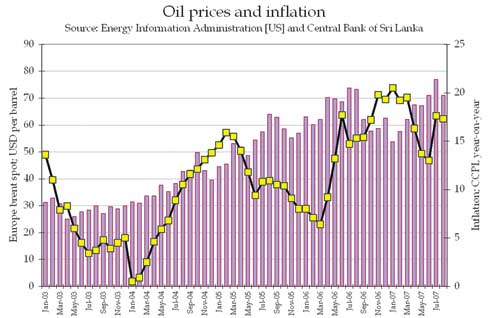
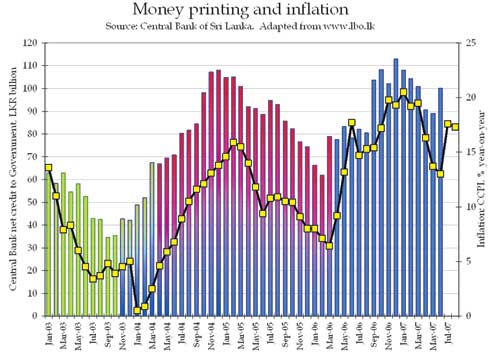
If that isn't proof enough, this graph from LBO/FT, showing the correlation between money printing and inflation and lack of a correlation between inflation and oil prices should really settle it.
So what can be done about this?

Sri Lankan economists offer two basic solutions. Both of which has to do with Central Bank Independence.

I'd say all solutions must include firing Ajith Nivard Cabraal from his post as governor of the Central Bank. If you are serious about Central Bank's independence you simply can't have the President's former campaign manager at it's helm.

The two dominant views on institutional reforms to central banking in Sri Lanka are the following:
  1. Bring in inflation-targeting legislation. This involves the parliament passing a law which mandates the Central Bank to stick to a particular level of inflation (say from 1-3%). Countries like New Zealand, Australia, Canada and Great Britain have enacted such legislation and it has proven to be relatively successful. Harsha De Silva, the well-known Sri Lankan economist is an advocate of this type of reform.

  2. A Currency Board arrangement. This involves pegging the SL rupee against a hard currency such as the US Dollar, which allows Sri Lanka to basically import the pegged currencies' inflation rate, in the case of the USD this would be 4% as opposed to the current 20+% inflation rate. Hong Kong has this type of arrangement with the US Dollar. LBO's Fuss-Budget and international monetary expert, Steve Hanke have recommended Sri Lanka follow a currency board, which we had till 1950 with relatively low inflation.
I tend to side with Fuss and Hanke although in the U.S. too there are renewed calls to keep inflation in check, by guys like my friend Ron Paul and others, especially from the Austrian School of Economics. Austrians happen to think that the U.S. should be on a gold standard, where the value of the U.S. dollar is by a commodity such as gold.

That's it for the dummies guide. It's been considerably longer than I wanted it to be, but I don't have time for a shorter post, hence the longer one. I Hope this has been helpful, I wish some of our politicians and newspaper editors can have a look at the actual causes of inflation rather than ranting on false, long-debunked theories.

Recommended Links :
The author is a student of economics and far from a monetary expert, the blog nor the author will take responsibility for any riots, profit/losses or a great depression which might trigger as a result of this post. Endorsements, criticisms and comments are welcome.

Wednesday, March 26, 2008

My Socialist Experiment

When I was growing up, this idea that 'our country was poor' puzzled me. How can we be poor I thought, the government print the money don't they? So how can they have all the money and still be poor? After days of thinking over this, I came to the conclusion that perhaps printing money costs, about the same amount of money that's being printed. That is for example, it costs the value of Rs.10 to print a Ten Rupee note. I remember asking my dad if this was the case, he said no, money is just paper he told me. I Can't remember if I followed up on the question, but I'm pretty sure he did not satisfactorily answer my questions.

This is about the time I invented my own version of socialism (I was really very young, honestly.) Deanist-Socialism was simple. Under my plan, every citizen in the country will receive a fixed amount of money at the end of every month courtesy the government. That way, there's no real need to work and we can live happily ever after.

I can't quite remember what I did with my theory, but finding answers to why oh why governments didn't just print money and distribute lead me to many realizations. First among them - not many people understand 'money'. For a long time, I didn't either.

So in my quest to understand this thing called money better, I began reading by coincidence (now this is much much later) the likes of Friedman, Rothbard, Mises and (eventually) the likes of Mankiw, Cowen and other contemporary practitioners. Having gone through all of this, I feel like I have the basics covered. But seeing media reports, listening to local politicians and even what some of our Central Bankers say, it seems many doesn't even have these basics covered.

So in the near future, (possibly tomorrow, I'm sleepy now) this blog will have Inflation for Dummies by dummies post to dispel some of the myths that's being perpetuated when talking about Cost of Living and particularly inflation in Sri Lanka.

But first, a few more of those realizations..

#2) Wealth is not Money. If it were, my little socialist experiment would have worked, to make it's people more wealthy, all a government has to do was print money and distribute them. Wealth, put it bluntly, is stuff or things we value (some of which could be money) and can be defined as the productive capacity of the economy.

But why doesn't governments do this? why don't they just print the money and distribute? The answer, is to do with the value of money.

#3) Paper-money has no intrinsic value. It's just paper. Turns out dad was right, the kind of money we use is just paper (fiat money). The only reason why you would accept it in exchange for payment for something is because we have the confidence that in the future, some other person would take it to exchange with something we value. If anyone doesn't think they can exchange this paper for something valuable in the future, they would not accept it.

For example, right now, I have with me a 20 Rupee Indian-Note in my purse, signed by a few friends and given to me as a souvenir. In India, this would have bought be breakfast. But here, in Sri Lanka, this would buy me nothing. The Indian rupee has (almost) no value here. (unless at a money-exchanger) The value of money, like any thing else is determined by the forces of it's supply and demand.

Realizing these two things, and the notion of value of money is perhaps the key to understanding inflation.

A Google Government

What if Google ran government? Jeff Jarvis has some interesting ideas. Reason Summarizes them here. Google 4 President? hmm..

Do read the post, He's dead serious.

Tuesday, March 25, 2008

Monday, March 24, 2008

So What's the bread?

Eshan. Coming soon on Facebook.

Sunday, March 23, 2008

Why I Love Ron Paul

I stumbled upon one of my favorite Ron Paul interviews, the one he did with John Stossel. Really offers insight into the man's philosophy. What can I say - endorsed 100%.

Here's a good quote from a
Though Paul argues passionately for liberalizing marijuana laws and is beloved by potheads (Timothy Leary once held a fund-raiser for him), he has never smoked pot himself. He sounded shocked when I asked him. "I have never seen anyone smoke marijuana," he said. "I don't think I'd be open to using it." For some people, libertarianism is the philosophical justification for a zany personal life. Paul, by contrast, describes his hobbies as gardening (roses and organic tomatoes) and "riding my bicycle."

He has never had a cigarette. He doesn't swear. He limits his drinking to an occasional glass of wine and goes to church regularly. He has been married to the same woman for 50 years. Three of their five children are physicians.Ron Paul is deeply square, and every bit as deeply committed to your right not to be.

"I don't gamble, but I'm the gambler's best friend," he says, boasting of his support for online casinos. He is a Second Amendment absolutist who doesn't own a gun. "I've only fired one a couple of times in my life. I've never gotten around to killing anything." It's an impressively, charmingly principled world view,..[link]
Here's the first part of the Stossel interview on YoutTube:


and Here's Part 2, 3, 4, 5 and 6.

Obama on Sri Lanka

Obama speaking about the Sri Lankan conflict, gets it horribly wrong. He thinks Religion is fueling a civil war in Sri Lanka in an interview in November 2007. Here's the quote :
W. E. B. Du Bois said that the problem of the 20th century is the problem of color. and if you expand that, the problem of the 21st century is the problem of the other - people who are not like us. Whether it's in religious terms, if you go to Sri Lanka, it's what's been fueling a vicious civil war there even though everybody looks exactly the same. Same with Northern Ireland, or it manifests in this country[united states] in racial terms.
Here's the relevant clip from YouTube:


No, I do like him, really, but he talks crap from time to time, you know, like all those other fellows.

More on Obama on Deaned.

Saturday, March 22, 2008

Freeing Tibet

There's lot of talk recently about the Tibetan situation. There's calls to action from all sorts of places. There's even an online petition, that's being circulated. Now, a petition to a communist regime is probably as useful as a wedding ring to the pope but symbolic gestures have their place, I suppose.

The upcoming Olympics is suggested the best place for to take this kind of stand, apparently the charter of the Olympic committee is to"to create a window of opportunities for dialogue, reconciliation and the resolution of conflicts...and to encourage political leaders to act in favour of peace". There are already calls to call on U.S. congress to call for a boycott of the Olympics. lot of calls, I doubt any of this will happen, but here's an interesting idea from Megan McArdle's blog,
A far better approach would be if the athletes themselves engaged in all manner of subversive tactics. I've heard it suggested that the athletes shave their heads in solidarity with Tibetan monks. Can you imagine the apoplectic fits the Chinese would go into if wave after wave of athlete representing various nations entered the arean with shaved heads? What if there was some symbol for Tibet the athletes wore on the medal podium? What if during press conferences, the athletes consciously mentioned the plight of Tibet? The possibilities for mischief are endless. [link]
Being China's little pee-boy, Sri Lanka won't be doing anything much. Funny how the usually-vocal lefties keep silent with this sort of thing. If it's under the banner of communism, what's the harm in a bit of oppression no?

The Geekiest Election Headline

Comes from the Huffington Post, Obama's a mac, Clinton a PC.

Friday, March 21, 2008

What I want for Easter

Is a Ganja Teddy. From the DM,

[..]in a surprising turn of events the Matara police found a teddy bear that could make the person who cuddles it “high”.

The novel way of hiding Ganja was discovered by the police when they found the teddy bear stuffed with a kilo of Ganja in the possession of an alleged Ganja kingpin of the area.

He was among ten young men who were arrested possessing a massive stock of ganja.[link]

I like your style maan.

Thursday, March 20, 2008

Development Indicators..

According to recent reports, Christina Caldera, a Sri Lankan student at the University of Texas made it to the PlayBoy Magazine.

Sri Lanka is really coming along, blond bimbos - check, gay celebrity - check, PlayBoy Mag - check. Next stop, um.. MILF Hunter?

Ok ok I know this is old news, but did you know Authur C Clarke was also on Play boy in 1986? So technically speaking, Ms.Caldera isn't the first Sri Lankan to be on PlayBoy. This kind of proves my point about Sri Lankan development, JR really did ruin everything.

Wednesday, March 19, 2008

Excellencies, Worships and honorables

Apparently, it's protocol to call a foreign Ambassador "excellency". Which is kinda funny, because I never liked the fact that even the President is called 'excellency'? why should he be an excellency? and Mayor a worship, and MPs honorables?

Technically speaking, shouldn't we, the people be the bosses with the politicians serving us? But of course, this shows how things are in reality. The sad part is this is exactly how most people treat them as well: as kings, worships and some sort of pseudo-gods. It's time people realized, president is just the head of government. He's not your king, excellency or worship, he's just a person put there to to do a job, just like everyone else. Maybe we just call these fellows assholes Mister (or madam) when we cant use their names.

Related, Government is Government.

Monday, March 17, 2008

On Pakistan

William Dalrymple, the historian and popular author has an insightful piece on the recent elections in Pakistan. He's quite optimistic about the country's future. Here's a relevant excerpt:

widespread publicity given to the [recent] crisis obscured the important changes that had quietly taken place in Pakistani society during Musharraf's eight years in power. Pakistan's economy is currently in difficulty, with fast-rising inflation and shortages of electricity and flour; but between 2002 and 2006 it had grown almost as strongly as India's. Until the beginning of 2007, Pakistan had a construction and consumer boom, with growth approaching 8 percent; for several years its stock market was the fastest-rising in Asia.

As you travel around Pakistan today you can see the effects of the boom everywhere: in vast new shopping malls and smart roadside filling stations, in the cranes of the building sites and the smokestacks of factories, in the expensive new cars jamming the roads and in the ubiquitous cell-phone stores. In 2003 the country had fewer than three million cell phones; today apparently there are 50 million, while car ownership has been increasing at roughly 40 percent a year since 2001. At the same time foreign direct investment has risen from $322 million in 2002 to $3.5 billion in 2006.

Pakistan's cities, in particular, are fast changing beyond recognition. As in India, there is a burgeoning Pakistani fashion scene full of ambitious gay designers and amazingly beautiful models. [link]
The trouble with International Media is that, it only reports the most compelling stories about places like Pakistan. The trouble with that is, the compelling stories are chaotic - a bomb, a shooting or something of the sort. So people develop this perception that Pakistan = chaos + Jihad+ bombs + kill. Which is not true for, well, much of the country.

Being Sri Lankan - another country which reminds people of all things Pakistan (minus jihad) - I kept getting ask by my non-Sri Lankan friends about the dreadful situation in the country. Now, the situation is dreadful and there are bombs, but I'm not exactly ducking bullets. I mean, when there is a bomb and you are not dead as a result of it, you kind of avoid that route and get on with life. That's kind of what Pakistan is. Dalrymple relates the story by analyzing the election results where most secular-democratic forces have secured victory over the mullah's and feudal leaders. Read the whole thing.

Anura Bandaraike, R.I.P.

Anura Bandaraike is no more. I wasn't a fan of his politics, but I appreciate the man. I met him briefly a couple of times, first, when I was about 15/16 he advised me to go out of the country, learn and come back. I haven't heeded his advice so far, but I'm likely to at some point or the other.

People often portrayed him as this slightly crazy chap, but in truth, he's quite a learned fellow, he knew and understood what's going on in politics and in the world.

In fact, I've come to realize that politicians aren't nearly as stupid as they sound. They just bank on the electorate to be stupid, and time after time, they are proven right.

I'm pretty certain Mahinda Rajapakse is genuinely grieving Anura's death, but you have to say the President has some luck. This is turning out to be a really bad year for MPs. The 5th one to die ?

Anyway, good bye Anura Boss. You will be missed.

Obituaries : Daily News, Daily Mirror.
Pictures from the Funeral.

Greg Mankiw on Free Trade

Mankiw writing for the New York Times,
NO issue divides economists and mere Muggles more than the debate over globalization and international trade. Where the high priests of the dismal science see opportunity through the magic of the market’s invisible hand, Joe Sixpack sees a threat to his livelihood. This gap in perspective grows especially wide whenever the economy experiences short-run difficulties, as it is now. By all indications, the issue could come to dominate the presidential campaign.

Economists are, overwhelmingly, free traders. A 2006 poll of Ph.D. members of the American Economic Association found that 87.5 percent agreed that “the U.S. should eliminate remaining tariffs and other barriers to trade.”

The benefits from an open world trading system are standard fare in introductory economics courses. In my freshman course at Harvard, we start studying the topic in the second week, and we return to issues of globalization throughout the year. The basic lessons can be traced back to Adam Smith of the 18th century and David Ricardo of the 19th century: Trade between two countries creates winners and losers, but it leaves both nations with greater overall prosperity. [link]

Ok, a few things: First, isn't it a pity when most policy-makers remain ignorant to one of the fundamental lessons taught by people like Smith as early as the 18th century?

Secondly, Mankiw rocks. I highly recommend his textbook for anyone interested in learning about economics. It should be the standard textbook book in intro-econ courses.

Thirdly, the rest of Mankiw's article confirms much of what I said about Obama. He's bad on Trade. Do read the whole thing.

Saturday, March 15, 2008

What Causes Poverty?

Nothing!. ASI has the explanation,
There are no causes of poverty. It is the rest state, that which happens when you don't do anything. If you want to experience poverty, just do nothing and it will come. To ask what causes poverty is like asking what causes cold in the universe; it is the absence of energy. Similarly poverty is the absence of wealth. For most of humanity's existence on this planet, poverty has been the norm, the natural condition. People hunted to survive or lived by subsistence farming, and they were poor. In some parts of the world this is still the case.
Read the whole thing.

Friday, March 14, 2008

Medical Prostitution?

During the days of recent the spilitzer scandal, A reader of Andrew Sullivan's site asked, Why can't there be "medical Prostitution". That is, prostitution be legal for medical requirements. After all, in some states in the U.S. have legalized Marijuana for medicinal use.

This report from TOI confirms that Sullvan's reader definitely has a case,
According to a research from Queen’s University in Belfast, a good morning session at least three times a week, decreases the risk of heart attack or stroke by half and a regular session improves circulation, thereby reducing blood pressure.

According to a study in New Scientist, a steamy session twice a week enhances IgA, an antibody that provides protection against microbes that multiply in body secretions, reports the ‘Sun’. Morning sex also helps in alleviating arthritis and migraine. It burns around 300 calories an hour that simultaneously diminishes the risk of developing diabetes.

Moreover, an American study involving 300 sexually active women whose partners did not use condoms revealed that they were less prone to depression.

Sex increases the production of testosterone that provides stronger bones and muscles thus helping to stave off osteoporosis.

A good morning session can make the hair shine and skin glow by raising the output of oestrogen and other hormones which are associated with it.

According to Yale School of Medicine researchers, having morning sex can aid in averting endometriosis, a condition where the tissue that normally lines the uterus, grows in other parts of the pelvis. [link]
Best form of exercise too.. maybe prostitution joints can pretend to be gyms.

Thursday, March 13, 2008

Sachin is Gay

nah.. he just doesn't have a good angle.

Wednesday, March 12, 2008

Pimping Morals

The American politico-blogosphere is going crazy over the Eliot Splitzer story, virtually every U.S. blog I read has a post on the New York Governor's involvement in an international prostitution ring. The Governor, a democrat, will step down from his job next week.

If something like this happened in Sri Lanka, (like a few years ago when a government deputy minister was caught in the infamous Liberty Plaza brothel, who later explained he went there to have tea) it would be an almost non-story, finding itself space only in perhaps the satire pages of Sri Lankan news papers without even their name being mentioned .

But wait, aren't we supposed to be morally superior to these yankee-pankie Americans? we are of course. Just that, our strategy is to pretend stuff like this never happens. Which I'm down with, by the way.

Thankfully, spitzer's scandal has opened the debate on legalizing prostitution. It's time the Sri Lankan lawmakers accept the reality of their own moral standing and legalize prostitution here as well no?

Who knows, it might even solve the 'abductions' problem.

How J.R. Ruined Everything

If you are a socialist, that is.

The chart below from Gapminder shows increasing incomes per person at accelerating rates after president JR Jaywardene liberalized the Sri Lankan economy in 1977. Certainly, this isn't good news for the lefties.

(a still pic from gap minder, an awesome tool. You can link to the real-time chart too)

Say what you want about JR's politics, but the fact remains - his (partial) market-based reforms did make a lot of people's lives better. We need more of it, not less.

These stats of course, wouldn't change the mind of people like this commenter to whom I dedicate the title of this post. These are obviously some fake statistics compiled as part of a neoliberal conspiracy initiated by the CIA and planted in Google gapminder.

No but seriously, Gapminder is just awesome, it converts boring numbers into enjoyable, animated and interactive graphics. See it's founder Hans Rosling's talks on TED here and here. Must See videos!

Monday, March 10, 2008

The AID Epidemic

I think the World Bank should close down.

Ok, not really but that was kind of what I suggested some time ago at the End Poverty in South Asia blog run by Shanta Devrajan, WB's chief economist for the South Asian region. Devrajan was addressing questions raised by various anti-worldbank groups. The usual criticism about "pressurizing governments" so on. His answers to those questions were quite comprehensive, but my beef with the world bank was quite the opposite of the usual lefty-criticism.

To summarize, my comment went something like this, (the original comment was a bit um. drunk, hence a summary)

The World Bank funds governments with economic policies which (by their own assertions) are just wrong. By subsidizing wrong policies, the World Bank and other droner agencies encourage more of it. It also messes up governance structures and democracy. Governments are now able to have relatively low taxes, and huge expenditure and other fiscal irrationality because they have external sources of income. Perhaps if the massive government spending is to be financed by the tax payer there will be a backlash against spending and room for political capital to build under the question of "where the money is going to come from" for all those government programs (agricultural subsidies, hand-out schemes, massive state-sector employees, failed state enterprises, etc.)

The last claim is probably only partly true. Like the present Sri Lankan administration has skillfully demonstrated, when even AID money dries up, governments will resort to costly commercial borrowing and excessive money printing. Although the recent HSBC loan did generate of antagonism from the opposition, it was short-lived and not deterministic enough to stop the practice.

Anyway, I argued since the kind of reforms the World Bank advocate has only historically occurred through a crisis (e.g. reforms in India in the early 1990s, Sri Lanka in late 70s or anywhere else) the best the World Bank can do is to put a stop to aid altogether which would lead to a form of a crisis. The bank would only engage research and policy advocacy stuff. I went on to say that the world bank should not to give "lollipops to thieving kids".

Devrajan responded through a separate post. Agreeing with the problem, but arguing that the role of foreign aid in the the situations which I described (he refers to them as government failure) is to build "climate for reform" by supporting public debate on these issues.

I maintain since these occasions of government failure are all too frequent, in fact permanent - the best possible way is to indeed cut down on aid given to governments and encourage civil society actors to engage in advocacy programs for reform.

More recently, Devesh Kapur expressed much of the sentiments in an article on Yale Global Online,
The failings of the Indian state to deliver basic goods and services are a specter that haunts the country – ignored by the hoopla of India’s high growth rates.

The World Bank’s well-intentioned efforts – and it’s by no means alone – exacerbate the problem [..]

The abject failure of the Indian state to improve the quality of life of hundreds of millions of its citizens is as unconscionable as it is deeply rooted in the country’s political economy. Any solution squarely lies there. Perhaps the biggest error the bank has made in India has been not to walk away earlier and realize that non-lending might serve the country – especially its poor – better. [link]

Devrajan has responded here to the article, again agreeing with diagnosis, but arguing "there is no guarantee that public services will improve if the Bank stops lending money", Kapur responding, disagrees.

I'm with Kapur here (obviously, or is it Kapur who's with me? smirks), sure there's no guarantee that public services will improve, but like I said in the comment there's ample evidence that market-friendly reforms, the kind that the Bank is after - will happen through a financial crisis. So perhaps the WB shouldn't try and delay this inevitability, our present-day economic policies stand deserving of one.

The Meaning of Politics

According to one Larry Hardiman,
The word ‘politics’ is derived from the word ‘poly’, meaning ‘many’, and the word ‘ticks’, meaning ‘blood sucking parasites’.
They had it all figured out when they invented it..

Saturday, March 08, 2008

sorry, I can't apologize.

India's vice president Hamid Ansari thinks that Britain owes India an Apology over 'the mass killings during the 1857 revolt'. He thinks India is 'too polite' to even ask for an apology.

Recently, the new Australian Prime Minister Kevin Rudd apologized to aboriginal people for injustices caused by white settlers.

Similarly former Sri Lankan President Chandrika Bandaranaike issued an apology some time back to the 1983 riots against Tamils.

I find all this a bit absurd. How can someone apologize on behalf of the things they didn't do? I empathize of course, but I can't and I won't apologize.

"Britain" need not apologize to "India", because neither India nor Britain is a person. Both are temporary political constructs. Similarly "whites" need not apologize for aborigines, and "Sinhalese" need not apologize for '83 riots and Tamils or Muslims need not apologize for LTTE or Al-Qaeda.

The same idelogy which demands "group responsibility" is the same one which perpetuates "group blame". I don't blame Tamils for the LTTE, nor do I blame myself for '83.

I understand the point about political expediency, but principally speaking.. Sorry, I can't apologize.

French Mayor Bans Death

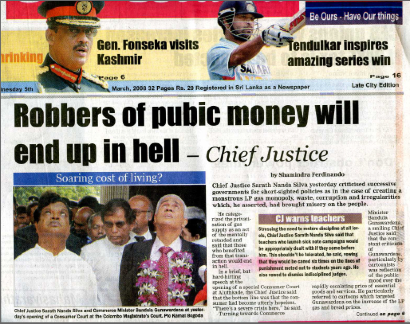
News is much more fun these days. C.J. wants to send pube robbers to hell, in Kandy they have a blow job test, and now in France..
The mayor of a village in south west France has banned residents from dying.

Village graveyard is full and Gerard Lalanne has threatened "severe" punishment for anyone who disobeys.[..]

In an ordinance posted in the council offices, Mayor Lalanne told the 260 residents that "all persons not having a plot in the cemetery and wishing to be buried in Sarpourenx are forbidden from dying in the parish".

It added: "Offenders will be severely punished." However, the nature of the punishment - apparently a fate worse than death - was not specified. [link]
Last year the Chinese banned reincarnation, the French are much smarter. Why even give that chance? duh!.

But no, seriously don't laugh, this is perfectly normal. They do this all the time. Whatever you don't like you just ban it. Don't like Gay people? ban them. Prostitution? banned. Smoking in public- banned. Alcohol for women, Porn, Abortion - All of it banned. Has that stopped any of this? No.. so what's so different here?

This is just the ultimate logical conclusion of government 'rationality', wonder why our fellows didn't think of this before. I mean it's so obvious..

Friday, March 07, 2008

Dealing with terrorists

There is a modified version of this circulating around email, but according to wikiquote (which sort of means according to some guy) both Indian and Sri Lankan army operate under the following motto:
Forgiving or punishing the terrorists is left to God.But, fixing the appointment is our responsibility.
Heh. Never knew these buggers could be so witty.

Buffet, The World's richest man

Forbes has it's annual World's billionaires list out which places Warren Buffet on top beating Bill Gates, and that Mexican guy, who supposedly overtook him. The Indians are catching up too, from the WSJ:
the biggest surprise is the rise of the Indian rich — four of the top eight billionaires in the world are from India. Topping the ranks is steel tycoon Lakshmi Mittal, whose worth Forbes puts at $45 billion. Next up are the Ambani brothers, Mukesh and Anil, with $43 billion and $42 billion respectively, largely from petrochemicals. Rounding out the list is KP Singh, the real-estate magnate, at $30 billion.

[..]a greater and greater share of the world’s millionaires and billionaires will come from India, China, Brazil, and Russia. That’s not to say the U.S. won’t keep producing rich people of its own. Rather, it’s that the most rapid growth, and the billionaire “market share,” will move to emerging markets. [link]
Mark Zuckerberg, the founder of Facebook, is the youngest billionaire, at 23 years of age. I wonder when will the first Sri Lankan enter the list, maybe Mahinda has a chance. He'll own most of the country before he leaves office.

Thursday, March 06, 2008

Government is Government

I've been meaning to blog about Jonah Goldberg's new book, Liberal Fascism, I haven't read it, but isn't that an awesome title? Evidently he has a blog under the same name. In it he offers a key libertarian insight,
the one thing libertarians grasp better than conservatives or liberals is the danger of the category error when it comes to the role of government. While there are certainly plenty of radical individualists swelling the ranks of libertarianism, libertarianism is not in fact an ideology of radical individualism. Or at least it need not be.

The fundamental insight of libertarianism is that the government is the government. It cannot be your mommy, your daddy, your big brother, your nanny, your friend, your buddy, your god, your salvation, your church or your conscience. It is the government. A big bureaucracy charged with certain responsibilities, some of which it is qualified to carry out, many of which it is not. [link]
Quite right. As Cato's vice president David Boaz put it, "Conservatives want to be your daddy, telling you what to do and what not to do. Liberals want to be your mommy, feeding you, tucking you in, and wiping your nose. Libertarians want to treat you as an adult." In our part of the world of course, all political parties want to be both your mom and your dad. The only claim they make is that, they can do it better!

For related stuff, see this piece by Amit Varma for the Mint:Mommy-Daddy, go away!.

Wednesday, March 05, 2008

A Very Pubic Mistake

Sanjana from Grounviews points out this WTF headline from the Island,


Aney Manda Sarath. Unfortunately, the Island site isn't into pubes quite like it's print-twin.

Update (03/06): Amit Varma points me to the Island Apology. Apparently Satan works there. No wonder..

Now, a Pregnant man..

A few days ago when a pregnant woman in India decided to use the toilet on a Ahmadabad train and realized her baby had slipped through toilet bowl,
My delivery was so sudden," said the Bhuri Kalbi, the mother of the infant, born two months prematurely. "I did not even realize that my child had slipped from the hole in the toilet." [..]

"They stopped the train and ran on the tracks to find the baby," she said, speaking from her hospital bed in the western city of Ahmedabad. [link]
Geez. don't they overdo it on TV.. turns out this delivery thing is a simple matter after all.. TOI has more,
"Usually, children are born head first. It seems the girl either came legs first or swing around her umbilical cord and landed on her hip. She has no trace of injury whatsoever on her head, though she has some internal injury on the hip bone," said Dr Kumar. [link]
If you thought that was the WTF pregnancy story you've ever heard, check this out:


ABC News has the story..

Only in Cuba

One Cuban young woman complains to another. "He lied to me! He told me that he was a luggage handler! It turns out, he's nothing but a neurosurgeon!"

Apparently luggage handlers in Cuba make more money in one day than some doctors get in a month. Heh. Arnold Kling has more on the life under Socialism.

The Business of Cricket

Lalit Modi, the boss of the much hyped about Indian Premier League (IPL) thinks that cricketers will soon be the most highly-paid of any sport. According to FoxSports,

Modi says his IPL will eventually rival - and surpass - football's English Premier League for providing players with unprecedented riches.

"If you look at the comparison, Aston Villa were recently sold for $132 million," he said.

"That is a historic club with a ground and established supporters. We just sold the Mumbai franchise for almost the same amount of money, and the team doesn't even exist yet.

"Then you can compare the players: Andrew Symonds is making $213,000 a week for the duration of the tournament, Mahendra Singh Dhoni even more than that.

"Tell me who in the Premier League earns as much? Maybe (Chelsea's) Frank Lampard ($213,300), maybe (Manchester United's) Cristiano Ronaldo ($298,000). But not many." [..]

India wicketkeeper Mahendra Singh Dhoni attracted the biggest bid at the recent player auction, earning $1.65 million per season, while Symonds was second-highest with a $1.47 million a season with the Hyderabad franchise. [link]
Modi says that they imposed a $5 million salary cap per team to prevent a few people from controlling the league, He went on to say that after the cap is removed, cricketers will be among the most highest paid sportsmen in the world.

If money talks in cricket, it screams loudest in India. Here you have 1/6th of the world population, most of them crazy about cricket. The league has already collected a very cool Rs.7,000 crore (about US$1.7 Billion, if my conversion skills hold) from team auctions to investors for a contract of 10 years. The team owners share 60-80% of TV revenue, 60% of sponsorship revenue with the league and they can keep 100% of other forms of revenue - merchandise, tickets, etc.

IPL's impact on the game would be revolutionary, I say would be because I fully expect IPL to succeed. The IPL as of now has attracted some of India's biggest businessmen and Bollywood stars of the likes of Mukesh Ambani(Relliance), Vijay Maliya(Kingfisher), Sharukh Khan and Preity Zinta. If people like Ambani and Maliya are willing to gamble this big, you can be rest assured they think the league would be big in terms of returns.

Cricket clubs running as business ventures is how it should have been all along, that's how every other major sports in the world is run and it works like a charm. More money in the business of cricket would mean more investment in infrastructure, training facilities, better coaches and players. Aspiring cricketers will now have potential employers competing for their services and all of this will be good for the game.

But how did all this happen so suddenly? I can think of two reasons. One India winning the 20/20 Cricket World Cup. Two, the Indian Cricket League - the rebel league which started a similar tournament last year. ICL may or may not have been a success but what it brought was competition in the market, BCCI suddenly found itself facing competition, the result - it's own version of a 20/20 cricket league, the IPL. Sure, BCCI bullied ICL and behaved like a typical monopoly, but they are after all (unlike in Sri Lanka) a private entity - albeit with heavy political influence. So this kind of practice was to be expected. You could argue, and I would agree, BCCI is a monopoly only because (las is often the case with monopolies) of government's involvement in the game. But at least the BCCI has built in competition in the IPL, which is a good thing.

A pertinent question is whether IPL-like initiative can be spawned anywhere else in the world, the answer is it's entirely possible. Although I don't expect the revenues to be as high in India, there can definitely be some profits made if SriLankaCricket or any other cricketing authority is willing to experiment.

In an impressive paper Preston, Ross & Szymanski (PDF link) has called for pro-cricket back in 2001 proposing there should be a "World Cricket League" for one day internationals, for clubs based on cities/regions. They have argued for ICC to sanction such a tournament and predicted that "if this does not happen, we also think it quite likely that such a competition would generate itself spontaneously". The paper incidentally, recommends India as the most suitable place for such an enterprise.

Their predictions have mostly come true, but there's still a lot of room for innovation and enterprise in cricket, especially in places such as Sri Lanka where the business potential for cricket has been poorly utilized.

Sunday, March 02, 2008

Inviting Al-Qaeda

My friend Aufdius and MissingSandwich relates a story about how a group of Sinhalese nationalist types in Dehiwela have put up posters and dumped garbage to offend the Muslims in the area for attempting to build a mosque. More from Aufidius:
In Ramazan this year, some Muslims started a thakkiya (small mosque) on Kadawatha Road , Dehiwela and were conducting tharaweeh prayers. The mosque was operating on a very low key and causing no hindrance to anyone. However some Sinhalese villagers banded together, along with a few monks who then sent a delegation to this mosque demanding them to stop conducting prayers. The activities of the mosque were stopped overnight. Some Sinhalese villagers had already started intimidating Muslims in the area and dumping garbage right in front of the building in question.

Around February 23rd 2008, this building was reopened as "The All Ceylon Muslim Educational Conference" but some Sinhalese villagers banded under the leadership of some extremist monks, hung black flags in the vicinity and defaced the walls of the building with racist posters. A fresh pile of trash was also dumped just outside the parapet wall and some garbage thrown in over the wall as well.An ad hoc meeting was arranged adjacent to the mosque and presided by monks, where it is alleged that many racial statements were issued.

Some Sinhalese villagers then kept overnight vigil by assembling at close by Sinhalese houses and drinking through the night and singing and reveling. The police had posted two officers at the point to watch out for any mishaps, but a confrontation has been avoided.. [link]
I support unhindered freedom of expression as long as you do it on your own property (which in this case is not true) but people need to realize the 'blow back' that comes with this kind of intolerable behavior.

All terrorist groups - be it Tamil, Islamic or Catholic - are born and sustained by exploiting a perceived grievance of the 'people' they claim to represent. For LTTE it's the Sinhalese majoritarianism as perceived by the general population of Tamils, for Al-qaeda it's how the general Islamic population perceives American foreign policy. Objectivity matters little here, it's perception which counts.

Sri Lanka so far has somehow being lucky in avoiding Islamic extremism which has gripped some parts of the world, The Muslim lobby groups (including Muslim-dominated parties) have rarely invoked religious sentiment in political demands and has played only soft-ball identity politics. It's in everyone's interest to keep it that way. The last thing anyone would want now (including perhaps the LTTE) is another terrorist movement.

P2P Lobbying

I was chatting to a friend of mine about all the talk about Lobbying in the U.S. elections and how Sri Lanka doesn’t seem to have a ‘formal lobbying’ process, there are no PACs (Political Action Committees), no people with the job title of ‘lobbyist’ or pressure groups waiting with campaign support in exchange for favorable policy.

Actually we do, but in Sri Lanka and much of the developing world, policy matters little. It’s people in control who matter. Lobbying in Sri Lanka is essentially peer-to-peer – you want something done you contact your man in Parliament. He probably can get it done for you. To keep this relationship going you keep your guy happy. Invite him for parties; send him monthly gifts, so on. I personally know businessmen as part of their mandate in city-based business associations send gifts to the local minister and fund ‘local initiatives’ undertaken in the name of the minister.

Lot of people think money to politicians comes from them stealing out of contracts, etc. This is probably the case, but a good part of the wealth of politicians is from, well, P2P Lobbying.

Thursday, February 28, 2008

AirTel troubles


Apparently Airtel, scheduled to start operations in Sri Lanka this year, have run into some trouble. I like Airtel, it's my operator of choice whenever I'm in India, I've got good memories with it. It worked well for me, and i did do some traveling across states in remote moutanes areas. The Advert above with the two boys playing football is probably my favorite ad on TV.

I was looking forward to the increased competition, I think Air-tel could have given dialog run for their money. I think they have already woken up dialog from a monopoly lethargy and if Airtel do some of the things they do in India, they can lure in customers. Airtel as a brand will have instant recognition from anyone has table, so they have a good start. I don't think I will switch, changing numbers is a bitch unless Air-tel can give me a remarkably better deal.

As for the troubles, a few weeks back in a flight back from Delhi I met a guy from Chandigarh, who's flying to Colombo. He turned out to be a senior telecoms engineer at Airtel, flown down to SL to help with the operations here. I asked him what's taking Airtel so long to set up here, he told me they faced two main problems. one, was permissions issues - Setting up towers and that sort of thing needed all sorts of clearances from the ministry of defense, TRC, and the bureaucracy is taking time. The other, he told me is lack of telecoms engineers, He said latter is going to be a bigger problem in the long-term.

This is probably why dialog have invested in heavily University of Moratuwa, they desperately need the people. All of this is a problem of too much government. in 2006, Lirneasia, a Colombo-based policy research agency concluded the Telecom regulatory environment in Sri Lanka one of the worse in the region and heading in the wrong direction (PDF link). The impact of national security concerns since would only have worsen the situation.

It's heartening however, that the sector has grown tremendously despite having too much regulation. Often times, technology itself is a liberator, government bureaucracies cannot keep up with the dynamism of changing technologies and that's why telecoms 'work' for most people, when fixed-lines become a limiting factor, the industry comes up with CDMA, so on, before the bureaucrats can get their head around that, there'll be another technology.

It just beats me why when simple logic would tell you (and the data backs up the claim) that having barriers to entry, too much of regulation is just bad for business and bad for consumers, yet we are still stuck in this old paradigm of "license-permit" economic (mis)management. sigh.

Tuesday, February 26, 2008

S.B, the Higher Ed. Reformer?

Former Sri Lankan Minister, and the national organizer of the main opposition UNP, S.B. Dissanayake seems to 'get it' when it comes to Higher Education reform. Here's S.B. from an Interview with the Colombo Post :

During 1960 to 70, our main five universities were included in the world’s best 500 universities. There were only two universities from India among the 500. Today ours are not even in the first 1000 universities. But even today we have a huge demand in this sector. When our students lose the opportunity of getting admission to our Medical College by a few marks, they go to medical colleges in Nepal which is a donation to the army, or to the Bangladesh Medical College for higher studies.

Last year 150,000 students were eligible for university admission, 17,000 were selected. About 25,000 leave this country every year. If they are permitted to pay and study here, then our universities need not depend on government funds to build libraries, to purchase books or for research, they can earn by themselves. In the world today there aren’t any universities that depend on their governments. Those universities earn by themselves. If we improve and market these universities to Asian countries we may get down students from China and India and make this a good service country. [link]

I've so far met no reasonable person who's against higher education reform. Yes, there are few insecure undergraduates in local universities who are against it, but they don't quite make
cut as 'reasonable' in my book.

I've chatted about this with various folks, including government ministers and MPs about the need for reform. All of them get it. They know Higher ed. in this country, sucks, that's why most of the ministerial offspring (including His Excellency's sons) are studying abroad.

The great tragedy is the incentives are arranged such that it doesn't make sense for any politician to invest political capital in higher ed. reform and disturb the apple cart. The ruling party don't want to give any more reasons for the JVP to mobilize its left-wing student unions, there are no other pressure groups at work - including the Colombo civil society, who's primarily obsessed with peace.

It's a tragedy because higher ed. reform is essentially a middle-class project. Most people in the affluent class, if I'm to use that word, don't usually have their children studying in Sri Lanka at the undergraduate level. It's the middle to lower income earners who will benefit the most from reform with increased access with lower costs to undergraduate degrees.

How do you reform? I'm no higher ed. expert, but I can offer some clues. One option as I've said before, is to grant the university autonomy as to it's administration and make them accredition bodies for potential private colleges, so you go to College Xyz, but get your degree from University of Colombo, the university sets the papers, the curriculum maybe even offer access to expensive labs and that sort of thing. This is what kind of happens in India, and Sri Lankan colleges like APIIT or ANC except they are affiliated to foreign universities. It would bring in competition in the sector, bring down costs, increase access to higher education, diversify options beyond just IT and business in the private sector and can potential bring in more revenue for the University which they can invest in paying their lectures, scholarships or improving their facilities. You can keep some (or all) of the universities in government hands privatize the rest and authorize setting up universities (not just colleges) by the private sector.

Another possibility is to privatize all universities, except for maybe one and offer educational vouchers on merit-basis , the students can reimburse the voucher at any college of his/her choosing and can add-value to it if he/she is able to afford it.

I think all these, especially a variation of the first option is entirely possible and even politically feasible, if more people start advocating it.

Previously, What's free in free education?

Monday, February 25, 2008

Unfair Trade

Adam Smith Institute has it's latest report Unfair Trade, Out today. From the ASI Blog:
Fairtrade is a nice idea, and it is great that so many consumers want to help the poor in the developing world. But it is important that we ask whether Fairtrade really helps. After all, 'Fairtrade' does not mean anyone who gives better terms to third-world farmers. It is a particular brand, which competes with other ethical schemes and charities for people's money.

There are a number of inconvenient truths about Fairtrade. Indeed, on closer inspection it may not be that fair at all. It only offers a very small number of farmers a higher fixed price for their goods. Given the way markets work, these higher prices come at the expense of many other farmers, who – unable to qualify for Fairtrade certification – are left even worse off.

More importantly, the Fairtrade scheme does not aid economic development. It sustains uncompetitive farmers on their land, holding back diversification, mechanization and moves up the value chain. In doing so it denies future generations the chance of a better life. [link]

Download the Report here

Raponomics

Greg Mankiw's 10 principles of economics, The Rap Version :


What can I say, just Awesome. I don't know about #7, but WTF. For anyone feeling really bored, here's the original version:
  1. People face tradeoffs
  2. The cost of something is what you give up to get it
  3. Rational people think at the margin
  4. People respond to incentives
  5. Trade can make everyone better off
  6. Markets are usually a good way to organize economic activity
  7. Governments can sometimes improve market outcomes
  8. A country’s standard of living depends on its ability to produce goods and services
  9. Prices rise when the government prints too much money
  10. Society faces a short-run tradeoff between inflation and unemployment.

Sunday, February 24, 2008

Al-flation

From Bloomberg.com:

U.S. plans to replace 15 percent of gasoline consumption with crop-based fuels including ethanol are already leading to some unintended consequences as food prices and fertilizer costs increase.

About 33 percent of U.S. corn will be used for fuel during the next decade, up from 11 percent in 2002, the Agriculture Department estimates. Corn rose 20 percent to a record on the Chicago Board of Trade since Dec. 19, the day President George W. Bush signed a law requiring a fivefold jump in renewable fuels by 2022.

[..]The energy bill requires the U.S. to use 36 billion gallons of renewable fuels by 2022, of which about 15 billion gallons may come from corn-based ethanol. The nation's current production capacity is about 8.06 billion gallons.

[..]Researchers led by Timothy Searchinger at Princeton University said their study showed greenhouse-gas emissions will rise with ethanol demand. U.S. farmers will use more land for fuel, forcing poorer countries to cut down rainforests and use other undeveloped land for farms, the study said. [link]
Ok ok, so it's called Agflation - the increase in price of food due as a result of agricultural products used for alternative energy resource. No, I'm not trying to blame all this on Al Gore, but as I've said before on this blog, I think the most adverse and immediate effects of climate change will be from bad policy rather than actual climate effects.

This is what happens when you meddle in the market (subsidies, mandates, etc.), you end up with something that nobody really wants at the tax payer's expense. Ethanol is bad for the planet, bad for the U.S. economy and bad for the rest of us. (Hell, even Krugman agrees)

I'd hold Gore somewhat responsible - after all he won a Nobel Price for talking about climate change - it's him and his alarmist faithfuls who demanded that something is done about climate change immediately, pushing the political climate in that direction. Unfortunately, what's to be done about climate change is not so clear, so you end up meddling in the market and do stuff like this.

Let's get this clear - the market is more likely to create an efficient, viable alternative energy source than any government bureaucrat. What's required is some trust in human ingenuity and markets, without jumping the gun and doing something stupid with unintended consequences.

Saturday, February 23, 2008

Terror, Architecture and Animal Rights

WTF story of the day comes from the the Daily Mirror (Fight terror, build monuments of art) :
Sri Lankan Premier Ratnasiri Wickramanayaka has asserted that they would fight the war on terrorism in the country while noting the architectural feats of the decades gone by. [link]
Meanwhile in other news,

People for the Ethical Treatment of Animals (PETA) said in a letter dated Feb. 15 to rebel leader Velupillai Prabhakaran that "the explosive device that was set off near the zoo's bird enclosures terrified many animals at the zoo."

In the letter, PETA president Ingrid E. Newkirk pleaded with Prabhakaran "to leave animals out of this conflict."

People saddened by the attack had inundated PETA with messages, Newkirk said.
[from AP]

Pass the Rotti on the Left hand side has more on the response of the LTTE and the Government.

Friday, February 22, 2008

Why Not Obama Part 2

Ouch:


That's got to hurt. I Rest my case.

“The Cost of Free Trade”

Recently the Island carried an article with the same title where the writer (a Kath Noble) goes on to explain the implications of the Indo-Lanka Free Trade Agreement (FTA). Now, I have seen worse articles on trade and economics in the Sri Lankan press, but it’s precisely the more reasonable guise of the article which makes it's errors more plausible.

Do read it in its entirety
. The following are the relevant excerpts where I think she (or he) has got it wrong.

[..]Trade between the two countries [India and Sri Lanka] has increased at least four-fold, and it is now worth well over $2 billion. India had cut its tariffs on Sri Lankan goods by 2003, and Sri Lanka is due to do away with all remaining taxes on Indian imports during 2008. Free trade has triumphed, apparently.
Unfortunately, the story isn’t so simple. Taking a closer look at what has happened in practice would prompt even the most ardent believer to question the undoubtedly beguiling theory of free trade
First of all, what pass these days as Free Trade Agreements, are not really “Free Trade” agreements. If they were, then that would require only a couple of pages long document with a place to sign. FTAs usually run into the hundreds of papers, precisely because the FTAs come with all sort of conditions and clauses on which products can be imported, the tariff levels, etc. They should be more accurately called Freer/Managed trade agreements. This makes them poor benchmarks to test the “theory of Free trade”, which can be done better by looking at say, domestic trade within a country where tariffs and other restrictions do not exist. There’s absolutely nothing special about International Trade that’s also not true about domestic trade, except for the fact that people have imposed barriers on International trade.

Now, I’ve met and seen many economists (ardent free-market kind) who think of FTAs, WTO, etc as being disruptive to real free trade. I think they have a point, which everyone should hear more often, but I support FTAs because they are the only politically feasible way of getting to a point where there are no (or virtually no) restrictions on trade.

The writer continues..
[..] Free trade is supposed to be about each country focusing on the goods that it can produce most efficiently, and then selling them to others and using the proceeds to buy whatever else it needs on a level playing field. However, this is clearly not the reality. [..]
Clearly not the reality? I wonder why. Her article certainly doesn’t offer a clue.

Perhaps she’s confused with what comparative advantage is, which according to some Economists is the most misunderstood concept in economics, here’s Brad Delong’s explanation:
“"Comparative advantage" holds that we should export not those commodities that we can make more efficiently than people in other countries can make them, but those commodities that we can make most efficiently relative to the efficiency with which we make the average good or service.” (Do read the whole thing)
But one has to keep in mind when we talk about trade between “two countries” we are really talking about people in those countries and comparative advantage is very much a reality. For example, if I’m the world’s greatest cricketer and also the world’s finest clerk. The law of comparative advantage says that I should play my Cricket instead of being a clerk although I do both better than anyone else on the planet. I do what I do best relative to whatever else I do and not just do everything I can do better than others. It works much the same way for aggregates of people...like countries.

The Writer then goes into a lengthy explanation of fate of the vegetable oil industry, supposedly Sri Lanka’s major export under the FTA:

[..]Sri Lanka has been importing crude palm oil from Malaysia, putting it through a rather simple chemical process, and then exporting the end result as hydrogenated vegetable oil to India. Indian products have been undercut only because the Sri Lankan government has been imposing very little duty on crude palm oil, while India has been taxing such imports heavily.

[..]Indian manufacturers were understandably upset[..]and they began pressing the Indian government to protect them. India decided to forget the free trade agreement and simply put a stop to Sri Lankan imports. Factories stood idle for months while negotiations were underway to find a compromise solution, and everybody was relieved when the Indian government agreed to restart the trade with a fixed ceiling [..].

In fact, the dispute didn’t end there. The Indian government faced further demands from its industrialists, and it finally decided to reduce its import tariff on crude palm oil at the end of 2007. Sri Lankan products rather abruptly became no cheaper than those made in India.
[..]Sri Lankan workers are hardly going to celebrate having temporarily stolen a few jobs from their probably no better off Indian counterparts. Sri Lankan leaders will have to start worrying about the trade deficit again.

There are indeed great risks in export-dependant industries. Shift in policy can have major repercussions, especially on industries operating on negotiated policy advantages alone created by the particular trade agreement. I know a few economists who are very critical of export-led development. They criticize the strategy of “East Asian tigers” and china as being prone to bubbles and sudden shocks when the demand for their goods suddenly drops.

I’m puzzled though as to why “Sri Lankan leaders have to start worrying about the trade deficit”. Trade deficits (like the good people at Cafe Hayek often points out) are no longer a relevant statistic to “worry about”. I for example, have an increasing trade deficit with the Island Newspaper. I buy their product without ever having sold them anything. But to suggest that I’m somehow loosing out from this transaction is quite silly.

The writer then goes on to explain the plight of the pepper farmers in Kerala. The infamous problem of Farmer suicides, etc. She suggests that “Sri Lanka should be ashamed” if more and more pepper is exported to India.

Now as Nitin Pai and others have pointed out, there are major structural issues in India (some of which are common to Sri Lanka as well) which leads to the unfortunate plight Indian farmer’s face. It’s a sector where the market has not being allowed to properly operate. There are price controls, subsidies, lack of property rights, government interventions in the credit market and interventions and overall perverse incentives created by government policy (The increase of compensation for widows of suicides for example) Blaming this situation on the Free Trade Agreement is hardly prudent.

The writer concludes with some cautionary advice to India’s Minister of Commerce of the upcoming Comprehensive Economic Partnership which is bound to bring closer trade-ties, saying there is a cost to free trade.

Nobody denies there is a “cost” to trade, when two people trade a third can loose out. This is true for domestic trade as well as international, what free trade does is allows producers to increase their market potential and consumers to increase their range of choices by having access to cheaper goods at lower prices. It increases wealth in people and therefore countries. But there will be cost to some people, the writer will have to realize you can’t have the cake and eat it too.

Related Links : The Island Article, Paul Krugman on comparative advantage, Cris Lingle's lecture, Jagdish Bhagwati and more at Deaned on free trade.

Tuesday, February 19, 2008

Inflation and Booze

This is what a Sri Lankan Government official had to say about not including alcohol and tobacco from the new consumer price index:

Sri Lanka's statistics officials said alcohol and tobacco had been dropped from the index because of a government policy against the use of intoxicants known as 'matherter thither.'

The head of price indices at the statistics office, D C A Gunewardene said each country may have to make their own decision and the dropped category was small.

"There is a policy called 'matherter thither', so we did not include it," Gunewardene said. [link]

Sigh. I need a drink..

Monday, February 18, 2008

Why not Obama

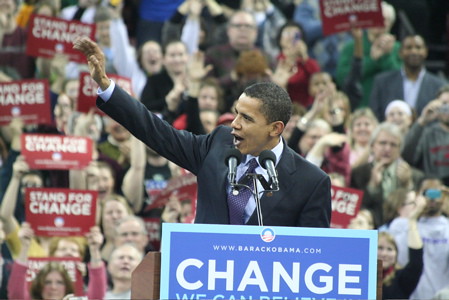
Lots of people like Barack Obama. He’s now the frontrunner for the democratic nomination, and if he does get it, He’ll be hard to beat for McCain. He’s articulate, charismatic and black. This appeals to a lot of people, not just in the U.S. but it seems around the world and here in Sri Lanka. The 20-somethings I meet often are captivated by his persona, excited about his message of “Hope” and “Change” and optimistic about the prospect of an Obama Presidency.

Obama has been celebrated as a Liberal Reagan – the great communicator of the American Left (which btw, is not so ‘left’ compared to say, Sri Lanka). People have written essays claiming he’s a left-libertarian, a Civil-Libertarian, a principled guy, a generation’s hope, yada yada. He has lot of independents supporting him, and even some conservatives. That’s all great. What’s going for Obama is that he’s the new kid on the block, so he doesn’t have a lot of baggage. Couple this with the kind of romance that people have developed for him, it makes people want to cherry-pick facts and project him as whoever they want to. As others have noted, Obama as of now is whatever people want him to be. Infatuation can do that to people.

There was a time not so long ago I was idealistic enough for this kind of blind romance, but those days are gone. This romance is unhealthy, because it stops you from actually examining the issues.

Let’s take foreign policy. Now I oppose the Iraq war, and I agree with the fundamentals of his withdrawal plan. But Obama’s position on the Iraq isn’t necessarily principled as some would like it to be, it’s just populist. His call for a troop withdrawal in Iraq is not coming from a principled non-interventionist position, based on his assessment of ground realities or from a fundamental change in the way U.S. approaches foreign policy, it’s coming from an assessment of voter sentiment.

My biggest beef with Obama of course, is with his economics, I’m not going to talk much about specific U.S. domestic policy issues, but it’s safe to say that Obama offers no “change” from the standard liberal democrat rhetoric, except Obama’s whole game is based on rhetoric.

Where Obama suck is trade, his “fair trade” plan would not only have free-traders worried (that’s basically most economists on the planet – including Obama’s own advisors.) but his “Fair Trade” plan to protect American jobs and Open foreign markets will have Oxfam-type- Do-gooder Fair Traders scratching their heads. Obama wants to talk to Chaves, but wants to renegotiate NAFTA. In other words he wants to talk to their oil-dictator while screwing over the people of Latin America.

Having civil liberties for Americans doesn’t really matter for the rest of us, but trade and foreign policy, those are heavy impact areas. It’s time some of us stop being swept away by Obama speeches and really look into what policies Obama’s advocating. If you agree – if you think protecting American jobs at our cost is a good thing – fine enough. But otherwise, it’s time to stop being in love and grow up.

Sunday, February 17, 2008

End of Chávez

It seems, like others who try to follow his ideology in a democratic set up, Hugo Chávez's run of popularity is slowly coming to an end. According to The Economist, during the last 5 years of the Chávez presidency, the proportion of households below the poverty line increased by 11 percent, despite the increased "social spending". It's a sad day for Sri Lankan quasi-socialists, who used to sing his praises. Micheal Moynihan has more to say at Reason.

Saturday, February 16, 2008

Competing currencies: putting the Central Bank out of business.

The Inflation in Sri Lanka is now at about 20%, and the Central Bank expects the figures to remain at 16% to 20% at least for the first half of 2008. It’s getting so unprecedented now, that it’s receiving some attention from international monetary experts. Over in the U.S. too they have problems with their currencies, the Dollar is loosing value against other currencies at record levels.

So the question is when certain currencies under performs say the SL Rupee or the Zimbabwean Dollar, why wouldn’t the market choose other currency instead? (Economists call this dollarization – replacing a countries currency with currency from another country – e.g. US Dollars) While the Central Bank may have the monopoly authority to print money in Sri Lanka, what stops the market from choosing foreign currencies? Why wouldn’t for example, retailers in Colombo declare, they “now accept Euros, Dollars and Pounds for transactions" and consumers follow suit. After all, most retailers support multiple types of credit cards and modes of payment, why not different currencies? It’s a question I put to FussBudget of LBO, who’s possibly one of the few Sri Lankan economists who’s taking the issue of Inflation head on. Here’s his response:

Deane,
Good one ! It is legal tender laws that bar you from accepting for payment or keeping foreign currency with you. You are barred from even keeping dollars with you. These exchange control rules were a little relaxed last year. But still you have to deal in Sri Lanka currency and keeping large quantities of foreign currency is still illegal.

Foreign exchange is subject to exchange control as well as customs laws here, and the govt could not only confiscate them and land you in jail but also fine you 300 percent.

By allowing NRFC accounts Sri Lanka slightly relaxed the monopoly on savings in local currency some time ago.

When people keep dollar notes, keep travellers cheques without changing and NRFC accounts it chips away at the note issuing monopoly of a government. (Notes - reserve money - deposits - M2). The liking for foreign currency and the distrust of the local currency is due to the loose monetary policy of the central bank.

However with tighter monetary policy since 1995, when the Central Bank changed from a pure inflationary money printer to something that at least tried to keep inflation in check we have seen a slight change in the situation and confidence increasing in the local currency.

As you know at one time the US banned citizens from holding gold through legal tender laws.

Deane, your friend Ron Paul is asking for competitive currencies inside the US. In the US though gold is no longer illegal to hold, it is still taxed when traded. This makes it less easy to challenge the dollar monopoly.

At the moment we have a 100 percent reserve backed currency. That means if govt wants, they can dollarize Sri Lanka tomorrow and eliminate high inflation.

While the Euro is obviously the best currency to dollarize to keep inflation as low as possible, for purposes of exports it may be better to dollarize with US dollars to prevent a big shock to the industrial sector.

As you know a currency board is also the same as dollarizing in a practical sense - except that we will have notes of a different colour.

If you followed Yugoslavia, there was dollarization with the German mark, when hyperinflation struck. Then you had the situation of currency boards, Euro union etc.
Here the debate about monetary reform has been muted until now. With Steve Hanke also getting into the picture now the 60 years of deception practised by the central bank on the poor of this country is also getting chipped away. [Link to comment. The Links, emphasis in the quote are mine]
Well, whad’ya know, I’m a criminal. Hopefully none of the custom’s chaps read this blog. I have from recently actually kept some of my savings in foreign currencies instead of Rupees.

I knew there was probably a truck-load of regulation preventing a market-led dollarization from ever happening (in any country, really) but I didn't know the exact provisions in Sri Lanka.

FussBudget’s (who’s real identity I do not know) reference to Ron Paul is an exchange we had before and a few days ago Ron Paul – whom I backed for U.S. president – made a speech in the house floor asking congress to consider the concept of “competing currencies” . Here is a relevant excerpt:

At this country's founding, there was no government controlled national currency. While the Constitution established the Congressional power of minting coins, it was not until 1792 that the US Mint was formally established. In the meantime, Americans made do with foreign silver and gold coins. Even after the Mint's operations got underway, foreign coins continued to circulate within the United States, and did so for several decades.

On the desk in my office I have a sign that says: “Don't steal – the government hates competition.” Indeed, any power a government arrogates to itself, it is loathe to give back to the people. Just as we have gone from a constitutionally-instituted national defense consisting of a limited army and navy bolstered by militias and letters of marque and reprisal, we have moved from a system of competing currencies to a government-instituted banking cartel that monopolizes the issuance of currency. In order to introduce a system of competing currencies, there are three steps that must be taken to produce a legal climate favorable to competition. [link] (Emphasis mine)
None of this will probably happen for a very long time. But I’m glad the debate has started.

Friday, February 15, 2008

Crack Tax

Recently, the Reason's Hit&Run reported that over in Tennessee,U.S. they collect taxes on illegal substances (drugs, moonshine, etc.) apparently the revenue department has vowed they will not share info with the cops as long as the drug dealers pay up taxes. Now if that wasn't WTF enough, The NY Post reports this :
A prominent Democratic Queens assemblyman yesterday warned that Gov. Spitzer's proposed tax on illegal drugs - dubbed the "crack tax" by critics - could unfairly impact the drug dealers themselves.

Assemblyman Jeffrion Aubry told Spitzer Tax Commissioner Robert Megna during a legislative budget hearing that requiring drug users and dealers to pay state sales tax on their illegal stash is an undue burden since they already face fines and possible forfeiture of property and money.

"This component adds another financial hardship on people who don't have a lot of money," Aubry said.

Aubry, chairman of the Assembly Corrections Committee, added that the plan could "create another class of individual who can't escape the process and has to go back out and sell drugs."

Said Megna, "It is not our intent to burden certain portions of the population." [link]
I mean, I couldn't agree more. All drug dealers need our love and protection.