Tuesday, May 13, 2008

Free lunch and Freeconomics

Chris Anderson, the editor-in-chief of Wired Magazine wrote this very interesting piece based on his forthcoming book "FREE" where he argues that following the pattern of the Web that $0.00 will be the future of business. My beef with the article at the time was this section,
Milton Friedman himself reminded us time and time again that "there's no such thing as a free lunch.

"But Friedman was wrong in two ways. First, a free lunch doesn't necessarily mean the food is being given away or that you'll pay for it later — it could just mean someone else is picking up the tab. Second, in the digital realm, as we've seen, the main feedstocks of the information economy — storage, processing power, and bandwidth — are getting cheaper by the day. Two of the main scarcity functions of traditional economics — the marginal costs of manufacturing and distribution — are rushing headlong to zip. It's as if the restaurant suddenly didn't have to pay any food or labor costs for that lunch.

Surely economics has something to say about that?

It does. The word is externalities, a concept that holds that money is not the only scarcity in the world. Chief among the others are your time and respect, two factors that we've always known about but have only recently been able to measure properly. The "attention economy" and "reputation economy" are too fuzzy to merit an academic department, but there's something real at the heart of both. [link]
In fact, the word isn't externalities. Chris is really missing the point about the phrase "there ain't no such thing as free lunch. Friedman didn't mean you won't get to have free lunch in the literal sense. What Friedman meant had more to do with opportunity costs rather than "externalities". Any economist would tell you that "cost" is simply what you have to give up to get something (reputation economy, etc. like Chris suggests) and not necessarily monetary. Even if your aunt invites you for lunch, there's still the cost of the time which you could have used to say, read something (opportunity cost) and of course your aunt, or at least someone along the line is footing the bill. So no, there ain't no such thing as a free lunch.

I've blogged about this in the past. Chris is featured this week on EconTalk with Russ Roberts in which he discusses the no free lunch concept, which Russ rebuts, quite accurately. Do listen to the podcast, it's interesting overall.

I'd be sure to pick up Chris' book when it arrives, especially since it's priced at $0.00. More on freeconomics and the economics of "free" later.

Sunday, May 11, 2008

Terrorists and Government win in the rigged Eastern Polls

It seems the Pillayan group(TMVP) a break away (still-armed) group of the Karuna faction a break away faction of the LTTE, who contested under the government's election symbol and patronage seems to have won the elections in the Eastern province after reports of ballot stuffing, voter impersonation and general violence. In short, surprise, surprise, the government and it's armed buddies have rigged the election.

Surely, someone has to call it right? No? See, it's often mistakenly thought there's a war against terror in Sri Lanka. Nonsense. Most Sri Lankans, the ruling party and particularly the president is fine with terrorrism as long as the terrorists are on 'their' side.

Official results are here.

Friday, May 09, 2008

WTF headline of the day

Comes from the Daily Mirror :
West responsible for cyclone in Burma.
How fitting it was a direct quote by Champika Ranwaka. Do check out the comments section, this is confirming my increasing cynicism of democracy, I mean forget an informed electorate, doesn't democracy at least require a not-retarded one?

Meanwhile in other news, BBC reports that, Great tits respond well to warming. Hallelujah

[links sent by NM and via IU respectively]

Reducing Poverty or Creating Wealth?

Yesterday's Daily Mirror FT had an article by Anila Dias tittled Reducing Poverty - What lessons can we learn?. Overall the article does a decent job of summarizing the recent report on poverty indicators (pdf link). It also correctly identifies the fact that whatever reduction there has been in poverty has little to do with the Government's handout scheme (the Samurdhi programme) and even points out a startling hypocrisy in the program when it says,
[..]the Census of Public and Semi Government Sector Employment 2006 reports that the Ministry of Samurdhi and Poverty Alleviation employed around 24,000 persons. This translated to one Samurdhi official for around 117 poor persons whose monthly benefits would have totalled around Rs.12,000. It is likely that the administrative costs of maintaining such a large contingent of staff would have exceeded total welfare payments to beneficiaries! [link]
Hypocrisy isn't a new word for governance, particularly in Sri Lanka. I (somewhat) agree with the article in general, but I think the problem of "poverty reduction" need to be thought differently. Poverty after all, is the natural state of the world. We don't create poverty, poverty just is, poverty is what you get if you don't do anything. Wealth is the unusual thing, so the question to ask is not "How do we reduce poverty?" but "How do we create wealth?"

The moment you frame the question this way, you will stop thinking about subsidies, charity, handouts and free milk and start thinking about enterprise, microfinance, education, infrastructure and markets. That's the kind of thing that will get people out of poverty even faster.

If ever there is one mechanism which stops wealth creation and sustained poverty, that's bad economic policy, and we have an abundance of that in Sri Lanka. History stands testament to the fact - and I know of no exception - that the simplest mechanism for creating wealth is economic freedom - that's free markets, rule of law and property rights. These are the institutions we need to be promoting.

In fact, Sri Lanka's own situation with poverty rates - with the Western Province almost eliminated abject poverty, is a test-case for this hypothesis. As Shjanta Devrajan, the World Bank's South Asian chief notes,
The reason the Western Province grew so fast is that it benefited the most from economic reforms. Trade liberalization and industrial de-regulation led to a boom in manufactured exports such as garments and electronics. These factories were concentrated in the Western Province, which halved its poverty rate.

Meanwhile, the rest of the country is heavily dependent on agriculture, which has seen very little growth. The reason is that there has been very little reform in agriculture. Owing to land regulations, farmers in Sri Lanka are forced to grow paddy, even though they can earn much more from growing fruits and vegetables. Fertilizer and other subsidies are also geared towards paddy farmers. Attempts to reform land regulations, or transform subsidies to across-the-board support for any crop, have been unsuccessful.

In short, Sri Lanka is a textbook case of how globalization works. Where there is liberalization, the economy booms; where there is no reform, the economy stagnates.

Do read the whole thing and resulting comments from his blog.

That kind of sums it up.

Nowadays, this blogs updates almost semi-daily, most of it is not on blog aggregators such as Kottu, so if you'd like to keep tabs on what's going on, subscribe to my live feed.

Thursday, May 08, 2008

Why We Shouldn't Study

A friend emails me these two adverts from the Sunday Observer :
(click images to enlarge)

and this one..

the email also goes on to say,
From the early ages of our lives our parents, teachers and relatives told us so many good things about education. But sometimes we come across situations where we have to think twice about them!
hmm. Maybe so, but maybe the secretary's job description doesn't include the occasional blow job for the chairman. But hell, who'd want to work for the Central Bank anyway!

Wednesday, May 07, 2008

Fairness, idealism and other atrocities

You gotta love P.J. O'Rourke.

Where Your Taxes Go

The Daily Mirror has this report today,

Making a stunning disclosure yesterday House Leader and Senior Minister Nimal Siripala de Silva told Parliament that six Nation Building Ministers were using 43 vehicles, incurring a staggering monthly fuel bill of Rs. 752,500. [..]

Minister de Silva said each minister was paid a monthly fuel allowance of Rs. 17,500 for each vehicle and that there was no move to purchase new vehicles for these ministers. [link]

I keep telling my friends for the what we have in Sri Lanka, is not that great debate between American Liberals and American Conservatives about Big Government vs. Small Government, we are talking about is absolutely freakin huge government vs. more-than-big government. We are not even at a stage where we can even begin to have that debate of big vs small government.

Sri Lanka not only have the world's largest cabinet of more than 100 Ministers, but possibly the world's largest (per capita) bureaucracy with 1 bureaucrat per 20 persons. Most of our tax money (56 cents of every tax rupee) goes to paying salaries for these bureaucrats and even more of it for maintaining this massive bureaucracy, in fact in his last budget speech, the President proudly declared (pdf link) that all government revenue (your taxes included) have been used for recurrent expenditure (salaries, pensions, subsidies, etc.) and all the capital expenditure (your roads, hospitals, etc.) was financed through debt.

So if you are one of those people who feel mushy about the fact your taxes are funding infrastructure and suchlike, think again. Also, if you are on of those people who think that the "tax payer" is rich people, think again too. Tax payer, thanks to the VAT, is everybody. So forget about ducking income tax guys, if you buy soap, you pay taxes. In fact if you just hold money, even without buying anything, you'd still be hit by the inflation tax, which will squander nearly 30% of the value of your money. Inflation is a result of having a massive government, with government printing money to keep itself afloat.

So yeah, whether you like it or not, we need to cut down the size of government. We can certainly start by cutting down the number of vehicles the 6 nation building ministers use, then perhaps cutting down the number of nation building ministers (seriously, what exactly does a 'nation building' minister do ?), then the size of the cabinet, and then cutting down on the number and scale of state institutions (that's CEBs, Railways, SLTB, Mihin Lanka). In short, Privatize and liberalize, and maybe then, we can have that big government vs. small government debate.

Sunday, May 04, 2008

HilBama's Broken Window Fallacy

James Pethokoukis of Capital Commerce points out a serious flaw in all those new "green collar" jobs Barrack Obama and Hilary Clinton hope to create in their plans to battle climate change. He writes,
As Clinton said in one presidential debate, "This issue of energy and global warming has the promise of creating millions of new jobs in America. It can be a win-win, if we do it right."

Heck, if climate change was a sham, it almost seems that it would be worthwhile to fabricate it, given all the apparent economic benefits. Then again, maybe not. Here is what William Pizer, an economist at Resources for the Future and a lead author on the most recent report from the U.N.'s Intergovernmental Panel on Climate Change, said at a symposium earlier this week here in Washington: "As an economist, I am skeptical that [dealing with climate change] is going to make money. You'll have new industries, but they'll be doing what old industries did but a higher net cost.... You'll be depleting other industries." [link]

So here's an idea for Obama and Clinton, next time try throwing stones at random windows, that way the people who fix windows will make a profit, and so many window-fixing jobs will be created and that would help the economy.

None of the democrats apparently have never heard of the broken window fallacy. In one of his most famous works, Fedric Bastiat, the 19th century French economist, wrote about the broken window fallacy about people who talk about the "economic benefits of war" adhere to. In an essay tittled What is seen and the unseen, Bastiat argued that while breaking windows will certainly benefit the window-fixers(glaziers), at the expense of other actors. He wrote,

Have you ever witnessed the anger of the good shopkeeper, James Goodfellow, when his careless son happened to break a pane of glass? If you have been present at such a scene, you will most assuredly bear witness to the fact, that every one of the spectators, were there even thirty of them, by common consent apparently, offered the unfortunate owner this invariable consolation—"It is an ill wind that blows nobody good. Everybody must live, and what would become of the glaziers if panes of glass were never broken?"

Now, this form of condolence contains an entire theory, which it will be well to show up in this simple case, seeing that it is precisely the same as that which, unhappily, regulates the greater part of our economical institutions.

Suppose it cost six francs to repair the damage, and you say that the accident brings six francs to the glazier's trade—that it encourages that trade to the amount of six francs—I grant it; I have not a word to say against it; you reason justly. The glazier comes, performs his task, receives his six francs, rubs his hands, and, in his heart, blesses the careless child. All this is that which is seen.

But if, on the other hand, you come to the conclusion, as is too often the case, that it is a good thing to break windows, that it causes money to circulate, and that the encouragement of industry in general will be the result of it, you will oblige me to call out, "Stop there! Your theory is confined to that which is seen; it takes no account of that which is not seen."

It is not seen that as our shopkeeper has spent six francs upon one thing, he cannot spend them upon another. It is not seen that if he had not had a window to replace, he would, perhaps, have replaced his old shoes, or added another book to his library. In short, he would have employed his six francs in some way, which this accident has prevented. [link]

Broken window fallacy, and Bastiat's essay could help in explaining the futility of how the Sri Lankan government is supposedly "creating jobs" for thousands of "unemployed graduates" by offering them jobs in an already over-bloated government.

Incidentally, the annual Bastiat prize for journalism is open for entries. Tragically, I can't name a single print or electronic media journalist from Sri Lanka, whom I can recommend for the prize.

Mihin Air

..Has been grounded until further notice. Now, His Excellency is trying to fly on his own. Budget-airline no.

The "Money" in Sex

This piece by Amit Varma on victimless crimes reminds me of something I've been thinking of recently about illegal prostitution.

Like I wrote earlier on this blog, there's no such thing called free sex. Sex has costs, just like any other thing, not all of it is monetary - emotional baggage, burden of relationship, so on. But money can (and often is) used to incentivise sex between two consenting adults (think flowers, booze, etc) none of this is considered a crime. But when money changes hands directly - without flowers intervening for example - it suddenly becomes a crime. Hypocrisy? not a new term for governance is it?

Thursday, May 01, 2008

Who is John Galt? (the movie)

According to Cato's blog, the movie of Any Rand's Atlas Shrugged is finally set to start shooting later this year.
Scott Holleran at Box Office Mojo is all over the Atlas Shrugged movie project. A few days ago he talked to Michael Burns, vice chairman of Lionsgate, the studio that is planning to make the film. He confirmed that Angelina Jolie will star as Dagny Taggart. Burns says John Galt should not be played by a movie star but by an actor with “an incredibly remarkable face, a face that just pops out at you,” to which his Randian interviewer responds, “A face with no fear, no pain, no guilt?”

Read the whole thing.
I have read both Atlas Shrugged and Rand's other acclaimed work, fountainhead. I appreciate the contributions Rand has made and accept part of her philosophy of objectivism, but I find some of it repulsive. Particularly objectivism's modern day interpretations like the stuff dished out by the Ayn Rand Institute.

Anyway, the book is a good read and I look forward to seeing the movie.

What's Up With Food?


As you probably know, the world's food prices are soaring. So far I've come across two basic explanations which I find reasonable for the hike in food and commodity prices.
  • Increased demand, constrained supply.

    This one is straight from your basic Econ 101 textbook. The increase in demand is attributed to the high growth rates in China and India, the newly richer Indians and Chinese demand more food. The supply hasn't kept up with demand hence the rice in food prices.

    The reasons for the supply constraints are attributed to the use of agricultural land for bio fuels (ethanol in the U.S. for example). This is yet another example of how climate change hysteria and resulting policy is actually doing more harm than the climatic effects of the supposed phenomena (I call it Al-flation).

    Second reason (See Tyler Cowen's excellent piece in the New York Times) there isn't enough international trade in foodstuff and the everywhere in the world there's a plethora of government interventions in the agriculture markets distorting price signals which stops produces from effectively responding to the increased demand.

    Also the resulting panicky situation from high food prices creates even more government intervention like putting in place price controls like in Sri Lanka and banning export of rice in India all of which destroys incentives for increased production.

  • It's created by loose monetary policy.

    This time the culprit is the U.S. Federal Reserve. The explanation is the monetary expansion in the U.S. via lower interest rates is causing higher inflation and a weaker dollar. Most commodities (including agricultural commodities) are priced in dollars, and when the dollar weakens the prices of commodities in terms of dollars go up. This also invites speculation of future declines driving up the prices further. See this chart from WSJ for example,

    The chart shows rapid increase in the price of oil in terms of dollars relative to euros since September 2007, about the time the US Fed started it's loose monetary policy practices. The hike in oil prices in terms of euros is fairly moderate, like the WSJ says, "had the dollar merely retained the same purchasing power as the euro, today's price of oil would be below $70 a barrel"

    Add to this picture that some developing countries (like Sri Lanka and India) partially pegs it's currency to the U.S. dollar basically importing U.S. inflation in addition to creating it's own inflation by printing money to finance government expenditure at home, we have a hike in almost all prices including that of agricultural commodities.
What is the true story? I think a bit (or a lot) of both. Sri Lanka being a net food importer is directly seeing the impact of these increases. The poor in particular who spend most of their earnings on foodstuff are really feeling the pinch. This is on top of more than 20% inflation even without food prices factored in (food inflation stands at about 34%) due to loose monetary policy by the central bank as a result of financing unsustainable government spending.

A pertinent question to ask is whether the high price of rice in particular, which didn't have much interaction with the global markets until recently be explained by generally high inflation alone. General inflation is probably the driving factor, but somehow I don't think captures the complete picture. It's possible there is an increased demand locally for rice due to people abandoning close substitutes like bread given the high price of wheat.

Now I'd love to see some numbers supporting that, something which is unfortunately sorely lacking in Sri Lankan media.

Related articles on food prices:

Wednesday, April 30, 2008

Who da Liberal?

Sometime back, a friend of mine writing an article for the ST Mirror commented that I have a passion for "Liberal Economics". Immediately, that label is confusing. After all, economics is just, well, economics. There's the good economics, the bad and the very ugly, adding a political modifier to what is essentially a science can only lead to confusion.

There's perhaps no word in the English language subject to more abuse than the world "Liberal", Americans (mostly) use it to refer to democrats, the kind who thinks that governments should take care of people from cradle to grave. In Europe, the term (which derives from the Latin word Libre meaning free) largely retains it's original meaning of individual freedom manifested in it's political, cultural and economic sense. In places like India and Sri Lanka the label is even more confusing where people claiming to be liberal can come be from all over the political spectrum. My guess is the thinking here, particularly among the Colombo elites (whom I fondly call Colombo Liberals) have been influenced by American political language, which is completely incompatible with the local political landscape and hence, the confusion.

Personally speaking, although I'm often accused of being one, I religiously avoid using the term Liberal to describe my political leanings. When I have to, I use the term Libertarian to describe my politics which is the political philosophy of Classical Liberalism (true liberalism in my opinion).

Coming back to economics, it is true that economists may have certain political goals, therefore the term "liberal economics" may not be a total misnomer. But given the amount of confusion of the term generates and given the fact that no serious economist relies on politics to describe or justify their work, the label is little more than annoying if not completely wrong.

For more on the abuse of the term by the American left see Jonah Goldberg's book Liberal Fascism and India Uncut's Amit Varma's take.

Tuesday, April 29, 2008

Sri Lanka Celebrates Earth Hour

In typical Sri Lankan fashion - about a month late and for a few more than one hour. Ok so it was an island-wide power failure. Given the frequency of these failures, (multiple times a month where I live) the folks at Greenpeace or WWF should nominate the Ceylon Electricity Board for the Nobel Prize this year.

To me the whole Earth Hour idea is symbolically a catastrophe, and today this reminded me of a post in Cafe Hayek on the subject. Here's a key excerpt from a letter written to WWF:
You and members of your organization worry that industrialization and economic growth are harming the earth's environment. I worry that the intensifying hysteria about the state of the environment - and that the resulting hostility to economic growth - might harm humankind's prospects for comfortable, healthy, enjoyable, and long lives.

So I commend you on your "Earth Hour" effort. Persuading people across the globe to turn off lights for one hour supplies the perfect symbol for modern environmentalism: a collective effort to return humankind to the dark ages.
Do read the whole thing.

Sunday, April 27, 2008

Defining Globalization

unlike those anti-globalization types, who tend attribute globalization to everything they don't like (poverty, war, disease, job-loss, etc.) I tend to use Tom Palmer's non-moralized definition , "The diminution or elimination of restrictions on exchange across political borders". That pretty much sums it up. But a friend of mine emails me this more funnier definition :
Question : What is the truest definition of Globalization ?
Answer : Princess Diana's death.

Question: How come?

Answer : An English princess with an Egyptian boyfriend crashes in a French tunnel, driving a German car with a Dutch engine, driven by a Belgian who was drunk on Scottish whisky, followed closely by Italian Paparazzi, on Japanese motorcycles; treated by an American doctor, using Brazilian medicines.

This is sent to you by a Sri Lankan , using Bill Gates's technology, and you're probably reading this on your computer, that uses Taiwanese chips, and a Korean monitor, assembled by Bangladeshi workers in a Singapore plant, transported by Indian lorry-drivers, hijacked by Indonesians, unloaded by Sicilian longshoremen, and trucked to you by Mexican illegals.....

That, my friends, is Globalization!!!!

British Humour

This summary is not available. Please click here to view the post.

Saturday, April 26, 2008

Friday, April 25, 2008

Government Bullying Ganja Farmers

According to the Daily Mirror,
The Excise Department Narcotics Detection Unit recovered a large stock of Ganja worth over Rs.2 million in Tanamalwila area during a special operation today [link]
There's only one thing Thanamalwila is famous for - Ganja (Marijuana) . You know that, I know that, the local authorities knows that. In fact, if the Nacrotics Detention Unit were to raid thanamalwila weekly, they'd probably keep on discovering "large stocks" of Ganja.

The point is, you can't really enforce a law against something for which a large number of people have no opposition for. Murder and theft are enforcible by law, because people in general agree these are crimes. Illicit liquor, Ganja, smoking in public or no-liquor on the Buddhist Poya Day cannot and should not be crimes, because for one, these 'crimes' are victimless and secondly, most of them are non-enforcible because not enough people agree these are crimes.

The so called "drug war" in the U.S., an attempt to actually enforce anti-drug laws is a monumental failure, but selective enforcement, like what happens in Sri Lanka is not really much better and amounts to nothing but bullying by the government.

So yes, if you haven't figured it already, legalize Ganja!

No such thing called a Free fu*k

Dinidu reminds me of this one time at band camp, ok no, over vodka, we invented (I'm pretty sure it was just me, and not "we") the phrase there's no such thing called a free fuck. Although, at the time we kind of meant it differently, suggesting that no sex really comes without emotional baggage, direct payment or other consequences, the quote is pretty much a derivative of the infamous saying often attributed to the economist Milton Friedman who liked to remind people that there's no such thing called a free lunch.

Now what this really mean is not that you won't ever get to have no-strings-attached sex. (or lunch for that matter) it just means to get something you like, you have to give up something else you also kinda like. That is, the "cost" of something is whatever you have to give up to get it. So even if your friend sponsors you a hooker, who comes to your house to have sex with you, and you don't really have a girlfriend to feel guilty about, there will always be costs, like the time wasted having sex, while you could have watched good TV. Sometimes (probably most), the costs are well worth the benefits.

Economics of Sex is a fascinating subject, something I wish I could write more on.

Saturday, April 19, 2008

Inflation for Dummies.Take 2

Mises Institute blog recently had an interesting piece by Henry Hazlitt on "everything you need to know about inflation". Here's a key excerpt:

The word "inflation" originally applied solely to the quantity of money. It meant that the volume of money was inflated, blown up, overextended. It is not mere pedantry to insist that the word should be used only in its original meaning. To use it to mean "a rise in prices" is to deflect attention away from the real cause of inflation and the real cure for it.

Let us see what happens under inflation, and why it happens. When the supply of money is increased, people have more money to offer for goods. If the supply of goods does not increase — or does not increase as much as the supply of money — then the prices of goods will go up. Each individual dollar becomes less valuable because there are more dollars. Therefore more of them will be offered against, say, a pair of shoes or a hundred bushels of wheat than before. A "price" is an exchange ratio between a dollar and a unit of goods. When people have more dollars, they value each dollar less. Goods then rise in price, not because goods are scarcer than before, but because dollars are more abundant. [link]

Do read the whole thing. Hazlitt is the author of the extremely useful book Economics in One Lesson, which is a great introduction for economics for anyone. He's also the author of many other books found free on the Mises Institute site.

It's interesting how more and more economists keep giving pseudo-Austrian analysis on the current financial crisis in the U.S. and the problem of inflation. In a recent column Fuss-Budget of Lanka Business Online does much the same. Are we all Austrians now?

Economists in the Austrian School generally advocate a return to the gold standard, or a free-banking system , or 100% reserve banking (a currency board arrangement, etc) to tackle the problem of inflation and the creation of "bubbles resulting from malinvestment.

Related, my own version of Inflation for Dummies.

Friday, April 18, 2008

Obama's Bad Day

That's probably an understatement. Obama's debate performance on the last democratic debate is the worst I've seen of him. Obama having gone through a rough time, with his 'bitter' comment and pastor wright's association came under heavy fire under Clinton and the two anchors from NBC.

For a someone who's winning, Obama looked defeated. He looked tired and weary and he tumbled over the first 40 minute of the debate trying to fend off attacks, and looked incoherent and stuck to rehersed-answers for the rest of the debate. It wasn't pretty. Clinton on the other hand looked competent, and for the first time can confidently say she won the debate.

Obamedia is trying to spin this as a great failure of the NBC moderators, and how being lost will actually help Obama. Bullshit. Someone should remind them that Charles Gibson and George Stephanopoulos are not running for the democratic nomination, Barrack Obama and Hillary Clinton is.

and let's not talk about this , "oh how unfair, the debate-didn't'-get-to-the-real-issues" nonsense. Are we retarded? I mean, if someone was living under a rock for the past year, maybe that's a relevant question. People know their positions on the issues, and guess what, it's not so different. So let's play this straight, it ain't about the issues anymore, it's about personality. In fact, it was personality all along and Obama was winning it. So the Obamedia can stop whining about getting a black eye now. Grow up, and admit it. Obama Lost the Debate. End of story.

The real winner, may not have been in the debate. I keep telling my friends to get used to the term President McCain. This guy has some luck, and that's a dangerous asset to have in an election. If there's one thing McCain could have wished for, that's for the two Dems to keep fighting, and that's exactly what's happening.

I think Obama would still be the nominee, and like I've said before, I do like him, really. I hate Hillary, I mean, if Hilary Clinton and George Bush happen to run for president, I'd pick a clear candidate, and it ain't Clinton. If it turned out to be (as it should) a McCain Vs. Obama election, then that's a difficult choice. Luckily, a choice I don't have to make.

Related, Why Not Obama.

Thursday, April 17, 2008

Our Socialist Ways

Today the Sri Lankan government announced price controls on rice. From the Daily Mirror:

The government in a move to control the escalating prices of locally produced rice imposed maximum wholesale and retail prices from midnight yesterday. A gazette notification to this effect was issued last night.

According to the new government regulations, the retail price of Samba rice will be Rs 70 per kilo while the wholesale price will be Rs 63. Prices have been fixed for Nadu, Rathu Kekulu and Sudu Kekulu rice as well.

Trade Minister Bandula Gunawardene told a news conference last night that this decision was taken to resolve the current crisis in the marketing of rice and to control the sky rocketing prices. He said this was the first time in the country’s history that price control had been imposed on rice.

[..]The minister said that those who sell above the specified rates and those who hide stocks would be severely dealt with under the Consumer Protection Act. [link]

This is coming from the supposedly pro-market minister of trade and consumer affairs, Bandula Gunawardene who previously warned that he would introduced legislation which could bark and bite solve the problem of cost of living. With pro-marketers like this, who need socialists?

No, I'm not saying we are on the road to serfdom just yet, but like I've said before, we still have this socialist mentality which assumes we can centrally plan the economy. It's one thing allow the market to flourish and introduce regulation where you think it's inefficient (I would argue against it, but at least that's tolerable), it's quite another to believe that a government bureaucrat knows the accurate price of something.

Wednesday, April 16, 2008

Typically Sri Lankan

This blog has taken a new year break, and like many Sri Lankans, a long one. But fear not, it will return soon.

Typically, it takes about a week from the official holidays, (and the other holiday we got because the official holiday is on a Sunday) for everyone to start working. It's frustrating sometimes, I know. Someone should really do a GDP cost of having a 11-month working year.

Wednesday, April 09, 2008

Starving Billionaires

With the rate of inflation at 100,000% that's the state of affairs in Zimbabwe. Recently, the Zimbabwean reserve bank put out a $50 Million currency note. I wonder if the Zimbabwean central bankers are pushing "cost-push" theories like their Sri Lankan counterparts. "Oil is expensive you see, you'll have to pay 16 Million for that bread". Now with the 50 Million note , at least carrying cash will be easier. Just ask this littler chap.

The country has a black market for US Dollars, a (black)market-led dollarization of sorts. Something I think should be allowed to happen elsewhere, legally.

There might now be hope so, here's what Morgan Tsvangirai, the man who should be Zimbabwe's next president said recently in a WSJ article:
Today, Zimbabwe ranks last out of the 141 countries surveyed by the Fraser Institute's Economic Freedom in the World report. According to 2007 World Bank estimates, it takes 96 days to start a business in Zimbabwe. It takes only two days in Australia. Waiting for necessary licenses takes 952 days in Zimbabwe, but only 34 days in South Korea. Registering property in Zimbabwe costs an astonishing 25% of the property's value. In the United States, it costs only 0.5%. [link]
At least someone there gets it. Hope might be short lived though, power transfers from dictators are never smooth.

[bank note link via reason, WSJ quote via division of labor]

Tuesday, April 08, 2008

Quote of the Century

This one is for you democrats (and local variants). Apparently, this fellow called Joseph Sobran said this:
"Need" now means wanting someone else's money. "Greed" means wanting to keep your own. "Compassion" is when a politician arranges the transfer.
ring true..? it should.

Monday, April 07, 2008

The Myth of the Open Economy

The Sri Lankan left (and it's modern-day 'mainstream' apologists) often point to 1977, the year when Sri Lanka started liberalizing the economy to describe anything 'bad' to do with Sri Lanka, from moral degradation, the persistence of poverty and occasionally as the root cause of the war.

Recently, when I pointed out that the partial liberalization in '77 has in fact, increased per-person income levels of Sri Lankans, a reader (and my friend) Andy, left the this comment:
Ya, it has increased incomes. But This can be hardly called great development. Countries like Singapore, the Asian Tigers have grown much faster.

Open Economy in Sri Lanka has not worked well enough. Maybe it's the war.
Now, I don't like the phrase, "Open economy" for two reasons. one, it somehow gives this notion that being open or not open to international trade is the only concern in a modern economic system, which is clearly not true. Two, in Sri Lanka the term is used as a catch-all-phrase for market liberalization. I prefer the term a free-market economy, but Sri Lanka isn't much of a free-market either, nor is it all that 'open' under any sort of definition.

To answer Andy, if at all the "Open Economy" has not worked, it's because the economy hasn't been open enough or if you ask me, isn't free enough.

Sri Lanka still has a mediocre socialist attitude towards policy.

In recent times, policymakers proposed using (and have used) price-controls to tackle inflation, we have a string of failing state enterprises, and if that's not enough we start more disasters. Investing in Sri Lanka is made difficult, with excessive restrictions on capital transactions, so on. The Central bank has lost all credibility as an independent institution and comes up with absurd theories to justify 20+% inflation. The labor market is heavily regulated, wasteful subsidies and welfare schemes which are nothing but political support systems

Entrepreneurs in Sri Lanka face high taxes, all sorts of restrictive licensing requirements and bureaucratic red tape, which results in heavy corruption. The World Bank doing business report in 2008 ranks Sri Lanka 101 of 178 countries, down 1 place from last year. We are with the worst lot when it comes to ease of doing business and things are not getting better.

We have a bloated government, the largest cabinet of ministers in the world and possibly the largest bureaucracy in the world with over a million state-sector employees for a country with 21 million people - one bureaucrat for every 20 people. India, often thought of as the worst bureaucracy only has about a 1:54 ratio of bureaucrats to people. The government spends most of our taxes on paying salaries to keep this massive bureaucracy alive, not on infrastructure, education or health, and no, not even the war effort. We simply can't afford this.

So no, Sri Lanka isn't much of a free-market. Yes, there are things we have managed to right and It's great that Sri Lanka still manages to grow, despite the government and despite the war, but things can be so much better.

There are two indices which measure how "free" an economy is. One published by the Heritage Foundation/Wall Street Journal ranks Sri Lanka 90 out of 162 countries. They are kinder, whereas the report published by the Fraser Institute ranks Sri Lanka 101 out of 142 countries. (pdf link) . The two reports differ on approach with the Heritage foundation depends on a more subjective analysis using a group of experts while the Fraser Institute relies on purely statistical analysis to come up with the rankings.

In both cases, Sri Lanka's rating is nothing to write home about, and that should tell the story why we are still a poor country. Economic Freedom promotes economic growth and prosperity and if we can have that, we can still progress despite having a war, like Ireland and so many other countries have.

Sunday, April 06, 2008

Jeyaraj, RIP


I already said this is one bad year for for MPs and it seems more so for MPs in the Gampaha District in Sri Lanka. Jayaraj Fernandopulle, the minister of Commerce and strongman of the SLFP has been a target of the LTTE for sometime now, it's generally believed that the claymore mine which killed Minister D.M. Dassanayake was intended on Jeyaraj Fernandopulle.

Jeyeraj knew the threats to his life, but he didn't take security arrangements seriously. Much to his family's distress. He was an ambitious guy as well, he has come a long way in politics and more recently has had an ambition to be Prime Minister. He was genuinely popular in his constituency, so much so that there is a Perahara in his honor in Negombo.

There's a lot I can say about Jeyaraj, but I'd rather let the man rest in peace. To be honest, I'm kind of sad.

Saturday, April 05, 2008

Selling Adam Smith's House

This week Edinburgh's city council selling Adam Smith's house,
This week Edinburgh's city council put on the market the house where Adam Smith spent his last 12 years, from 1778 until 1790. Advertisements in the property sections of local newspapers seek offers in excess of £700,000 ($1.4m) for a 17th-century house of historical interest, but fail to point out its connection with the father of modern economics.

This indifference to one of Scotland's greatest sons in the city where he spent much of his adult life is curious, but consistent. His house, recently a municipal centre for troubled boys, has a small, tarnished bronze plaque recording it as the town house of the Earls of Panmure and the home of Adam Smith. [link]

I'm with Alex Tabarrok when he says that " it would be a disgrace if the house went to anyone but the highest bidder". So this campaign by some concerned individuals (which includes some Edinburgh's economists) to save Smith's house is rather surprising.

In some ways, it throws light into a key Smithian insight of self-interest, which is often misunderstood to mean "selfishness" or "greed". Self-interest can, at times, be charitable. That's something Randians, who likes to talk about the virtue of selfishness and left-wing critics who likes to talk about, well, nonsense never seems to understand. The Market works on self interest, not necessarily greed or selfishness which are just human traits visible in any system.

and Self-interest, is what is driving these fans of Adam Smith to "Save" their hero's home from a potential demolition. I wish them luck, but I hope they intend on doing this by becoming the highest bidder and not by throwing political weight, which would be a disgrace to Adam Smith.

Tuesday, April 01, 2008

Pooja Endorses SLT. or does she?


According to LBO, Pooja Umashankar, the Sri Lankan/Indian actress has been appointed as Sri Lanka Telecom's brand ambassador for Broadband services. Bad move, Pooja, really. We hate SLT. It's slow, and if you ever call them for Technical assistance for absolutely anything, they think it's because of spyware.

But maybe she's not that dumb, see..
"I personally will not endorse any product which I would never use," Umashankar told reporters after being appointed brand ambassador for the telecom operator. [link]
Now, doesn't she live in India? I don't have the slightest clue. If she did, this is her way of saying " DONT USE THIS CRAP, MY MANAGER TOTALLY TALKED ME INTO THIS!". Either that, or she's a bit blond, like anar!!

Doesn't matter anyways, luckily I got a free life-time connection from Dialog Broadband. To get yourself one, Click here.

Saturday, March 29, 2008

Inflation for Dummies

The theory of oil-induced inflation

For the Background of this post, do read my last one. This post is a result of the many frustrating times I spent listening government politicians, the media, and most other people attributing the causes of inflation to increasing of prices in the world market, in particular spiraling Oil prices.

The fundamental argument of Oil-induced inflation, was summarized in a recent editorial in the Daily Mirror:
Obviously, it is the inexorable skyrocketing of the oil prices in the world market – over which the government has no control - that have the ripple effect on prices of all goods and services. Increased fuel prices have its inevitable impact on electricity prices. The combined effect of price hikes in these two items, fuel and power, impact on all activities ranging from transport to production of various consumer items of food. The inevitable result is phenomenal increase in prices. [link : DailyMirror Editorial, March 21, 2008]
The argument is elegantly simple. Oil prices rise. All goods are transported using vehicles, which uses oil, costs go up, so does the prices. It seems so reasonable, that the theory has many adherents. So much so, the Central Bankers in Sri Lanka (who now presides over an embarrassing 20% rate of inflation) help perpetuate this theory.

Now, I'm a great fan of peer education. So in my last post, I promised a sort of a for dummies-by-dummies guide on inflation. Looking back now, that was a silly promise to give. You can probably write a book on the subject. So what follows is a basic debunking of the oil-induced inflation myth, it's not unfortunately a complete dummies guide. But I will try to be as elaborate as possible.

The explanations may come across as being overly simplistic, and grossly inadequate. I accept both these charges. This is after all a dummies guide, and a blog post at that.

That thing called money.

As I discussed in my earlier post, Money has no value all by itself. It's just pieces of paper, what gives it value is that people use money to buy goods and services and because of that, there is a demand and therefore a value attached to it. Money also has a different value, than the number that's printed on it.

For example, like I said in my last post, I have a 20 Rupee Indian Note in my pocket. As you know, there is less acceptance (demand) for Indian rupees here in Sri Lanka, than in India. So the 20 Indian Rupee note I have is significantly less valuable here than it would be in India.

It's also true that what was a Rs.20 now in Sri Lanka is significantly less valuable than a Rs.20 in say, 1970.

First lesson in understanding inflation is perhaps realizing that money has different value attached to it than what's printed on the currency notes and thinking of inflation in terms of value of money rather than the prices of goods.

Do-It-Yourself Inflation experiment.

Literally speaking, printing money is quite simple. In Sri Lanka, it's printed in a factory (which I think is) in Biyagama. The Central Bank of a country has the control of much money is in the system, now that is not so simple to explain, but you'll have to trust me on that one. The point is, when I say "Printing Money" it doesn't mean literally printing notes, it refers to any way the Central Bank use to increase the money supply. Whenever you hear the phrases like , The Central bank has purchased Treasury Bills, the CB has lowered interest rates, it means the Central bank has put more money into to the system by increasing the money in circulation, expanding access to credit, so on. So in short, "money printing" is not just printing notes, it's any form of expansion of "money" in the system. Money, as you know, exists in many forms other than notes (credit, etc.) (updated - HT: ddm)

So, how is any of this relevant to inflation? Well, inflation is created by excessive money printing, which in turn is controlled by the central blank. So to put it bluntly, the Central Bank creates inflation. It's as simple as that.

Now, if you haven't heard of this before, this might come across as something between hallucinatory and laughable. So let me run through this thought-experiment I've developed.

Imagine that you are in grade 7. You and a friend of yours (let's call him Tom) want this really cool key-tag I have. I'm a cheeky little you-know-what, that I will only give it to the highest bidder. You have Rs.80 in your pocket, Tom has Rs.90. I start calling for bids at Rs.40. Both of you really like this key-tag.

The bidding starts: Tom starts biding at 50, You raise it to 60. Tom in turn raises the bid to 70. Now, you are in bit of a soup - you have only 10 Rupees left, but you really need Rs.5 of that to go home. If you don't use that 5 you'll have to walk your way home, and your mom would be very very annoyed. This Rs.5 is really valuable to you right now, so after thinking it over, you decide the to raise your bid to Rs. 75. Leaving Tom with Rs.15, to outbid you. But at this moment, there's a little twist in our tale.

Enter: The counterfeiter. Now (for no real reason, totally randomly) let's call this counterfeiter, Cabraal. Now Cabraal has this really cool laser printer which can print currency notes and he wants to test out some of his newly-printed stuff. So he walks over to you, and takes you to the side and hands you what appears to be two bills of Rs.10 notes, he says he's just helping out and everything is cool.

Suddenly, that Rs.5 you had with you doesn't seem too important anymore. The bidding starts again, Tom raises the bid to 80, you bid at 85. Again Tom retaliates by raising the bid to Rs.90, you raise the bid to Rs.95 and poor old Tom, not having the money to out-bid you, looses out and you get to buy the key-tag at Rs.95.

Think again as to what actually happened. The key-tag which would have sold at possibly Rs.80 (and a maximum of Rs.90 - all the money Tom had) was sold at Rs.95. The price increased simply because more money was injected into the process by counterfeiter Cabraal.

This is kind of what happens in our economy, when The Central Bank prints too much money without an increase in productive activity in the economy, all prices go up. This is inflation. It's a result of too much money chasing too few goods, we would eventually attach a smaller value to money and spend more of it, so prices 'sky rocket'.

In fact, most classical economists explicitly defined inflation as the growth of the money supply rather than the overall increase of prices.

Price of a particular item, like Oil, or Soap can increase (or decrease) due to all sorts of reasons and this may indeed contribute in recording a overall higher (or lower, with all other things being equal) value in the Consumer Price Index (which is used to measure inflation nowadays), but this is not the 'cause' of inflation. In fact general price increases are a result of inflation rather than it's cause.

So Why do they get it so wrong ?

If controlling inflation is so easy, Why do Central Banks like that of Sri Lanka and Zimbabwe get it so horribly wrong? Surely, Governor Cabraal and Co. know basic monetary economics? I certainly hope so. But the reason why certain central banks fail to control inflation is that governments (especially like ours) see printing money as a way to pay for their spending.

When you have a massive government set up like in Sri Lanka (100+ ministers and the obscenely large public sector), with a war, failing state enterprises and all other wasteful spending to finance, you end up having to tax, borrow when that's not enough - print money. This is why inflation is high in Sri Lanka.

But wait, why is this inflation thing so bad?

It might seem obvious, but it's a surprisingly good question. If prices of all things rise, then prices of whatever I sell must also be higher, so what's the big deal with inflation? Are we really worrying over nothing? Well, not exactly.

First of all, Inflation is a tax on everyone who holds money. Either in your wallet or a bank (savings/fixed deposit) account which pays less interest than the rate of inflation (which is the case in Sri Lanka). Every cent that you have in your bank and in your pocket right now is melting away as you read this. If you had Rs.100 in your savings account at 5% annual interest rate, and the annual inflation is 24% (pdf link) your Rs.100 at the end of the year is worth only Rs.81. You are literally being robbed of nearly 20% of your money.

Secondly, Incomes doesn't always keep up with the pace of inflation. So your purchasing power goes down. People with fixed incomes like pensioners are seeing their purchasing power plummet.

Thirdly, what makes free-market capitalism work is it's price system. Prices act as signal to producers, consumers and all actors of the market on what to buy, where to invest and how to allocate resources. High Inflation distorts this price signal (with an injection of money without productive activity) resulting in mal-investment, miss-allocation of resource and generally wrong economic decisions.

Additionally, inflation leads to an arbitrary distribution of wealth. When the Central Bank increases the money supply by say, lowering the interest on credit, those who get their hands on the credit first, generally benefit and those who don't, looses out. (Think of Tom in our thought-experiment)

Finally, high inflation creates uncertainty. If inflation is difficult to predict and volatile (a symptom of high inflation) that discourage productive economic activity. For example, a money lender may be reluctant to lend his money because he cannot predict if the interest he charges would be sufficient in face of volatile inflation.

Hmm, but can't the oil theory be also true?

The theory "Cost-Push" inflation, the idea that inflation is as a result of rising cost of things such as oil, was in fact quite a mainstream idea, about 30 years ago. Before Milton Friedman and others showed that inflation is always and everywhere a monetary phenomenon.

Without going into a theoretical argument on why this is not the case, let's say this hypothesis is true. Oil is the cause of (or the main contributor to) inflation.

What should we see? Surely,

1) All oil producing countries should have relatively low inflation. and,
2) All countries mostly importing their oil should have relatively higher inflation.

But none of these propositions are true. Iran, Russia and Venezuela three of the largest Oil producers have significantly higher inflation with Iran and Venezuela having close to 20% of inflation, much like Sri Lanka. On the other hand, countries which imports most (or all) of their oil consumption like New Zealand, Japan and Hong Kong are among the countries with lowest inflation.

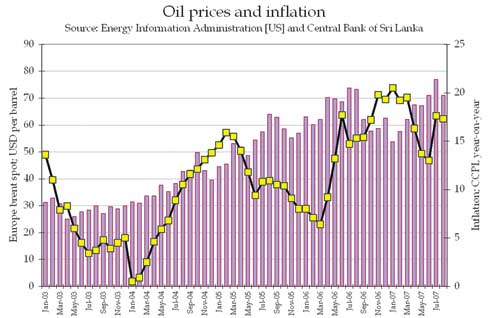
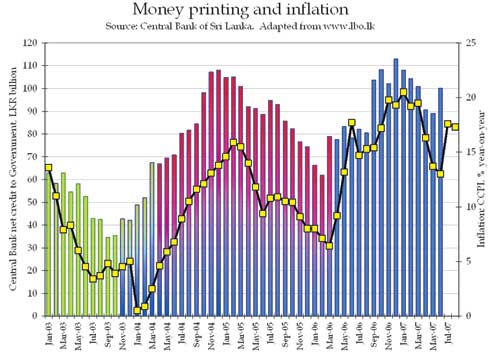
If that isn't proof enough, this graph from LBO/FT, showing the correlation between money printing and inflation and lack of a correlation between inflation and oil prices should really settle it.

So what can be done about this?

Sri Lankan economists offer two basic solutions. Both of which has to do with Central Bank Independence.

I'd say all solutions must include firing Ajith Nivard Cabraal from his post as governor of the Central Bank. If you are serious about Central Bank's independence you simply can't have the President's former campaign manager at it's helm.

The two dominant views on institutional reforms to central banking in Sri Lanka are the following:
  1. Bring in inflation-targeting legislation. This involves the parliament passing a law which mandates the Central Bank to stick to a particular level of inflation (say from 1-3%). Countries like New Zealand, Australia, Canada and Great Britain have enacted such legislation and it has proven to be relatively successful. Harsha De Silva, the well-known Sri Lankan economist is an advocate of this type of reform.

  2. A Currency Board arrangement. This involves pegging the SL rupee against a hard currency such as the US Dollar, which allows Sri Lanka to basically import the pegged currencies' inflation rate, in the case of the USD this would be 4% as opposed to the current 20+% inflation rate. Hong Kong has this type of arrangement with the US Dollar. LBO's Fuss-Budget and international monetary expert, Steve Hanke have recommended Sri Lanka follow a currency board, which we had till 1950 with relatively low inflation.
I tend to side with Fuss and Hanke although in the U.S. too there are renewed calls to keep inflation in check, by guys like my friend Ron Paul and others, especially from the Austrian School of Economics. Austrians happen to think that the U.S. should be on a gold standard, where the value of the U.S. dollar is by a commodity such as gold.

That's it for the dummies guide. It's been considerably longer than I wanted it to be, but I don't have time for a shorter post, hence the longer one. I Hope this has been helpful, I wish some of our politicians and newspaper editors can have a look at the actual causes of inflation rather than ranting on false, long-debunked theories.

Recommended Links :
The author is a student of economics and far from a monetary expert, the blog nor the author will take responsibility for any riots, profit/losses or a great depression which might trigger as a result of this post. Endorsements, criticisms and comments are welcome.

Wednesday, March 26, 2008

My Socialist Experiment

When I was growing up, this idea that 'our country was poor' puzzled me. How can we be poor I thought, the government print the money don't they? So how can they have all the money and still be poor? After days of thinking over this, I came to the conclusion that perhaps printing money costs, about the same amount of money that's being printed. That is for example, it costs the value of Rs.10 to print a Ten Rupee note. I remember asking my dad if this was the case, he said no, money is just paper he told me. I Can't remember if I followed up on the question, but I'm pretty sure he did not satisfactorily answer my questions.

This is about the time I invented my own version of socialism (I was really very young, honestly.) Deanist-Socialism was simple. Under my plan, every citizen in the country will receive a fixed amount of money at the end of every month courtesy the government. That way, there's no real need to work and we can live happily ever after.

I can't quite remember what I did with my theory, but finding answers to why oh why governments didn't just print money and distribute lead me to many realizations. First among them - not many people understand 'money'. For a long time, I didn't either.

So in my quest to understand this thing called money better, I began reading by coincidence (now this is much much later) the likes of Friedman, Rothbard, Mises and (eventually) the likes of Mankiw, Cowen and other contemporary practitioners. Having gone through all of this, I feel like I have the basics covered. But seeing media reports, listening to local politicians and even what some of our Central Bankers say, it seems many doesn't even have these basics covered.

So in the near future, (possibly tomorrow, I'm sleepy now) this blog will have Inflation for Dummies by dummies post to dispel some of the myths that's being perpetuated when talking about Cost of Living and particularly inflation in Sri Lanka.

But first, a few more of those realizations..

#2) Wealth is not Money. If it were, my little socialist experiment would have worked, to make it's people more wealthy, all a government has to do was print money and distribute them. Wealth, put it bluntly, is stuff or things we value (some of which could be money) and can be defined as the productive capacity of the economy.

But why doesn't governments do this? why don't they just print the money and distribute? The answer, is to do with the value of money.

#3) Paper-money has no intrinsic value. It's just paper. Turns out dad was right, the kind of money we use is just paper (fiat money). The only reason why you would accept it in exchange for payment for something is because we have the confidence that in the future, some other person would take it to exchange with something we value. If anyone doesn't think they can exchange this paper for something valuable in the future, they would not accept it.

For example, right now, I have with me a 20 Rupee Indian-Note in my purse, signed by a few friends and given to me as a souvenir. In India, this would have bought be breakfast. But here, in Sri Lanka, this would buy me nothing. The Indian rupee has (almost) no value here. (unless at a money-exchanger) The value of money, like any thing else is determined by the forces of it's supply and demand.

Realizing these two things, and the notion of value of money is perhaps the key to understanding inflation.

A Google Government

What if Google ran government? Jeff Jarvis has some interesting ideas. Reason Summarizes them here. Google 4 President? hmm..

Do read the post, He's dead serious.

Tuesday, March 25, 2008

Monday, March 24, 2008

So What's the bread?

Eshan. Coming soon on Facebook.

Sunday, March 23, 2008

Why I Love Ron Paul

I stumbled upon one of my favorite Ron Paul interviews, the one he did with John Stossel. Really offers insight into the man's philosophy. What can I say - endorsed 100%.

Here's a good quote from a
Though Paul argues passionately for liberalizing marijuana laws and is beloved by potheads (Timothy Leary once held a fund-raiser for him), he has never smoked pot himself. He sounded shocked when I asked him. "I have never seen anyone smoke marijuana," he said. "I don't think I'd be open to using it." For some people, libertarianism is the philosophical justification for a zany personal life. Paul, by contrast, describes his hobbies as gardening (roses and organic tomatoes) and "riding my bicycle."

He has never had a cigarette. He doesn't swear. He limits his drinking to an occasional glass of wine and goes to church regularly. He has been married to the same woman for 50 years. Three of their five children are physicians.Ron Paul is deeply square, and every bit as deeply committed to your right not to be.

"I don't gamble, but I'm the gambler's best friend," he says, boasting of his support for online casinos. He is a Second Amendment absolutist who doesn't own a gun. "I've only fired one a couple of times in my life. I've never gotten around to killing anything." It's an impressively, charmingly principled world view,..[link]
Here's the first part of the Stossel interview on YoutTube:


and Here's Part 2, 3, 4, 5 and 6.

Obama on Sri Lanka

Obama speaking about the Sri Lankan conflict, gets it horribly wrong. He thinks Religion is fueling a civil war in Sri Lanka in an interview in November 2007. Here's the quote :
W. E. B. Du Bois said that the problem of the 20th century is the problem of color. and if you expand that, the problem of the 21st century is the problem of the other - people who are not like us. Whether it's in religious terms, if you go to Sri Lanka, it's what's been fueling a vicious civil war there even though everybody looks exactly the same. Same with Northern Ireland, or it manifests in this country[united states] in racial terms.
Here's the relevant clip from YouTube:


No, I do like him, really, but he talks crap from time to time, you know, like all those other fellows.

More on Obama on Deaned.

Saturday, March 22, 2008

Freeing Tibet

There's lot of talk recently about the Tibetan situation. There's calls to action from all sorts of places. There's even an online petition, that's being circulated. Now, a petition to a communist regime is probably as useful as a wedding ring to the pope but symbolic gestures have their place, I suppose.

The upcoming Olympics is suggested the best place for to take this kind of stand, apparently the charter of the Olympic committee is to"to create a window of opportunities for dialogue, reconciliation and the resolution of conflicts...and to encourage political leaders to act in favour of peace". There are already calls to call on U.S. congress to call for a boycott of the Olympics. lot of calls, I doubt any of this will happen, but here's an interesting idea from Megan McArdle's blog,
A far better approach would be if the athletes themselves engaged in all manner of subversive tactics. I've heard it suggested that the athletes shave their heads in solidarity with Tibetan monks. Can you imagine the apoplectic fits the Chinese would go into if wave after wave of athlete representing various nations entered the arean with shaved heads? What if there was some symbol for Tibet the athletes wore on the medal podium? What if during press conferences, the athletes consciously mentioned the plight of Tibet? The possibilities for mischief are endless. [link]
Being China's little pee-boy, Sri Lanka won't be doing anything much. Funny how the usually-vocal lefties keep silent with this sort of thing. If it's under the banner of communism, what's the harm in a bit of oppression no?

The Geekiest Election Headline

Comes from the Huffington Post, Obama's a mac, Clinton a PC.

Friday, March 21, 2008

What I want for Easter

Is a Ganja Teddy. From the DM,

[..]in a surprising turn of events the Matara police found a teddy bear that could make the person who cuddles it “high”.

The novel way of hiding Ganja was discovered by the police when they found the teddy bear stuffed with a kilo of Ganja in the possession of an alleged Ganja kingpin of the area.

He was among ten young men who were arrested possessing a massive stock of ganja.[link]

I like your style maan.

Thursday, March 20, 2008

Development Indicators..

According to recent reports, Christina Caldera, a Sri Lankan student at the University of Texas made it to the PlayBoy Magazine.

Sri Lanka is really coming along, blond bimbos - check, gay celebrity - check, PlayBoy Mag - check. Next stop, um.. MILF Hunter?

Ok ok I know this is old news, but did you know Authur C Clarke was also on Play boy in 1986? So technically speaking, Ms.Caldera isn't the first Sri Lankan to be on PlayBoy. This kind of proves my point about Sri Lankan development, JR really did ruin everything.

Wednesday, March 19, 2008

Excellencies, Worships and honorables

Apparently, it's protocol to call a foreign Ambassador "excellency". Which is kinda funny, because I never liked the fact that even the President is called 'excellency'? why should he be an excellency? and Mayor a worship, and MPs honorables?

Technically speaking, shouldn't we, the people be the bosses with the politicians serving us? But of course, this shows how things are in reality. The sad part is this is exactly how most people treat them as well: as kings, worships and some sort of pseudo-gods. It's time people realized, president is just the head of government. He's not your king, excellency or worship, he's just a person put there to to do a job, just like everyone else. Maybe we just call these fellows assholes Mister (or madam) when we cant use their names.

Related, Government is Government.