


Sometime back, a friend of mine writing an article for the ST Mirror commented that I have a passion for "Liberal Economics". Immediately, that label is confusing. After all, economics is just, well, economics. There's the good economics, the bad and the very ugly, adding a political modifier to what is essentially a science can only lead to confusion.
There's perhaps no word in the English language subject to more abuse than the world "Liberal", Americans (mostly) use it to refer to democrats, the kind who thinks that governments should take care of people from cradle to grave. In Europe, the term (which derives from the Latin word Libre meaning free) largely retains it's original meaning of individual freedom manifested in it's political, cultural and economic sense. In places like India and Sri Lanka the label is even more confusing where people claiming to be liberal can come be from all over the political spectrum. My guess is the thinking here, particularly among the Colombo elites (whom I fondly call Colombo Liberals) have been influenced by American political language, which is completely incompatible with the local political landscape and hence, the confusion.
Personally speaking, although I'm often accused of being one, I religiously avoid using the term Liberal to describe my political leanings. When I have to, I use the term Libertarian to describe my politics which is the political philosophy of Classical Liberalism (true liberalism in my opinion).
Coming back to economics, it is true that economists may have certain political goals, therefore the term "liberal economics" may not be a total misnomer. But given the amount of confusion of the term generates and given the fact that no serious economist relies on politics to describe or justify their work, the label is little more than annoying if not completely wrong.
For more on the abuse of the term by the American left see Jonah Goldberg's book Liberal Fascism and India Uncut's Amit Varma's take.
Wednesday, April 30, 2008

Tuesday, April 29, 2008
Sri Lanka Celebrates Earth Hour
In typical Sri Lankan fashion - about a month late and for a few more than one hour. Ok so it was an island-wide power failure. Given the frequency of these failures, (multiple times a month where I live) the folks at Greenpeace or WWF should nominate the Ceylon Electricity Board for the Nobel Prize this year.
To me the whole Earth Hour idea is symbolically a catastrophe, and today this reminded me of a post in Cafe Hayek on the subject. Here's a key excerpt from a letter written to WWF:Do read the whole thing.
To me the whole Earth Hour idea is symbolically a catastrophe, and today this reminded me of a post in Cafe Hayek on the subject. Here's a key excerpt from a letter written to WWF:
You and members of your organization worry that industrialization and economic growth are harming the earth's environment. I worry that the intensifying hysteria about the state of the environment - and that the resulting hostility to economic growth - might harm humankind's prospects for comfortable, healthy, enjoyable, and long lives.
So I commend you on your "Earth Hour" effort. Persuading people across the globe to turn off lights for one hour supplies the perfect symbol for modern environmentalism: a collective effort to return humankind to the dark ages.
Sunday, April 27, 2008
Defining Globalization
unlike those anti-globalization types, who tend attribute globalization to everything they don't like (poverty, war, disease, job-loss, etc.) I tend to use Tom Palmer's non-moralized definition , "The diminution or elimination of restrictions on exchange across political borders". That pretty much sums it up. But a friend of mine emails me this more funnier definition :
Question : What is the truest definition of Globalization ?
Answer : Princess Diana's death.
Question: How come?
Answer : An English princess with an Egyptian boyfriend crashes in a French tunnel, driving a German car with a Dutch engine, driven by a Belgian who was drunk on Scottish whisky, followed closely by Italian Paparazzi, on Japanese motorcycles; treated by an American doctor, using Brazilian medicines.
This is sent to you by a Sri Lankan , using Bill Gates's technology, and you're probably reading this on your computer, that uses Taiwanese chips, and a Korean monitor, assembled by Bangladeshi workers in a Singapore plant, transported by Indian lorry-drivers, hijacked by Indonesians, unloaded by Sicilian longshoremen, and trucked to you by Mexican illegals.....
That, my friends, is Globalization!!!!
Saturday, April 26, 2008
Friday, April 25, 2008
Government Bullying Ganja Farmers
According to the Daily Mirror,
The point is, you can't really enforce a law against something for which a large number of people have no opposition for. Murder and theft are enforcible by law, because people in general agree these are crimes. Illicit liquor, Ganja, smoking in public or no-liquor on the Buddhist Poya Day cannot and should not be crimes, because for one, these 'crimes' are victimless and secondly, most of them are non-enforcible because not enough people agree these are crimes.
The so called "drug war" in the U.S., an attempt to actually enforce anti-drug laws is a monumental failure, but selective enforcement, like what happens in Sri Lanka is not really much better and amounts to nothing but bullying by the government.
So yes, if you haven't figured it already, legalize Ganja!
The Excise Department Narcotics Detection Unit recovered a large stock of Ganja worth over Rs.2 million in Tanamalwila area during a special operation today [link]There's only one thing Thanamalwila is famous for - Ganja (Marijuana) . You know that, I know that, the local authorities knows that. In fact, if the Nacrotics Detention Unit were to raid thanamalwila weekly, they'd probably keep on discovering "large stocks" of Ganja.
The point is, you can't really enforce a law against something for which a large number of people have no opposition for. Murder and theft are enforcible by law, because people in general agree these are crimes. Illicit liquor, Ganja, smoking in public or no-liquor on the Buddhist Poya Day cannot and should not be crimes, because for one, these 'crimes' are victimless and secondly, most of them are non-enforcible because not enough people agree these are crimes.
The so called "drug war" in the U.S., an attempt to actually enforce anti-drug laws is a monumental failure, but selective enforcement, like what happens in Sri Lanka is not really much better and amounts to nothing but bullying by the government.
So yes, if you haven't figured it already, legalize Ganja!
No such thing called a Free fu*k
Dinidu reminds me of this one time at band camp, ok no, over vodka, we invented (I'm pretty sure it was just me, and not "we") the phrase there's no such thing called a free fuck. Although, at the time we kind of meant it differently, suggesting that no sex really comes without emotional baggage, direct payment or other consequences, the quote is pretty much a derivative of the infamous saying often attributed to the economist Milton Friedman who liked to remind people that there's no such thing called a free lunch.
Now what this really mean is not that you won't ever get to have no-strings-attached sex. (or lunch for that matter) it just means to get something you like, you have to give up something else you also kinda like. That is, the "cost" of something is whatever you have to give up to get it. So even if your friend sponsors you a hooker, who comes to your house to have sex with you, and you don't really have a girlfriend to feel guilty about, there will always be costs, like the time wasted having sex, while you could have watched good TV. Sometimes (probably most), the costs are well worth the benefits.
Economics of Sex is a fascinating subject, something I wish I could write more on.
Now what this really mean is not that you won't ever get to have no-strings-attached sex. (or lunch for that matter) it just means to get something you like, you have to give up something else you also kinda like. That is, the "cost" of something is whatever you have to give up to get it. So even if your friend sponsors you a hooker, who comes to your house to have sex with you, and you don't really have a girlfriend to feel guilty about, there will always be costs, like the time wasted having sex, while you could have watched good TV. Sometimes (probably most), the costs are well worth the benefits.
Economics of Sex is a fascinating subject, something I wish I could write more on.
Saturday, April 19, 2008
Inflation for Dummies.Take 2
Mises Institute blog recently had an interesting piece by Henry Hazlitt on "everything you need to know about inflation". Here's a key excerpt:
It's interesting how more and more economists keep giving pseudo-Austrian analysis on the current financial crisis in the U.S. and the problem of inflation. In a recent column Fuss-Budget of Lanka Business Online does much the same. Are we all Austrians now?
Economists in the Austrian School generally advocate a return to the gold standard, or a free-banking system , or 100% reserve banking (a currency board arrangement, etc) to tackle the problem of inflation and the creation of "bubbles resulting from malinvestment.
Related, my own version of Inflation for Dummies.
Do read the whole thing. Hazlitt is the author of the extremely useful book Economics in One Lesson, which is a great introduction for economics for anyone. He's also the author of many other books found free on the Mises Institute site.The word "inflation" originally applied solely to the quantity of money. It meant that the volume of money was inflated, blown up, overextended. It is not mere pedantry to insist that the word should be used only in its original meaning. To use it to mean "a rise in prices" is to deflect attention away from the real cause of inflation and the real cure for it.
Let us see what happens under inflation, and why it happens. When the supply of money is increased, people have more money to offer for goods. If the supply of goods does not increase — or does not increase as much as the supply of money — then the prices of goods will go up. Each individual dollar becomes less valuable because there are more dollars. Therefore more of them will be offered against, say, a pair of shoes or a hundred bushels of wheat than before. A "price" is an exchange ratio between a dollar and a unit of goods. When people have more dollars, they value each dollar less. Goods then rise in price, not because goods are scarcer than before, but because dollars are more abundant. [link]
It's interesting how more and more economists keep giving pseudo-Austrian analysis on the current financial crisis in the U.S. and the problem of inflation. In a recent column Fuss-Budget of Lanka Business Online does much the same. Are we all Austrians now?
Economists in the Austrian School generally advocate a return to the gold standard, or a free-banking system , or 100% reserve banking (a currency board arrangement, etc) to tackle the problem of inflation and the creation of "bubbles resulting from malinvestment.
Related, my own version of Inflation for Dummies.
Friday, April 18, 2008
Obama's Bad Day
That's probably an understatement. Obama's debate performance on the last democratic debate is the worst I've seen of him. Obama having gone through a rough time, with his 'bitter' comment and pastor wright's association came under heavy fire under Clinton and the two anchors from NBC.
For a someone who's winning, Obama looked defeated. He looked tired and weary and he tumbled over the first 40 minute of the debate trying to fend off attacks, and looked incoherent and stuck to rehersed-answers for the rest of the debate. It wasn't pretty. Clinton on the other hand looked competent, and for the first time can confidently say she won the debate.
Obamedia is trying to spin this as a great failure of the NBC moderators, and how being lost will actually help Obama. Bullshit. Someone should remind them that Charles Gibson and George Stephanopoulos are not running for the democratic nomination, Barrack Obama and Hillary Clinton is.
and let's not talk about this , "oh how unfair, the debate-didn't'-get-to-the-real-issues" nonsense. Are we retarded? I mean, if someone was living under a rock for the past year, maybe that's a relevant question. People know their positions on the issues, and guess what, it's not so different. So let's play this straight, it ain't about the issues anymore, it's about personality. In fact, it was personality all along and Obama was winning it. So the Obamedia can stop whining about getting a black eye now. Grow up, and admit it. Obama Lost the Debate. End of story.
The real winner, may not have been in the debate. I keep telling my friends to get used to the term President McCain. This guy has some luck, and that's a dangerous asset to have in an election. If there's one thing McCain could have wished for, that's for the two Dems to keep fighting, and that's exactly what's happening.
I think Obama would still be the nominee, and like I've said before, I do like him, really. I hate Hillary, I mean, if Hilary Clinton and George Bush happen to run for president, I'd pick a clear candidate, and it ain't Clinton. If it turned out to be (as it should) a McCain Vs. Obama election, then that's a difficult choice. Luckily, a choice I don't have to make.
Related, Why Not Obama.
For a someone who's winning, Obama looked defeated. He looked tired and weary and he tumbled over the first 40 minute of the debate trying to fend off attacks, and looked incoherent and stuck to rehersed-answers for the rest of the debate. It wasn't pretty. Clinton on the other hand looked competent, and for the first time can confidently say she won the debate.
Obamedia is trying to spin this as a great failure of the NBC moderators, and how being lost will actually help Obama. Bullshit. Someone should remind them that Charles Gibson and George Stephanopoulos are not running for the democratic nomination, Barrack Obama and Hillary Clinton is.
and let's not talk about this , "oh how unfair, the debate-didn't'-get-to-the-real-issues" nonsense. Are we retarded? I mean, if someone was living under a rock for the past year, maybe that's a relevant question. People know their positions on the issues, and guess what, it's not so different. So let's play this straight, it ain't about the issues anymore, it's about personality. In fact, it was personality all along and Obama was winning it. So the Obamedia can stop whining about getting a black eye now. Grow up, and admit it. Obama Lost the Debate. End of story.
The real winner, may not have been in the debate. I keep telling my friends to get used to the term President McCain. This guy has some luck, and that's a dangerous asset to have in an election. If there's one thing McCain could have wished for, that's for the two Dems to keep fighting, and that's exactly what's happening.
I think Obama would still be the nominee, and like I've said before, I do like him, really. I hate Hillary, I mean, if Hilary Clinton and George Bush happen to run for president, I'd pick a clear candidate, and it ain't Clinton. If it turned out to be (as it should) a McCain Vs. Obama election, then that's a difficult choice. Luckily, a choice I don't have to make.
Related, Why Not Obama.
Thursday, April 17, 2008
Our Socialist Ways
Today the Sri Lankan government announced price controls on rice. From the Daily Mirror:
No, I'm not saying we are on the road to serfdom just yet, but like I've said before, we still have this socialist mentality which assumes we can centrally plan the economy. It's one thing allow the market to flourish and introduce regulation where you think it's inefficient (I would argue against it, but at least that's tolerable), it's quite another to believe that a government bureaucrat knows the accurate price of something.
This is coming from the supposedly pro-market minister of trade and consumer affairs, Bandula Gunawardene who previously warned that he would introduced legislation which could bark and bite solve the problem of cost of living. With pro-marketers like this, who need socialists?The government in a move to control the escalating prices of locally produced rice imposed maximum wholesale and retail prices from midnight yesterday. A gazette notification to this effect was issued last night.
According to the new government regulations, the retail price of Samba rice will be Rs 70 per kilo while the wholesale price will be Rs 63. Prices have been fixed for Nadu, Rathu Kekulu and Sudu Kekulu rice as well.
Trade Minister Bandula Gunawardene told a news conference last night that this decision was taken to resolve the current crisis in the marketing of rice and to control the sky rocketing prices. He said this was the first time in the country’s history that price control had been imposed on rice.
[..]The minister said that those who sell above the specified rates and those who hide stocks would be severely dealt with under the Consumer Protection Act. [link]
No, I'm not saying we are on the road to serfdom just yet, but like I've said before, we still have this socialist mentality which assumes we can centrally plan the economy. It's one thing allow the market to flourish and introduce regulation where you think it's inefficient (I would argue against it, but at least that's tolerable), it's quite another to believe that a government bureaucrat knows the accurate price of something.
Wednesday, April 16, 2008
Typically Sri Lankan
This blog has taken a new year break, and like many Sri Lankans, a long one. But fear not, it will return soon.
Typically, it takes about a week from the official holidays, (and the other holiday we got because the official holiday is on a Sunday) for everyone to start working. It's frustrating sometimes, I know. Someone should really do a GDP cost of having a 11-month working year.
Typically, it takes about a week from the official holidays, (and the other holiday we got because the official holiday is on a Sunday) for everyone to start working. It's frustrating sometimes, I know. Someone should really do a GDP cost of having a 11-month working year.
Wednesday, April 09, 2008
Starving Billionaires
With the rate of inflation at 100,000% that's the state of affairs in Zimbabwe. Recently, the Zimbabwean reserve bank put out a $50 Million currency note. I wonder if the Zimbabwean central bankers are pushing "cost-push" theories like their Sri Lankan counterparts. "Oil is expensive you see, you'll have to pay 16 Million for that bread". Now with the 50 Million note , at least carrying cash will be easier. Just ask this littler chap.
The country has a black market for US Dollars, a (black)market-led dollarization of sorts. Something I think should be allowed to happen elsewhere, legally.
There might now be hope so, here's what Morgan Tsvangirai, the man who should be Zimbabwe's next president said recently in a WSJ article:

The country has a black market for US Dollars, a (black)market-led dollarization of sorts. Something I think should be allowed to happen elsewhere, legally.
There might now be hope so, here's what Morgan Tsvangirai, the man who should be Zimbabwe's next president said recently in a WSJ article:
Today, Zimbabwe ranks last out of the 141 countries surveyed by the Fraser Institute's Economic Freedom in the World report. According to 2007 World Bank estimates, it takes 96 days to start a business in Zimbabwe. It takes only two days in Australia. Waiting for necessary licenses takes 952 days in Zimbabwe, but only 34 days in South Korea. Registering property in Zimbabwe costs an astonishing 25% of the property's value. In the United States, it costs only 0.5%. [link]At least someone there gets it. Hope might be short lived though, power transfers from dictators are never smooth.
[bank note link via reason, WSJ quote via division of labor]
Tuesday, April 08, 2008
Quote of the Century
This one is for you democrats (and local variants). Apparently, this fellow called
[via ASI]
Monday, April 07, 2008
The Myth of the Open Economy
The Sri Lankan left (and it's modern-day 'mainstream' apologists) often point to 1977, the year when Sri Lanka started liberalizing the economy to describe anything 'bad' to do with Sri Lanka, from moral degradation, the persistence of poverty and occasionally as the root cause of the war.
Recently, when I pointed out that the partial liberalization in '77 has in fact, increased per-person income levels of Sri Lankans, a reader (and my friend) Andy, left the this comment:
To answer Andy, if at all the "Open Economy" has not worked, it's because the economy hasn't been open enough or if you ask me, isn't free enough.
Sri Lanka still has a mediocre socialist attitude towards policy.
In recent times, policymakers proposed using (and have used) price-controls to tackle inflation, we have a string of failing state enterprises, and if that's not enough we start more disasters. Investing in Sri Lanka is made difficult, with excessive restrictions on capital transactions, so on. The Central bank has lost all credibility as an independent institution and comes up with absurd theories to justify 20+% inflation. The labor market is heavily regulated, wasteful subsidies and welfare schemes which are nothing but political support systems
Entrepreneurs in Sri Lanka face high taxes, all sorts of restrictive licensing requirements and bureaucratic red tape, which results in heavy corruption. The World Bank doing business report in 2008 ranks Sri Lanka 101 of 178 countries, down 1 place from last year. We are with the worst lot when it comes to ease of doing business and things are not getting better.
We have a bloated government, the largest cabinet of ministers in the world and possibly the largest bureaucracy in the world with over a million state-sector employees for a country with 21 million people - one bureaucrat for every 20 people. India, often thought of as the worst bureaucracy only has about a 1:54 ratio of bureaucrats to people. The government spends most of our taxes on paying salaries to keep this massive bureaucracy alive, not on infrastructure, education or health, and no, not even the war effort. We simply can't afford this.
So no, Sri Lanka isn't much of a free-market. Yes, there are things we have managed to right and It's great that Sri Lanka still manages to grow, despite the government and despite the war, but things can be so much better.
There are two indices which measure how "free" an economy is. One published by the Heritage Foundation/Wall Street Journal ranks Sri Lanka 90 out of 162 countries. They are kinder, whereas the report published by the Fraser Institute ranks Sri Lanka 101 out of 142 countries. (pdf link) . The two reports differ on approach with the Heritage foundation depends on a more subjective analysis using a group of experts while the Fraser Institute relies on purely statistical analysis to come up with the rankings.
In both cases, Sri Lanka's rating is nothing to write home about, and that should tell the story why we are still a poor country. Economic Freedom promotes economic growth and prosperity and if we can have that, we can still progress despite having a war, like Ireland and so many other countries have.
Recently, when I pointed out that the partial liberalization in '77 has in fact, increased per-person income levels of Sri Lankans, a reader (and my friend) Andy, left the this comment:
Ya, it has increased incomes. But This can be hardly called great development. Countries like Singapore, the Asian Tigers have grown much faster.Now, I don't like the phrase, "Open economy" for two reasons. one, it somehow gives this notion that being open or not open to international trade is the only concern in a modern economic system, which is clearly not true. Two, in Sri Lanka the term is used as a catch-all-phrase for market liberalization. I prefer the term a free-market economy, but Sri Lanka isn't much of a free-market either, nor is it all that 'open' under any sort of definition.
Open Economy in Sri Lanka has not worked well enough. Maybe it's the war.
To answer Andy, if at all the "Open Economy" has not worked, it's because the economy hasn't been open enough or if you ask me, isn't free enough.
Sri Lanka still has a mediocre socialist attitude towards policy.
In recent times, policymakers proposed using (and have used) price-controls to tackle inflation, we have a string of failing state enterprises, and if that's not enough we start more disasters. Investing in Sri Lanka is made difficult, with excessive restrictions on capital transactions, so on. The Central bank has lost all credibility as an independent institution and comes up with absurd theories to justify 20+% inflation. The labor market is heavily regulated, wasteful subsidies and welfare schemes which are nothing but political support systems
Entrepreneurs in Sri Lanka face high taxes, all sorts of restrictive licensing requirements and bureaucratic red tape, which results in heavy corruption. The World Bank doing business report in 2008 ranks Sri Lanka 101 of 178 countries, down 1 place from last year. We are with the worst lot when it comes to ease of doing business and things are not getting better.
We have a bloated government, the largest cabinet of ministers in the world and possibly the largest bureaucracy in the world with over a million state-sector employees for a country with 21 million people - one bureaucrat for every 20 people. India, often thought of as the worst bureaucracy only has about a 1:54 ratio of bureaucrats to people. The government spends most of our taxes on paying salaries to keep this massive bureaucracy alive, not on infrastructure, education or health, and no, not even the war effort. We simply can't afford this.
So no, Sri Lanka isn't much of a free-market. Yes, there are things we have managed to right and It's great that Sri Lanka still manages to grow, despite the government and despite the war, but things can be so much better.
There are two indices which measure how "free" an economy is. One published by the Heritage Foundation/Wall Street Journal ranks Sri Lanka 90 out of 162 countries. They are kinder, whereas the report published by the Fraser Institute ranks Sri Lanka 101 out of 142 countries. (pdf link) . The two reports differ on approach with the Heritage foundation depends on a more subjective analysis using a group of experts while the Fraser Institute relies on purely statistical analysis to come up with the rankings.
In both cases, Sri Lanka's rating is nothing to write home about, and that should tell the story why we are still a poor country. Economic Freedom promotes economic growth and prosperity and if we can have that, we can still progress despite having a war, like Ireland and so many other countries have.
Sunday, April 06, 2008
Jeyaraj, RIP

I already said this is one bad year for for MPs and it seems more so for MPs in the Gampaha District in Sri Lanka. Jayaraj Fernandopulle, the minister of Commerce and strongman of the SLFP has been a target of the LTTE for sometime now, it's generally believed that the claymore mine which killed Minister D.M. Dassanayake was intended on Jeyaraj Fernandopulle.
Jeyeraj knew the threats to his life, but he didn't take security arrangements seriously. Much to his family's distress. He was an ambitious guy as well, he has come a long way in politics and more recently has had an ambition to be Prime Minister. He was genuinely popular in his constituency, so much so that there is a Perahara in his honor in Negombo.
There's a lot I can say about Jeyaraj, but I'd rather let the man rest in peace. To be honest, I'm kind of sad.
Saturday, April 05, 2008
Selling Adam Smith's House
This week Edinburgh's city council selling Adam Smith's house,
This week Edinburgh's city council put on the market the house where Adam Smith spent his last 12 years, from 1778 until 1790. Advertisements in the property sections of local newspapers seek offers in excess of £700,000 ($1.4m) for a 17th-century house of historical interest, but fail to point out its connection with the father of modern economics.This indifference to one of Scotland's greatest sons in the city where he spent much of his adult life is curious, but consistent. His house, recently a municipal centre for troubled boys, has a small, tarnished bronze plaque recording it as the town house of the Earls of Panmure and the home of Adam Smith. [link]
I'm with Alex Tabarrok when he says that " it would be a disgrace if the house went to anyone but the highest bidder". So this campaign by some concerned individuals (which includes some Edinburgh's economists) to save Smith's house is rather surprising.
In some ways, it throws light into a key Smithian insight of self-interest, which is often misunderstood to mean "selfishness" or "greed". Self-interest can, at times, be charitable. That's something Randians, who likes to talk about the virtue of selfishness and left-wing critics who likes to talk about, well, nonsense never seems to understand. The Market works on self interest, not necessarily greed or selfishness which are just human traits visible in any system.
and Self-interest, is what is driving these fans of Adam Smith to "Save" their hero's home from a potential demolition. I wish them luck, but I hope they intend on doing this by becoming the highest bidder and not by throwing political weight, which would be a disgrace to Adam Smith.
Tuesday, April 01, 2008
Pooja Endorses SLT. or does she?

According to LBO, Pooja Umashankar, the Sri Lankan/Indian actress has been appointed as Sri Lanka Telecom's brand ambassador for Broadband services. Bad move, Pooja, really. We hate SLT. It's slow, and if you ever call them for Technical assistance for absolutely anything, they think it's because of spyware.
But maybe she's not that dumb, see..
"I personally will not endorse any product which I would never use," Umashankar told reporters after being appointed brand ambassador for the telecom operator. [link]Now, doesn't she live in India? I don't have the slightest clue. If she did, this is her way of saying " DONT USE THIS CRAP, MY MANAGER TOTALLY TALKED ME INTO THIS!". Either that, or she's a bit blond, like anar!!
Doesn't matter anyways, luckily I got a free life-time connection from Dialog Broadband. To get yourself one, Click here.
Saturday, March 29, 2008
Inflation for Dummies
The theory of oil-induced inflation
For the Background of this post, do read my last one. This post is a result of the many frustrating times I spent listening government politicians, the media, and most other people attributing the causes of inflation to increasing of prices in the world market, in particular spiraling Oil prices.
The fundamental argument of Oil-induced inflation, was summarized in a recent editorial in the Daily Mirror:
Now, I'm a great fan of peer education. So in my last post, I promised a sort of a for dummies-by-dummies guide on inflation. Looking back now, that was a silly promise to give. You can probably write a book on the subject. So what follows is a basic debunking of the oil-induced inflation myth, it's not unfortunately a complete dummies guide. But I will try to be as elaborate as possible.
The explanations may come across as being overly simplistic, and grossly inadequate. I accept both these charges. This is after all a dummies guide, and a blog post at that.
That thing called money.
As I discussed in my earlier post, Money has no value all by itself. It's just pieces of paper, what gives it value is that people use money to buy goods and services and because of that, there is a demand and therefore a value attached to it. Money also has a different value, than the number that's printed on it.
For example, like I said in my last post, I have a 20 Rupee Indian Note in my pocket. As you know, there is less acceptance (demand) for Indian rupees here in Sri Lanka, than in India. So the 20 Indian Rupee note I have is significantly less valuable here than it would be in India.
It's also true that what was a Rs.20 now in Sri Lanka is significantly less valuable than a Rs.20 in say, 1970.
First lesson in understanding inflation is perhaps realizing that money has different value attached to it than what's printed on the currency notes and thinking of inflation in terms of value of money rather than the prices of goods.
Do-It-Yourself Inflation experiment.
Literally speaking, printing money is quite simple. In Sri Lanka, it's printed in a factory (which I think is) in Biyagama. The Central Bank of a country has the control of much money is in the system, now that is not so simple to explain, but you'll have to trust me on that one. The point is, when I say "Printing Money" it doesn't mean literally printing notes, it refers to any way the Central Bank use to increase the money supply. Whenever you hear the phrases like , The Central bank has purchased Treasury Bills, the CB has lowered interest rates, it means the Central bank has put more money into to the system by increasing the money in circulation, expanding access to credit, so on. So in short, "money printing" is not just printing notes, it's any form of expansion of "money" in the system. Money, as you know, exists in many forms other than notes (credit, etc.) (updated - HT: ddm)
So, how is any of this relevant to inflation? Well, inflation is created by excessive money printing, which in turn is controlled by the central blank. So to put it bluntly, the Central Bank creates inflation. It's as simple as that.
Now, if you haven't heard of this before, this might come across as something between hallucinatory and laughable. So let me run through this thought-experiment I've developed.
Imagine that you are in grade 7. You and a friend of yours (let's call him Tom) want this really cool key-tag I have. I'm a cheeky little you-know-what, that I will only give it to the highest bidder. You have Rs.80 in your pocket, Tom has Rs.90. I start calling for bids at Rs.40. Both of you really like this key-tag.
The bidding starts: Tom starts biding at 50, You raise it to 60. Tom in turn raises the bid to 70. Now, you are in bit of a soup - you have only 10 Rupees left, but you really need Rs.5 of that to go home. If you don't use that 5 you'll have to walk your way home, and your mom would be very very annoyed. This Rs.5 is really valuable to you right now, so after thinking it over, you decide the to raise your bid to Rs. 75. Leaving Tom with Rs.15, to outbid you. But at this moment, there's a little twist in our tale.
Enter: The counterfeiter. Now (for no real reason, totally randomly) let's call this counterfeiter, Cabraal. Now Cabraal has this really cool laser printer which can print currency notes and he wants to test out some of his newly-printed stuff. So he walks over to you, and takes you to the side and hands you what appears to be two bills of Rs.10 notes, he says he's just helping out and everything is cool.
Suddenly, that Rs.5 you had with you doesn't seem too important anymore. The bidding starts again, Tom raises the bid to 80, you bid at 85. Again Tom retaliates by raising the bid to Rs.90, you raise the bid to Rs.95 and poor old Tom, not having the money to out-bid you, looses out and you get to buy the key-tag at Rs.95.
Think again as to what actually happened. The key-tag which would have sold at possibly Rs.80 (and a maximum of Rs.90 - all the money Tom had) was sold at Rs.95. The price increased simply because more money was injected into the process by counterfeiter Cabraal.
This is kind of what happens in our economy, when The Central Bank prints too much money without an increase in productive activity in the economy, all prices go up. This is inflation. It's a result of too much money chasing too few goods, we would eventually attach a smaller value to money and spend more of it, so prices 'sky rocket'.
In fact, most classical economists explicitly defined inflation as the growth of the money supply rather than the overall increase of prices.
Price of a particular item, like Oil, or Soap can increase (or decrease) due to all sorts of reasons and this may indeed contribute in recording a overall higher (or lower, with all other things being equal) value in the Consumer Price Index (which is used to measure inflation nowadays), but this is not the 'cause' of inflation. In fact general price increases are a result of inflation rather than it's cause.
So Why do they get it so wrong ?
If controlling inflation is so easy, Why do Central Banks like that of Sri Lanka and Zimbabwe get it so horribly wrong? Surely, Governor Cabraal and Co. know basic monetary economics? I certainly hope so. But the reason why certain central banks fail to control inflation is that governments (especially like ours) see printing money as a way to pay for their spending.
When you have a massive government set up like in Sri Lanka (100+ ministers and the obscenely large public sector), with a war, failing state enterprises and all other wasteful spending to finance, you end up having to tax, borrow when that's not enough - print money. This is why inflation is high in Sri Lanka.
But wait, why is this inflation thing so bad?
It might seem obvious, but it's a surprisingly good question. If prices of all things rise, then prices of whatever I sell must also be higher, so what's the big deal with inflation? Are we really worrying over nothing? Well, not exactly.
First of all, Inflation is a tax on everyone who holds money. Either in your wallet or a bank (savings/fixed deposit) account which pays less interest than the rate of inflation (which is the case in Sri Lanka). Every cent that you have in your bank and in your pocket right now is melting away as you read this. If you had Rs.100 in your savings account at 5% annual interest rate, and the annual inflation is 24% (pdf link) your Rs.100 at the end of the year is worth only Rs.81. You are literally being robbed of nearly 20% of your money.
Secondly, Incomes doesn't always keep up with the pace of inflation. So your purchasing power goes down. People with fixed incomes like pensioners are seeing their purchasing power plummet.
Thirdly, what makes free-market capitalism work is it's price system. Prices act as signal to producers, consumers and all actors of the market on what to buy, where to invest and how to allocate resources. High Inflation distorts this price signal (with an injection of money without productive activity) resulting in mal-investment, miss-allocation of resource and generally wrong economic decisions.
Additionally, inflation leads to an arbitrary distribution of wealth. When the Central Bank increases the money supply by say, lowering the interest on credit, those who get their hands on the credit first, generally benefit and those who don't, looses out. (Think of Tom in our thought-experiment)
Finally, high inflation creates uncertainty. If inflation is difficult to predict and volatile (a symptom of high inflation) that discourage productive economic activity. For example, a money lender may be reluctant to lend his money because he cannot predict if the interest he charges would be sufficient in face of volatile inflation.
Hmm, but can't the oil theory be also true?
The theory "Cost-Push" inflation, the idea that inflation is as a result of rising cost of things such as oil, was in fact quite a mainstream idea, about 30 years ago. Before Milton Friedman and others showed that inflation is always and everywhere a monetary phenomenon.
Without going into a theoretical argument on why this is not the case, let's say this hypothesis is true. Oil is the cause of (or the main contributor to) inflation.
What should we see? Surely,
1) All oil producing countries should have relatively low inflation. and,
2) All countries mostly importing their oil should have relatively higher inflation.
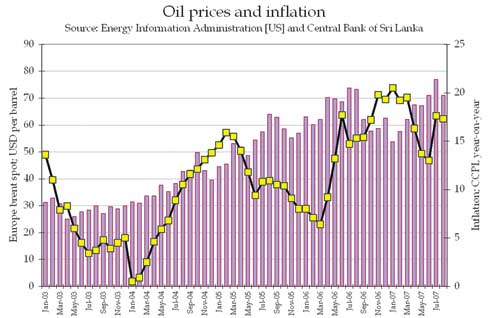
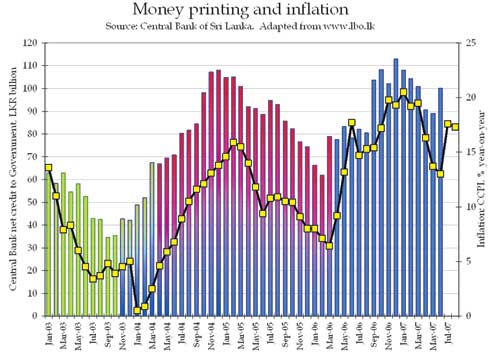
But none of these propositions are true. Iran, Russia and Venezuela three of the largest Oil producers have significantly higher inflation with Iran and Venezuela having close to 20% of inflation, much like Sri Lanka. On the other hand, countries which imports most (or all) of their oil consumption like New Zealand, Japan and Hong Kong are among the countries with lowest inflation.
If that isn't proof enough, this graph from LBO/FT, showing the correlation between money printing and inflation and lack of a correlation between inflation and oil prices should really settle it.

 So what can be done about this?
Sri Lankan economists offer two basic solutions. Both of which has to do with Central Bank Independence.
I'd say all solutions must include firing Ajith Nivard Cabraal from his post as governor of the Central Bank. If you are serious about Central Bank's independence you simply can't have the President's former campaign manager at it's helm.
The two dominant views on institutional reforms to central banking in Sri Lanka are the following:
That's it for the dummies guide. It's been considerably longer than I wanted it to be, but I don't have time for a shorter post, hence the longer one. I Hope this has been helpful, I wish some of our politicians and newspaper editors can have a look at the actual causes of inflation rather than ranting on false, long-debunked theories.
Recommended Links :
For the Background of this post, do read my last one. This post is a result of the many frustrating times I spent listening government politicians, the media, and most other people attributing the causes of inflation to increasing of prices in the world market, in particular spiraling Oil prices.
The fundamental argument of Oil-induced inflation, was summarized in a recent editorial in the Daily Mirror:
Obviously, it is the inexorable skyrocketing of the oil prices in the world market – over which the government has no control - that have the ripple effect on prices of all goods and services. Increased fuel prices have its inevitable impact on electricity prices. The combined effect of price hikes in these two items, fuel and power, impact on all activities ranging from transport to production of various consumer items of food. The inevitable result is phenomenal increase in prices. [link : DailyMirror Editorial, March 21, 2008]The argument is elegantly simple. Oil prices rise. All goods are transported using vehicles, which uses oil, costs go up, so does the prices. It seems so reasonable, that the theory has many adherents. So much so, the Central Bankers in Sri Lanka (who now presides over an embarrassing 20% rate of inflation) help perpetuate this theory.
Now, I'm a great fan of peer education. So in my last post, I promised a sort of a for dummies-by-dummies guide on inflation. Looking back now, that was a silly promise to give. You can probably write a book on the subject. So what follows is a basic debunking of the oil-induced inflation myth, it's not unfortunately a complete dummies guide. But I will try to be as elaborate as possible.
The explanations may come across as being overly simplistic, and grossly inadequate. I accept both these charges. This is after all a dummies guide, and a blog post at that.
That thing called money.
As I discussed in my earlier post, Money has no value all by itself. It's just pieces of paper, what gives it value is that people use money to buy goods and services and because of that, there is a demand and therefore a value attached to it. Money also has a different value, than the number that's printed on it.
For example, like I said in my last post, I have a 20 Rupee Indian Note in my pocket. As you know, there is less acceptance (demand) for Indian rupees here in Sri Lanka, than in India. So the 20 Indian Rupee note I have is significantly less valuable here than it would be in India.
It's also true that what was a Rs.20 now in Sri Lanka is significantly less valuable than a Rs.20 in say, 1970.
First lesson in understanding inflation is perhaps realizing that money has different value attached to it than what's printed on the currency notes and thinking of inflation in terms of value of money rather than the prices of goods.
Do-It-Yourself Inflation experiment.
Literally speaking, printing money is quite simple. In Sri Lanka, it's printed in a factory (which I think is) in Biyagama. The Central Bank of a country has the control of much money is in the system, now that is not so simple to explain, but you'll have to trust me on that one. The point is, when I say "Printing Money" it doesn't mean literally printing notes, it refers to any way the Central Bank use to increase the money supply. Whenever you hear the phrases like , The Central bank has purchased Treasury Bills, the CB has lowered interest rates, it means the Central bank has put more money into to the system by increasing the money in circulation, expanding access to credit, so on. So in short, "money printing" is not just printing notes, it's any form of expansion of "money" in the system. Money, as you know, exists in many forms other than notes (credit, etc.) (updated - HT: ddm)
So, how is any of this relevant to inflation? Well, inflation is created by excessive money printing, which in turn is controlled by the central blank. So to put it bluntly, the Central Bank creates inflation. It's as simple as that.
Now, if you haven't heard of this before, this might come across as something between hallucinatory and laughable. So let me run through this thought-experiment I've developed.
Imagine that you are in grade 7. You and a friend of yours (let's call him Tom) want this really cool key-tag I have. I'm a cheeky little you-know-what, that I will only give it to the highest bidder. You have Rs.80 in your pocket, Tom has Rs.90. I start calling for bids at Rs.40. Both of you really like this key-tag.
The bidding starts: Tom starts biding at 50, You raise it to 60. Tom in turn raises the bid to 70. Now, you are in bit of a soup - you have only 10 Rupees left, but you really need Rs.5 of that to go home. If you don't use that 5 you'll have to walk your way home, and your mom would be very very annoyed. This Rs.5 is really valuable to you right now, so after thinking it over, you decide the to raise your bid to Rs. 75. Leaving Tom with Rs.15, to outbid you. But at this moment, there's a little twist in our tale.
Enter: The counterfeiter. Now (for no real reason, totally randomly) let's call this counterfeiter, Cabraal. Now Cabraal has this really cool laser printer which can print currency notes and he wants to test out some of his newly-printed stuff. So he walks over to you, and takes you to the side and hands you what appears to be two bills of Rs.10 notes, he says he's just helping out and everything is cool.
Suddenly, that Rs.5 you had with you doesn't seem too important anymore. The bidding starts again, Tom raises the bid to 80, you bid at 85. Again Tom retaliates by raising the bid to Rs.90, you raise the bid to Rs.95 and poor old Tom, not having the money to out-bid you, looses out and you get to buy the key-tag at Rs.95.
Think again as to what actually happened. The key-tag which would have sold at possibly Rs.80 (and a maximum of Rs.90 - all the money Tom had) was sold at Rs.95. The price increased simply because more money was injected into the process by counterfeiter Cabraal.
This is kind of what happens in our economy, when The Central Bank prints too much money without an increase in productive activity in the economy, all prices go up. This is inflation. It's a result of too much money chasing too few goods, we would eventually attach a smaller value to money and spend more of it, so prices 'sky rocket'.
In fact, most classical economists explicitly defined inflation as the growth of the money supply rather than the overall increase of prices.
Price of a particular item, like Oil, or Soap can increase (or decrease) due to all sorts of reasons and this may indeed contribute in recording a overall higher (or lower, with all other things being equal) value in the Consumer Price Index (which is used to measure inflation nowadays), but this is not the 'cause' of inflation. In fact general price increases are a result of inflation rather than it's cause.
So Why do they get it so wrong ?
If controlling inflation is so easy, Why do Central Banks like that of Sri Lanka and Zimbabwe get it so horribly wrong? Surely, Governor Cabraal and Co. know basic monetary economics? I certainly hope so. But the reason why certain central banks fail to control inflation is that governments (especially like ours) see printing money as a way to pay for their spending.
When you have a massive government set up like in Sri Lanka (100+ ministers and the obscenely large public sector), with a war, failing state enterprises and all other wasteful spending to finance, you end up having to tax, borrow when that's not enough - print money. This is why inflation is high in Sri Lanka.
But wait, why is this inflation thing so bad?
It might seem obvious, but it's a surprisingly good question. If prices of all things rise, then prices of whatever I sell must also be higher, so what's the big deal with inflation? Are we really worrying over nothing? Well, not exactly.
First of all, Inflation is a tax on everyone who holds money. Either in your wallet or a bank (savings/fixed deposit) account which pays less interest than the rate of inflation (which is the case in Sri Lanka). Every cent that you have in your bank and in your pocket right now is melting away as you read this. If you had Rs.100 in your savings account at 5% annual interest rate, and the annual inflation is 24% (pdf link) your Rs.100 at the end of the year is worth only Rs.81. You are literally being robbed of nearly 20% of your money.
Secondly, Incomes doesn't always keep up with the pace of inflation. So your purchasing power goes down. People with fixed incomes like pensioners are seeing their purchasing power plummet.
Thirdly, what makes free-market capitalism work is it's price system. Prices act as signal to producers, consumers and all actors of the market on what to buy, where to invest and how to allocate resources. High Inflation distorts this price signal (with an injection of money without productive activity) resulting in mal-investment, miss-allocation of resource and generally wrong economic decisions.
Additionally, inflation leads to an arbitrary distribution of wealth. When the Central Bank increases the money supply by say, lowering the interest on credit, those who get their hands on the credit first, generally benefit and those who don't, looses out. (Think of Tom in our thought-experiment)
Finally, high inflation creates uncertainty. If inflation is difficult to predict and volatile (a symptom of high inflation) that discourage productive economic activity. For example, a money lender may be reluctant to lend his money because he cannot predict if the interest he charges would be sufficient in face of volatile inflation.
Hmm, but can't the oil theory be also true?
The theory "Cost-Push" inflation, the idea that inflation is as a result of rising cost of things such as oil, was in fact quite a mainstream idea, about 30 years ago. Before Milton Friedman and others showed that inflation is always and everywhere a monetary phenomenon.
Without going into a theoretical argument on why this is not the case, let's say this hypothesis is true. Oil is the cause of (or the main contributor to) inflation.
What should we see? Surely,
1) All oil producing countries should have relatively low inflation. and,
2) All countries mostly importing their oil should have relatively higher inflation.
But none of these propositions are true. Iran, Russia and Venezuela three of the largest Oil producers have significantly higher inflation with Iran and Venezuela having close to 20% of inflation, much like Sri Lanka. On the other hand, countries which imports most (or all) of their oil consumption like New Zealand, Japan and Hong Kong are among the countries with lowest inflation.
If that isn't proof enough, this graph from LBO/FT, showing the correlation between money printing and inflation and lack of a correlation between inflation and oil prices should really settle it.
 So what can be done about this?
Sri Lankan economists offer two basic solutions. Both of which has to do with Central Bank Independence.
I'd say all solutions must include firing Ajith Nivard Cabraal from his post as governor of the Central Bank. If you are serious about Central Bank's independence you simply can't have the President's former campaign manager at it's helm.
The two dominant views on institutional reforms to central banking in Sri Lanka are the following:
- Bring in inflation-targeting legislation. This involves the parliament passing a law which mandates the Central Bank to stick to a particular level of inflation (say from 1-3%). Countries like New Zealand, Australia, Canada and Great Britain have enacted such legislation and it has proven to be relatively successful. Harsha De Silva, the well-known Sri Lankan economist is an advocate of this type of reform.
- A Currency Board arrangement. This involves pegging the SL rupee against a hard currency such as the US Dollar, which allows Sri Lanka to basically import the pegged currencies' inflation rate, in the case of the USD this would be 4% as opposed to the current 20+% inflation rate. Hong Kong has this type of arrangement with the US Dollar. LBO's Fuss-Budget and international monetary expert, Steve Hanke have recommended Sri Lanka follow a currency board, which we had till 1950 with relatively low inflation.
That's it for the dummies guide. It's been considerably longer than I wanted it to be, but I don't have time for a shorter post, hence the longer one. I Hope this has been helpful, I wish some of our politicians and newspaper editors can have a look at the actual causes of inflation rather than ranting on false, long-debunked theories.
Recommended Links :
- No Escape: Inflation is created in the Central Bank
- Sri Lanka : Slaying the Bogey of Inflation
- Pod Casts : Tyler Cowen on Monetary Policy Competing currencies, Gold Standard, and more. Also, Milton Friedman on Money (Both highly recommended)
Wednesday, March 26, 2008
My Socialist Experiment
When I was growing up, this idea that 'our country was poor' puzzled me. How can we be poor I thought, the government print the money don't they? So how can they have all the money and still be poor? After days of thinking over this, I came to the conclusion that perhaps printing money costs, about the same amount of money that's being printed. That is for example, it costs the value of Rs.10 to print a Ten Rupee note. I remember asking my dad if this was the case, he said no, money is just paper he told me. I Can't remember if I followed up on the question, but I'm pretty sure he did not satisfactorily answer my questions.
This is about the time I invented my own version of socialism (I was really very young, honestly.) Deanist-Socialism was simple. Under my plan, every citizen in the country will receive a fixed amount of money at the end of every month courtesy the government. That way, there's no real need to work and we can live happily ever after.
I can't quite remember what I did with my theory, but finding answers to why oh why governments didn't just print money and distribute lead me to many realizations. First among them - not many people understand 'money'. For a long time, I didn't either.
So in my quest to understand this thing called money better, I began reading by coincidence (now this is much much later) the likes of Friedman, Rothbard, Mises and (eventually) the likes of Mankiw, Cowen and other contemporary practitioners. Having gone through all of this, I feel like I have the basics covered. But seeing media reports, listening to local politicians and even what some of our Central Bankers say, it seems many doesn't even have these basics covered.
So in the near future, (possibly tomorrow, I'm sleepy now) this blog will have Inflation for Dummies by dummies post to dispel some of the myths that's being perpetuated when talking about Cost of Living and particularly inflation in Sri Lanka.
But first, a few more of those realizations..
#2) Wealth is not Money. If it were, my little socialist experiment would have worked, to make it's people more wealthy, all a government has to do was print money and distribute them. Wealth, put it bluntly, is stuff or things we value (some of which could be money) and can be defined as the productive capacity of the economy.
But why doesn't governments do this? why don't they just print the money and distribute? The answer, is to do with the value of money.
#3) Paper-money has no intrinsic value. It's just paper. Turns out dad was right, the kind of money we use is just paper (fiat money). The only reason why you would accept it in exchange for payment for something is because we have the confidence that in the future, some other person would take it to exchange with something we value. If anyone doesn't think they can exchange this paper for something valuable in the future, they would not accept it.
For example, right now, I have with me a 20 Rupee Indian-Note in my purse, signed by a few friends and given to me as a souvenir. In India, this would have bought be breakfast. But here, in Sri Lanka, this would buy me nothing. The Indian rupee has (almost) no value here. (unless at a money-exchanger) The value of money, like any thing else is determined by the forces of it's supply and demand.
Realizing these two things, and the notion of value of money is perhaps the key to understanding inflation.
This is about the time I invented my own version of socialism (I was really very young, honestly.) Deanist-Socialism was simple. Under my plan, every citizen in the country will receive a fixed amount of money at the end of every month courtesy the government. That way, there's no real need to work and we can live happily ever after.
I can't quite remember what I did with my theory, but finding answers to why oh why governments didn't just print money and distribute lead me to many realizations. First among them - not many people understand 'money'. For a long time, I didn't either.
So in my quest to understand this thing called money better, I began reading by coincidence (now this is much much later) the likes of Friedman, Rothbard, Mises and (eventually) the likes of Mankiw, Cowen and other contemporary practitioners. Having gone through all of this, I feel like I have the basics covered. But seeing media reports, listening to local politicians and even what some of our Central Bankers say, it seems many doesn't even have these basics covered.
So in the near future, (possibly tomorrow, I'm sleepy now) this blog will have Inflation for Dummies by dummies post to dispel some of the myths that's being perpetuated when talking about Cost of Living and particularly inflation in Sri Lanka.
But first, a few more of those realizations..
#2) Wealth is not Money. If it were, my little socialist experiment would have worked, to make it's people more wealthy, all a government has to do was print money and distribute them. Wealth, put it bluntly, is stuff or things we value (some of which could be money) and can be defined as the productive capacity of the economy.
But why doesn't governments do this? why don't they just print the money and distribute? The answer, is to do with the value of money.
#3) Paper-money has no intrinsic value. It's just paper. Turns out dad was right, the kind of money we use is just paper (fiat money). The only reason why you would accept it in exchange for payment for something is because we have the confidence that in the future, some other person would take it to exchange with something we value. If anyone doesn't think they can exchange this paper for something valuable in the future, they would not accept it.
For example, right now, I have with me a 20 Rupee Indian-Note in my purse, signed by a few friends and given to me as a souvenir. In India, this would have bought be breakfast. But here, in Sri Lanka, this would buy me nothing. The Indian rupee has (almost) no value here. (unless at a money-exchanger) The value of money, like any thing else is determined by the forces of it's supply and demand.
Realizing these two things, and the notion of value of money is perhaps the key to understanding inflation.
A Google Government
What if Google ran government? Jeff Jarvis has some interesting ideas. Reason Summarizes them here. Google 4 President? hmm..
Do read the post, He's dead serious.
Do read the post, He's dead serious.
Subscribe to:
Posts (Atom)