Showing posts with label Conflict. Show all posts

Sunday, October 12, 2008

Military Bloggers

Via the 50 most busiest blogposts, I stumbled upon The Army of Dude, a U.S. Mil-blogger who was based in Iraq, who also happens to be a good writer

For us mere mortals who don't really know what it's like to run around legitimately shooting people, while some other bastard is trying to blow you to bits, Mil-blogs provide great insight into what really happens in the front lines, which is probably too boring for the movies and too real, too long for the mainstream media. 

The curiosity got the best of me, and I tried to find a Sri Lankan Mil-blogger. Milblogging.com lists one,  The Long Ranger, the blogger I'm pretty sure is not in the front lines (do they have Wi-Fi in Wanni?)  but he seems to be heavily clued nevertheless. I will be a faithful reader.

I also stumbled upon defencewire, supposedly run by a bunch of independent military analysts, which is also kind of good. This is probably as closest Sri Lanka will get to Mil-blogging, unless someone could convince David Blacker to take up a job in Wanni. 

Sunday, September 21, 2008

The upside of the Colombo Visa

Marking the International day of Peace, the Sri Lankan Police decided to launch registration of residents from the north currently staying as 'guests' in Colombo. The new Colombo Visa is complete with details such as purpose of visit, expiry date, etc. Those already having 'visas' will be able to confirm the validity of their documents. But that's not all, according to a report from the Sunday Observer,
Refreshments will be provided for the northern civilians who register themselves today with the police in the Western Province
Realiable sources say however, that the 'refreshments' consisted of bunty toffees. 

Wednesday, July 23, 2008

1983

July usually passes me by without too much notice, beyond the vague worry that there might be a Tiger attack on Colombo, and a few flashbacks to that weekend in 1983. But this time it’s been a bit different. I’ve found myself reliving that day a lot more this year. It isn’t the fact that this is the 25th anniversary of the carnage which most people see as the starting point of our war, though that has been the focus of a lot of attention. What did it was a phone call a couple of weeks ago.

My mobile rang with an unfamiliar number, and an equally unidentifiable male voice asked for me. When I confirmed that it was indeed yours truly, the voice asked whether I was an old boy of Wesley College. I groaned inwardly, and confirmed this too, expecting to be hit by my school’s OBU for a donation or offer of membership of some committee or whatever. However, it wasn’t any of these things, and the next question blew me away.

“My name is Cedric,” he said, “do you remember me?”

And after twenty-five years, I did.[..]
That's David Blacker. Read the whole thing. It's simply the best blog post on the '83 riots, ever.

Wednesday, June 11, 2008

Will there be a youth uprising?

A friend of mine commenting on my post about youth participation on the BB blog, contests my view that economic liberalization in Sri Lanka has made youth uprisings unlikely. She writes,
Economic Liberalization still remains, sadly, the dominion of cities & certain strata of society within those cities.

So the state is PRETTY MUCH the only opportunity for most young people, especially on the road to becoming young people where most of the education depends on the government. (Think free education policies, no teachers for English & Math etc… ;)

While it may not be the exclusive domain of the state, the state is definitely majority stake holder, unless & until these economic liberalizations you are talking about trickle down to the majority living without it! (taking my earlier example of education, you have to give them an opportunity that doesn’t cost too much to opt for private education, if the country can’t find enough English teachers for state schools!)

Money is the motivator, but money needs to go to everybody, not be hoarded by a few!

So true, young people are the present, agreed! But where is the present going to get them without a state that can back the initiative? Stopping youth uprisings is going to be quite hard in this context! [link]
My reply to Nipuni can be read on the same comment thread, but I want to expand on it here.

I agree that fruits of economic liberalization, the resulting growth has been largely concentrated in the Western Province and other urban places. In fact, earlier I've suggested quoting Shanta Devrajan, (World Bank chief econ geek) that the reason for this has been thattrade liberalization and deregulation which started in 1970s has benefited the western province who have been able to adjust with greater reliance on services and manufacturing industries. There haven't been any significant reforms, for example, in agriculture, where majority of the rural population depends on. This means that rural population is more dependent on government than others in terms of price supports, subsidies, and owing restrictive land regulations, etc which makes them enslaved to that in agriculture-based livelihoods (a grave mistake in my book, but that's another post)

I agree with her that education reform too has not come about and this is a place again, where rural youth in particular are made to depend on governments. I've long been an advocate of abolishing this fallacy called free education.

So as I mention in my reply to her, If Nipuni were to say that the greatest threat of a youth uprising is from lack of economic liberalization (which is partially related to lack of decentralization of political power, but economics matter more) I'd agree.

In fact, I think that the primal causes for both the Marxist insurgency of the JVP, and the rise of Tamil militancy which signaled the beginning of the 'ethnic conflict' (both examples of youth uprisings, so to speak) are essentially the same.

Both movement looked at the mainstream and saw no opportunities for them. One, the JVP, saw it as a class conflict, the rich dirty elites denying opportunity the rural mases. Whereas the Tamil militancy (including the LTTE, which was among many small militant groups at the time) saw it as the Sinhalese majority denying the Tamils opportunity, and therefore the conflict manifested itself in ethnic terms. The latter conclusion had more currency due to the discriminatory language policies practiced by governments of the day.

Now, at the time when the momentum for these violent movements was being built, Sri Lanka was nothing like a market-economy. The State was involved in almost everything. It was in fact the dominant employer. So if I was a young person in the early 70s, I can only look to the state to bring me prosperity, increase my quality of life, which every human being strives for. When those opportunities are denied to a section of people who can identify some commonality with others who suffer the same fate (i.e. rural youth in the case of the JVP, Tamilness in the case of the LTTE-types) it's not a mystery to me why they resorted to violence against this state and the status quo which they believed wasn't structured to bring about prosperity and justice for them.

Lot of other dynamics were in play of course, but this to me was one of the prime motivating factors. My contention is, that this is no longer the case.

Thanks to liberalization we have seen, with varying disparity, poverty rates reduced, incomes rise and private sector rising to be the dominant employer while the state has become less and less important in all aspects of life including development in general.

There is an enormous amount of internal migration that's taking place, which in my opinion might partially explain the disparity one sees of poverty rate aggregates outside the western province, since migrants tend to be young and the most educated of those areas, and therefore the highest income earners had they remained there.

So yes, I think that youth uprising, especially violent ones like we saw in the past, would be extremely unlikely. Because young people today don't suffer from the same lack of opportunities, or is at the mercy of the state in trying to bring them prosperity. Not many may explicitly think in those terms, but that's what's largely being happening in the country and indeed, around the world.

In fact I honestly believe that If the LTTE were to disappear today, there wouldn't be another insurgency owing to the facts I outlined above despite there being ethnic biases in the system, especially if the south learns to moderate it's own nationalist nutjobs. Unfortunately I don't think a a complete annihilation of the LTTE is possible without a huge loss of life, and short of something close to a genocide.

Monday, May 19, 2008

Religious-Conflict ignorance, again!

Last time, it was Obama's ignorance which became abundantly clear when he commented that Sri Lanka has a religious conflict. Today, it's Newsweek's turn. In an article titled "War is the answer" The newsweek comments,
In addition to being an ethnic conflict, the Sri Lankan civil war is a religious one: most Sinhalese are Buddhist, while most Tamils are Hindu. [link]
Obviously Obama reads the Newsweek. Heh. But seriously, let's rest it. Sri Lankan conflict is many things, what it's not is a religious conflict. The fact that most Sinhalese are Buddhist and most Tamils are Hindu (and all Mulims are well, muslims) doesn't mean that the conflict is drawn along those lines. That's like saying that in a war with say, the Americans and Japanese was a conflict between short people and tall people.

Other than that, the article is well worth a read.

Friday, April 27, 2007

Youth, Culture and Globalization

An increasingly globalized, volatile and a growth-oriented world present its citizens numerous challenges – be it in economic, social, environmental and indeed cultural spheres.

As the global economy steams ahead in full speed, geographical borders are becoming less and less significant as people move around, migrating into cities and countries in search of better opportunities and better lives.

Business corporations in both the East and the West are interchanging knowledge and capital in a mutually beneficial exercise. To succeed in this increasingly border-less world one needs to go beyond the familiar and the uniform and embrace the unfamiliar and the diverse, one must tolerate and accept different customs, behaviors, languages, attitudes and values. In other words, one must embrace multiculturalism.

Multiculturalism, however, isn’t simply just good business, but rather something that contributes a great deal in transforming modern day conflicts in the world and indeed here, in Sri Lanka. Roots of most conflicts or at least lack of progress in resolving them, has a lot to do with lack of understanding and lack of space for a different cultures and identities, which leads to marginalization and discontent which sometimes results in violent aggression and cycles of hatred. It is clear then, that multiculturalism is no longer simply a nicety but rather, a dire necessity in the times we live in.

Read the rest of the post in the BB Blog

Monday, January 08, 2007

Bus Bombs

I guess we are back where we started, even worse off. The LTTE have abandoned their targeted attacks and moved on to civilian killing mode. Perhaps this is because of their military set backs, or because their ‘targeted’ killings have miserably failed in recent times, perhaps it’s a case of GoSL and the so called International Community has simply run out of ‘carrots’ to tame the tigers. LTTE is already a banned organization in many countries of influence and they don’t have a whole lot to loose by doing basically anything.

There can be no justification for these things, there’s no doubt that the current administration has a poor human rights record, and the situation in the NE is unspeakably bad. But to say this was a reprisal attack on behalf of the Vahari Tamils is a bloody joke. LTTE uses the Vahari civilians to provoke attacks from the GoSL for International propaganda, and probably great pictures to extort diaspora cash.

Due to the mental instability of prabhakarn and the extensive intake of Viagra by Mahinda the situation in the country is a bit fucked up. Getting on a bus in Colombo is now that much more dangerous, I take comfort in the fact that statistically I still have a better chance of getting run over by some drunk IOM chief driver rather than getting blown up.

The ID-checking on buses was intensified yesterday; they check whether you are Sinhalese. I am, so it’s all good. To be honest though, they check whether you are from NE and if you’re Tamil, then you got to explain what the fuck you are doing here, for how long, and what your father does for a living. Some Army buggers are not disrespectful, they just do their job. Others try to mock; Police seems to be worse in this department. Of course the law-abiding Tamils are supposed to understand, some of them seem to, but if I was subjected to the same treatment, I’d be pretty pissed, I know they are too. It tends to be a vicious circle.

The great tragedy in all this is that the government doesn’t seem to have a coherent strategy to bring about progress in the resolution of this conflict, Sarath Fonseka and the Mihin-government seems to think they can win this war, and ‘liberate’ first the east and then the rest of the country. I hope for the sake of everyone, that their optimism is based on facts on the ground rather than advice of venerable war-monks and the red-clan.

I, as always have my doubts.

Sunday, December 03, 2006

To Delhi and back


I’ve been back for more than a month, but had this half-done blog post lying around, so I thought I’ll just blog it anyway, I’ve let these little things go without really penning keying my thoughts on them, it’s a worthwhile exercise to do, for my own recollection more than anything else.

If I find time, I might dwell on some of those past experiences, but that’s just a big ‘if’, ‘cos despite having this blog for about a year now, I’ve never really got in the habit of blogging. Which might actually be a good thing, but I’ve always had plenty of things to say, and not nearly as many people to listen to. So perhaps I would blog more.

Anyway..

The reason for the visit was a Beyond Borders Camp, perhaps the last major gathering of BB members before we wind up next year.

Delhi

The UL flight we were supposed to be on, was Usually Late taking off from Katunayake and as such, our arrival in New Delhi was somewhat delayed. The Delhi Airport was all right, without being really great; you could probably rate it alongside the BIA.

Once the annoying paperwork was done, (btw, Airport procedures, worldwide - are crap. I just can’t understand why I have to fill in the same info a million times, within the same trip– it’s the 21st century for haven’s sake) we were greeted first by our chauffeurs then by a bald headed man, in a Ghandi-like suit carrying a fair sized rock who in no kind words asked us to bugger off to where ever we came from. Apparently there are some, ahem.. ‘Nationalist elements’ roaming about the airport. I found the whole thing funny, but a few of my female companions were a bit shaken. Obviously this man was a bit mentally handicapped (perhaps like most nationalists).

Our destination was about a forty minute drive from the airport. Delhi certainly has its own flavor, but bits of it reminded me back home, most of it is a mix between pettah and Flower road. Sometimes you’d see boutiques, sometimes gardens. The cars on the road were mostly Indian, Tuk-tuks are painted green and yellow, you could hardly see a Mercedes or a BMW, but they tell me it’s more common than it used to be. Cable TV means most of the Indian brands and even products, are familiar. I could even hum the Airtel tune if I wanted to. The roads though, are invariably better than back home.
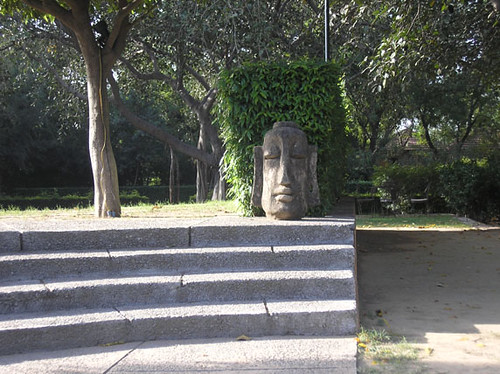
The Sanskiriti Kendra, the location of our residential camp was situated at the very outskirts of Delhi, the Kendra a very calm sort of place, a sanctuary for artists and the likes, wonderfully landscaped with cottages, trees and ponds. The place serves 100% vegetarian food, now this was an experience I’m going to remember. Thankfully though the food was good, and I liked the change.

Food-aside, I was looking forward to meeting the BBites. Some of whom I’ve met before. Beyond Borders worldwide is a one big family of sorts, I’ve never met a bunch of people who are as vibrant and accepting as these ones. Sadly, BB Bangladesh, and Pakistan were not in attendance for the camp. This was pretty much a Delhi-Mumbai-Colombo affair.

The Sessions

Beyond Borders, as a project under the British council was initiated under the themes of Identity, Diversity and Active Global Citizenship. Abstract nature of these themes, means there’s room for much exploration within these concepts, and the sessions at the camp dealt with these concepts, some times in an abstract sense and mostly in their practical manifestations. Some of the sessions were on topics such as secularism, social entrepreneurship, public policy, gender stereotypes, media for social change, faith, and many more. A thorough treatment of all these would mean a kind of a report on this blog, something I’m not prepared to do. Therefore I would touch on a few sessions I really liked, and perhaps blog about the rest in more detail later.

I most enjoyed the session titled Public Policy, conducted by Dr. Parth J Shah from the Centre for Civil Society, a leading think tank and an advocacy group based in Delhi. Part of the workshop involved coming up with policy solutions to common problems. Our subgroup focused on the problems of the Indian three wheeler (or auto-rickshaws as they call it) industry, I was ecstatic since I was finally given a chance to put my tuk-tuk observations to the test. Sri Lankan three-wheeler industry is a shining example of the how industries without regulation can prosper, compared to the Indian scenario, where the industry faces heavy regulation, which serves neither the drivers nor the consumers.

Dr. Shah has is the founder and president of CCS is an organization which promotes freedom, both in people and in markets. I was truly inspired by the work of CCS and Dr. Shah, and the amount of minds their advocacy can change. It made a believer out of me, change truly is possible. I only wish they could do some of their seminars in Colombo.

Another wonderful person I met is Mukul Kesavan, a professor of history from the Jamia Millia Islamia (National Islamic University), in New Delhi who led a session on ‘Secularism, Religion and Conflict’. This was one of the most thought provoking discussions I’ve had for along time, as well as being a more than a relevant topic to the times we live in.

The discussion touched on conflicts around the world from religious to ethnic, we discussed at length about religious secularism around the world, from the form of secularism practiced in India, to the separation of church and the state in the US to the French model of secularism, to various comments made by Inzamam, Dean Jones, Jack Straw and of course the Pope. The discussion also focused on the types of nationalisms, based on linguistic, ethnic and religious identities and the formation of nation states purely on the said identities, he discussed at length about the Indian partition and the creation of Pakistan, to a fruitful discussion on the Jewish state of Israel, as well as the conflict in the Middle East. In particular he kept referencing with ease and at length to the Sri Lankan conflict, and the Tamil demand for self-determination.

This was refreshing as I’ve never met a foreigner having such deep understanding about the Sri Lankan conflict. Later over lunch in a conversation which touched on Kumar Sangakara as well as Mangustine, Mukul explained that ‘Sri Lanka’ is in fact, a quite a frequent topic in Indian academic circles.

There were few more interesting people and sessions worth extending this already extended post. One was a bloke called Arijit Roy of Jagran who led the session on Media for Social Change, blogging was mentioned in passing, but it would be stretching the imagination a little to suggest that blogs can be considered a serious tool for social change. Surely it would come along, but certainly its not there yet, not in the developing world at least.

Arijit’s choice of media was the mime theatre, where Arijit’s organization, - Jagran - uses it to explore difficult issues such as rape, sexual health and HIV. It was encouraging to note that Jagaran work with the Delhi police, who have taken a keen interest in the theatre as a medium to communicate with the general public, especially in cases of rape (sometimes by family, and extended family) which rarely gets reported.

We ended the sessions with a wonderfully colorful BB alumni night, where all of the BBites from past to the present was invited BB, I even had to dress up in the Mahinda Chintana outfit…ahh.. the things I do for my country..

Delhi Shopping

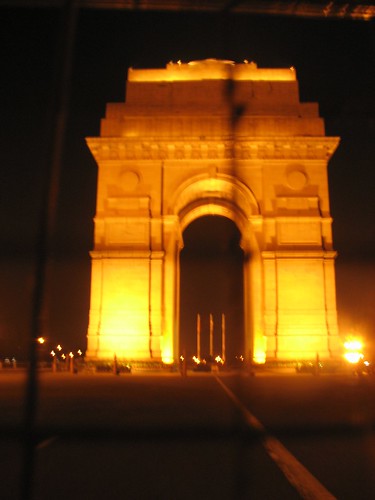
After winding up in Sanskirti Kendra we returned back to central Delhi, where we had a day and a little more for whatever we want to do. We haven’t done a whole lot of sight seeing except, a evening visitto the India gate. But my companions wanted to just shop.

Shopping in Delhi (like most places in the world) is more of a ‘woman-thing’, there’s the posh kind of malls you’d expect from a city and then there are like literally hundreds of boutique kind of shops which sells anything from pajamas to perfume and everything in between. In addition there are dozens of street-hawkers trying to sell stuff like socks, handkerchiefs and even books. Most buggers were annoying, they just don’t go away, so much so, that I felt like buying some of the stuff just to send them away. Stuff they have, of course are dirt cheap, but obviously inferior in quality. There are some useful ‘hawkers’ though, I managed to find a cheap copy of seven habits by Covey. Something I always wanted to pick up. All in all, Delhi’s probably not exactly my kinda place for shopping, there’s not a lot of electronic stuff, and the malls are kind of spread out. But it’s all right, especially if your after sarees, jewellery, cotton and traditional sort of stuff; I was obviously not, so while all the women were having a field day at these boutiques, and Saree shops I headed off to Ansal Plaza, the only sort of proper mall I had time to drop into, the mall is home to most international brands, like Lacoste and Marks & Spencer. There are also some music stores and watches and whatnots you’d also get the food outlets, with all the usual suspects and stuff like Subway, which you don’t get here.

All good things, as they say, have to come to an end. When all the good byes, and the hugs were done we had to fly back home. It was a wonderful experience; I’d never thought I’d actually miss India. Most of all I miss the Indians, and the sort of kick you’d get from being with like-spirited people. One moment you’re just singing some Hindi song, and the next you could be having a passionate debate on religion or language homogeneity. Good times.

Deane.