


 Yet I'm sure come next year, there will still be many who believe they can get something from the government for "free". More on the budget, later.
Showing posts with label public policy. Show all posts
Showing posts with label public policy. Show all posts
Saturday, November 08, 2008
Budget-Econ 101
Friday's Daily Mirror Cartoon captures the economics of government budget proposals with surprising accuracy:
 Yet I'm sure come next year, there will still be many who believe they can get something from the government for "free". More on the budget, later.
Yet I'm sure come next year, there will still be many who believe they can get something from the government for "free". More on the budget, later.

Tuesday, October 21, 2008
Politically Incorrect guide to politics
Wednesday, October 15, 2008
Good news on Reform
This is excellent news. From LBO,
Sri Lana's government plans to deregulate railway freight rates and invite private sector participation to increase movement of goods by rail, according to a new transport policy unveiled recently."Railway freight tariffs will be de-regulated and the Sri Lanka Railways will be permitted to determine tariffs competitively to attract freight transport from road to rail," the draft policy statement said.The move is part of a series of measures to revive the heavily loss-making state railway service and shift movement of people and goods from road to rail.The government expects to increase the share of passengers using rail to 10 percent by 2016 from six percent now, and freight to five percent from one percent now."Sri Lanka Railways will collaborate with the private sector towards achieving this objective," the policy put out by the transport ministry said.
Much more at the LBO article. This is genuinely a pleasent surprise. Now if only we can have the same policy for passenger rail and buses, we would have more or less fixed transport.
Monday, October 13, 2008
Global air traffic
This is just very cool. It' a simulation of air traffic worldwide, over a 24-hour period.
Just looking at that, can't help but feel that Sri Lanka would have been such a logical place for another heavy traffic point. But no..
Saturday, October 11, 2008
Silly statements
Two silly statements I read today,
Let's forget that 2. for the moment. Why does His Excellency think that the govt. should not sell any state owned land?
President Mahinda Rajapaksa adding that the future generations should be able to enjoy the benefits of these assets as we enjoy them today as a result of a great sacrific of the patriotic leaders of this nation. [link]I see. Mr.President would not sell, for example, Water's Edge, because he'd like to preserve it for the future generations. Because Water's Edge you see, is "a result of the great sacrifice of the patriotic leaders".
Actually, I don't see. In fact, that strikes me as a whole lot of nonsense. The state owns 85% of the lands in this country. That's a lot of dead capital. A good proportion of this can be used for productive development. Instead it's locked away, apparently preserved for future generations.
Ironically, most people will find those two statements appealing. I think it's derived from a fundamental misconception about the nature government, this romantic, yet nonsensical idea that "government is us". So state enterprises, state-land is seen as somehow being collectively owned by "us". Hence the phrases like "selling" to describe the process of privatization.
A lot of bad public policy can be averted if many of 'us' come to realize one simple thing : Government is not 'us', it's just government.
Friday, October 10, 2008
Where your taxes go (where they actually think it will go edition)
This is how the government intends on spending your taxes. At least partly how it will be spent. We can't afford the whole thing so the rest will be financed by debt and aid (yes, yes, eventually paid by you).
The largest expenditure is for defence, the largest ever allocation of Rs. 177 billion, about 18% of the total expenditure. The budget 2009 from daily mirror.

More on where your taxes are here and here. For a related post see, the biggest big government.

(HT: on Where Your Taxes Go concept, Amit Varma)
Sunday, September 28, 2008
Sri Lanka's brain drain -- Redux
Last month I tried to estimate how much of Sri Lankan youth go overseas for studies. I found this Island article which puts a number on that estimation:
Around 7,000 students go abroad for higher education annually but the Higher Education Ministry does not keep records or register students going abroad for higher studies privately, Ministry Secretary Mrs. P. B. G. Abeyratne said.7,000 seems like a conservative estimate, especially if the number of student visas issued are around 20,000. But even 7,000 per year is a big number, given that the state Universities can accommodate only around 16,000. There is absolutely no case for free higher education, more on that soon.
However, the Controller of Immigration and Emigration P. B. Abeykoon said there may be more than 7,000 who go abroad annually for studies but around 20,000 passports are issued purportedly for those leaving the country for higher education.
Higher Education Ministry sources attributed this large exodus of students to the inability of universities to admit all those who qualify at the AL examination. Parents who could afford to send their children abroad do so, source added. "This is a feature of the global scenario of this era."
Though university education is free, it can accommodate only a limited number of students. Currently, there are only 16 state universities and only about 16,000 students are admitted. [link]
Thursday, September 25, 2008
I, Society and Public Policy
Centre for Civil Society is organizing it's annual seminars on public policy, now called "I, Society and Public Policy" renamed from "Liberty & Society Seminars" starting in October in Delhi, Cochin, Bangalore and Pune. If you are between 18 - 25 with an interest in Public Policy, do apply before the time runs out.
Thursday, September 11, 2008
For a Colombo Reform Process
Finally, there's some good news on the reform front :
Sri Lanka does especially badly with regards to paying taxes with a total of 62 payments and a total tax rate of 63.7%, which frankly is insane. This ridiculously high number of interactions with the bureaucracy is one of the reasons for bribes and corruption in the public sector. Maldives, as LBO notes, only has to make 1 payment as opposed to our 62.
We also door horribly poorly when it comes to property registration, dealing with construction permits and enforcing contracts. Labour laws are inflexible as well, something that will really hurt Sri Lanka in a low-tariff, post-GSP world.
That said, it's great that we have done some reform in the past year. The type of reforms undertaken are just mainly improving legal framework rather than getting into more politically-explosive issues, which is, at least for the moment, a decent strategy. Another thing we can probably improve is trade facilitation, which will have enormous benefits without being a political hot-button issue.
I have been thinking for some time about, what I decided to call the Colombo Reform Process. The idea is kind of modeled similar to the Copenhagen Consensus. The idea is to bring together, perhaps bi-annually, bunch of experts (mostly economists) and get them to come up with the top 10 (or 20) reforms which Sri Lanka could peform and rank it according to effectiveness and political feasibility and produce a report. I think that could really speed things up.
But this is not something that I'm in a position to do at the moment, so here's a shoutout to all the policy people at IPS, Chamber of Commerce, and the likes -- try and do this!. It might just work.
Sri Lanka has been rated the top South Asian reformer in an annual business regulation study by the World Bank group, with a new company law and credit information improvements boosting its scores. [link]That's according to the World Bank's Doing Business Report 2009, an annual study which analyzes and ranks countries on easy it is to do business in countries are. The bad news of course, is there's still a long way to go. Although Sri Lanka is the top regional reformer for the last year, it still languishes in 102nd position globally and behind regional countries like Pakistan (rank 77) and Maldives (rank 69), south-asia's richest and most business friendly economy. India is further behind in 122nd position, but I think the study ignores the impact of SEZs and other regional disparities in terms of policy.
Sri Lanka does especially badly with regards to paying taxes with a total of 62 payments and a total tax rate of 63.7%, which frankly is insane. This ridiculously high number of interactions with the bureaucracy is one of the reasons for bribes and corruption in the public sector. Maldives, as LBO notes, only has to make 1 payment as opposed to our 62.
We also door horribly poorly when it comes to property registration, dealing with construction permits and enforcing contracts. Labour laws are inflexible as well, something that will really hurt Sri Lanka in a low-tariff, post-GSP world.
That said, it's great that we have done some reform in the past year. The type of reforms undertaken are just mainly improving legal framework rather than getting into more politically-explosive issues, which is, at least for the moment, a decent strategy. Another thing we can probably improve is trade facilitation, which will have enormous benefits without being a political hot-button issue.
I have been thinking for some time about, what I decided to call the Colombo Reform Process. The idea is kind of modeled similar to the Copenhagen Consensus. The idea is to bring together, perhaps bi-annually, bunch of experts (mostly economists) and get them to come up with the top 10 (or 20) reforms which Sri Lanka could peform and rank it according to effectiveness and political feasibility and produce a report. I think that could really speed things up.
But this is not something that I'm in a position to do at the moment, so here's a shoutout to all the policy people at IPS, Chamber of Commerce, and the likes -- try and do this!. It might just work.
Tuesday, September 02, 2008
The Brain Drain
Last Wednesday, Anila Banradanike's column for FT focused on Sri Lanka's 'Brain Drain' particularly among urban youth. She complains, rightly, that there are no credible statistics available on how many people go abroad for studies. I agree, all I can say is it's quite a large and growing number. Why do I say this? Let me offer a small anecdote.
After completing up to my O-levels at St.Peter's, a semi-government school in Colombo, I transferred to a so called 'international school' to finish my A-levels. For you non-Sri Lankans, that's a type of schools which offer (mostly) British curriculum of study. My batch consisted of about 70-80 people. Thanks to the weird subject combination I took -- Physics, Economics, Math and Computing -- I took a class with everyone in the batch and now about three years later, I can count only about 6 people in the country. I may have lost touch with a few, but I am quite positive the number remaining in Sri Lanka is less than 15. The rest of them are studying in places like Australia, U.K, U.S., Malaysia and increasingly in China, India and a few medical students in places like Bangladesh and Belarus.
Let's do the math, 15 out of 80 students is roughly about 20% of the batch in my school, that means in general roughly about 80% of most decent international schools (some more, some less) go overseas annually. Add to this the contribution from local schools, we have a significant proportion of some Sri Lanka's best talent going overseas mostly because, higher ed. in this country sucks.
If anyone's serious about stopping (or at least slowing down) the brain drain, they should really think about reforming higher education.
After completing up to my O-levels at St.Peter's, a semi-government school in Colombo, I transferred to a so called 'international school' to finish my A-levels. For you non-Sri Lankans, that's a type of schools which offer (mostly) British curriculum of study. My batch consisted of about 70-80 people. Thanks to the weird subject combination I took -- Physics, Economics, Math and Computing -- I took a class with everyone in the batch and now about three years later, I can count only about 6 people in the country. I may have lost touch with a few, but I am quite positive the number remaining in Sri Lanka is less than 15. The rest of them are studying in places like Australia, U.K, U.S., Malaysia and increasingly in China, India and a few medical students in places like Bangladesh and Belarus.
Let's do the math, 15 out of 80 students is roughly about 20% of the batch in my school, that means in general roughly about 80% of most decent international schools (some more, some less) go overseas annually. Add to this the contribution from local schools, we have a significant proportion of some Sri Lanka's best talent going overseas mostly because, higher ed. in this country sucks.
If anyone's serious about stopping (or at least slowing down) the brain drain, they should really think about reforming higher education.
Thursday, July 17, 2008
(un)free enterprise
Recently, Sri Lanka's government decided to impose severe restrictions on the use of mobile phones citing 'Security reasons'. Anything fly in Sri Lanka these days, if you say 'national security'.
The regulation dictates that all Sri Lankans must carry a certificate confirming they own the phone connection. The new regulations will also stop people from sharing mobile phones, and restrict mobility of CDMA phones which most lower-income groups use in both businesses and at home, the law requires users to use them only at a specific address. Much more at Lirneasia.
But even with such idiotic regulations, entrepreneurship reigns. One Sri Lankan mobile operator, Tigo, has already adjusted to the regulations by issuing a plastic ownership cards. The company aims to package the card with other perks for the users.
It's great to see spirit of enterprise alive and well, despite the government. But that's no justification for stupid regulations.
The regulation dictates that all Sri Lankans must carry a certificate confirming they own the phone connection. The new regulations will also stop people from sharing mobile phones, and restrict mobility of CDMA phones which most lower-income groups use in both businesses and at home, the law requires users to use them only at a specific address. Much more at Lirneasia.
But even with such idiotic regulations, entrepreneurship reigns. One Sri Lankan mobile operator, Tigo, has already adjusted to the regulations by issuing a plastic ownership cards. The company aims to package the card with other perks for the users.
It's great to see spirit of enterprise alive and well, despite the government. But that's no justification for stupid regulations.
Monday, July 14, 2008
What about legalizing hard drugs?
Prompted by my earlier post on legalizing marijuana, Jack Point thinks that a good way of tackling the problem of hard drugs, such as heroin is for government to give it away for free for addicts and encourage them to voluntary enroll themselves to treatment. I think that has some sense to it and better than our current policy.
I'm generally skeptical of government programs, once it's passed through the parliament and other bureaucratic processes, it wouldn't be nearly as optimal as one would want to design it. Given budgetary constraints, poor service delivery in places like Sri Lanka, there would inevitably be restrictions on accessible quantity nor would most taxpayers be too thrilled for the fact that they are financing someone else's doping habits. I think the market would do a better job in the goals Jack Point outlines, except in extreme cases where the addiction is uncontrollable.
None of this, including marijuana legalization, will happen anytime soon. At least in places like Sri Lanka where we (or at least the politicians and other intellectual types) like to pretend some sort of morally superior to the west. Even in the U.S. where marijuana usage is rampant -- Barack Obama of all people admitted he "inhaled frequently" both cocaine and marijuana. He even put it in his book. But once the changes comes in the west, not just in terms of attitude, but particularly in marijuana policy and eventually hard drugs, I think you will see changes starting happen here as well.
On the question of whether or not this will significantly reduce crime, I recall this interesting exchange between Tyler Cowen and Megan McArdle.
I'm generally skeptical of government programs, once it's passed through the parliament and other bureaucratic processes, it wouldn't be nearly as optimal as one would want to design it. Given budgetary constraints, poor service delivery in places like Sri Lanka, there would inevitably be restrictions on accessible quantity nor would most taxpayers be too thrilled for the fact that they are financing someone else's doping habits. I think the market would do a better job in the goals Jack Point outlines, except in extreme cases where the addiction is uncontrollable.
None of this, including marijuana legalization, will happen anytime soon. At least in places like Sri Lanka where we (or at least the politicians and other intellectual types) like to pretend some sort of morally superior to the west. Even in the U.S. where marijuana usage is rampant -- Barack Obama of all people admitted he "inhaled frequently" both cocaine and marijuana. He even put it in his book. But once the changes comes in the west, not just in terms of attitude, but particularly in marijuana policy and eventually hard drugs, I think you will see changes starting happen here as well.
On the question of whether or not this will significantly reduce crime, I recall this interesting exchange between Tyler Cowen and Megan McArdle.
Saturday, July 12, 2008
Legalizing Marijuana in Sri Lanka
I was recently reminded by a friend that Sri Lanka actually does have legal access medical Marijuana (Ganja). The practitioners of traditional Ayurvedic medicine are allowed to carry 1kg (figure unconfirmed) amount of Ganja to be used for medicinal purposes. Unfortunately, the government doesn't extend the same courtesy to medical doctors in the western tradition.
I am told the veda mahathays (ayurvedic doctors) have access to the best quality stuff, which they often sell for other um, recreational purposes. Don't ask me why, but I believe him.
A dilemma I often face is whether advocating for decriminalization or legalization of Marijuana in a place like Sri Lanka is actually worth it.
Obviously, there is very little case to ban the substance in the first place. Not only because Ganja has medicinal properties, but the risk of addiction is comparatively low, there's also no evidence that it's any more harmful than tobacco. Most arguments for prohibition is based on some notion that this is 'risky'. Well yes it is risky, so is tobacco, alcohol or for that matter, living in Colombo. Should most motorsports, or professions which has risk in it's job description -- policing, security guards, army personnel -- also be banned? I think not. What we have is a social stigma against using stuff like Marijuana. There is almost no objective case.
But now that it's illegal, does it make sense to advocate for legalization? From a purely consequentionalist standpoint, I think the answer leans on being 'No'.
I haven't been to a party in Colombo with late-teens or twentysomethings which didn't have someone lighting up Ganja. Even if you are caught using or carrying moderate amounts of ganja, you can pay the market-price for the bribe in most occasions (unless you really F up). Same goes for most other victimless crimes like prostitution. If you want the service, you can get it. When enforcement is weak like we have in Sri Lanka, does really it make sense to fire up the debate and actually make this an issue? from a user-perspective, I think the answer is No.
However, critical to the overall consequentionalist argument for the status quo is whether keeping marijuana illegal has other consequences, like providing revenue streams and upkeep for criminal gangs. Economics of prohibition is simple. If you ban something that's in high demand, it simply goes underground. Think prostitution, think kassipu (illicit liquor), think almost anything that has wide appeal, and is banned. These things don't disappear, they just fall into the black-market operated by goons and criminals.
People familiar with the Indian scene might remember the case of Scarlett Keeling, the 15-year-old British girl who was raped and murdered in Goa by a few drug dealers. Soon after the incident, I remember Jug Suraiya's article in TOI which hinted that perhaps Scarlett would have survived, had drugs in Goa was legal. In the article (I recommend a read) he presented the following statistics:
If we require a debate at all on this issue, it's this one we should be having. But what are the chances of that happening?
I am told the veda mahathays (ayurvedic doctors) have access to the best quality stuff, which they often sell for other um, recreational purposes. Don't ask me why, but I believe him.
A dilemma I often face is whether advocating for decriminalization or legalization of Marijuana in a place like Sri Lanka is actually worth it.
Obviously, there is very little case to ban the substance in the first place. Not only because Ganja has medicinal properties, but the risk of addiction is comparatively low, there's also no evidence that it's any more harmful than tobacco. Most arguments for prohibition is based on some notion that this is 'risky'. Well yes it is risky, so is tobacco, alcohol or for that matter, living in Colombo. Should most motorsports, or professions which has risk in it's job description -- policing, security guards, army personnel -- also be banned? I think not. What we have is a social stigma against using stuff like Marijuana. There is almost no objective case.
But now that it's illegal, does it make sense to advocate for legalization? From a purely consequentionalist standpoint, I think the answer leans on being 'No'.
I haven't been to a party in Colombo with late-teens or twentysomethings which didn't have someone lighting up Ganja. Even if you are caught using or carrying moderate amounts of ganja, you can pay the market-price for the bribe in most occasions (unless you really F up). Same goes for most other victimless crimes like prostitution. If you want the service, you can get it. When enforcement is weak like we have in Sri Lanka, does really it make sense to fire up the debate and actually make this an issue? from a user-perspective, I think the answer is No.
However, critical to the overall consequentionalist argument for the status quo is whether keeping marijuana illegal has other consequences, like providing revenue streams and upkeep for criminal gangs. Economics of prohibition is simple. If you ban something that's in high demand, it simply goes underground. Think prostitution, think kassipu (illicit liquor), think almost anything that has wide appeal, and is banned. These things don't disappear, they just fall into the black-market operated by goons and criminals.
People familiar with the Indian scene might remember the case of Scarlett Keeling, the 15-year-old British girl who was raped and murdered in Goa by a few drug dealers. Soon after the incident, I remember Jug Suraiya's article in TOI which hinted that perhaps Scarlett would have survived, had drugs in Goa was legal. In the article (I recommend a read) he presented the following statistics:
UN has estimated the international drug trade at $400 billion a year, a sum larger than the US defense budget and which constitutes 8 per cent of all global trade (textiles account for 7.5 per cent and automobiles for 5.3 per cent). [link]Most of this trade is not Marijuana, it's probably other drugs. The critical question is how much exactly does Marijuana contributes to crime. This is difficult to answer, since marijuana dealers don't exactly report their accounts to the Inland Revenue Department. But for what it's worth, legalizing may be a good way of cutting down revenue potential for criminals (including perhaps the LTTE) and getting entrepreneurs in to the business of ganja.
If we require a debate at all on this issue, it's this one we should be having. But what are the chances of that happening?
Saturday, June 28, 2008
Drew Carey on Free Trade
Drew Carey in another installment of his series at Reason.tv takes a swing at the U.S. protectionists' (Obama-types) fear mongering over NAFTA.
Something that's rarely understood by protectionist all over the world is that the biggest source of "job losses" is technology, not free trade agreements. The emergence of Digital Cameras have dented the guys who sell films. small-time Christmas/Vesak-card vendors are feeling the pinch because of SMS. Does this mean these technologies need to be banned, discouraged or taxed away at least until "everyone adjusts"? Protectionist usually don't say stuff like that.
In all economic activity, whether you buy this soap over that one, or go to KFC instead of McDonald's, you create winners and losers. Should you be fined for picking one over the other? Free Trade (or international trade) just allows you to do this across a political border. There's nothing special about international trade, that isn't also true about domestic trade, except for the fact that governments have introduced barriers. I agree with those who say, that the source of much of protectionist opposition to free trade comes from the fact that in international trade, the trading partner is a "foreigner".
If you haven't already, go See the video. It's drew carey! (I love that end bit)
Related Link :Tyler Cowen : This Global Show must go on
P.S : Now that the primaries are over, Obama is a "pro-growth, free-market guy". Heh.
Something that's rarely understood by protectionist all over the world is that the biggest source of "job losses" is technology, not free trade agreements. The emergence of Digital Cameras have dented the guys who sell films. small-time Christmas/Vesak-card vendors are feeling the pinch because of SMS. Does this mean these technologies need to be banned, discouraged or taxed away at least until "everyone adjusts"? Protectionist usually don't say stuff like that.
In all economic activity, whether you buy this soap over that one, or go to KFC instead of McDonald's, you create winners and losers. Should you be fined for picking one over the other? Free Trade (or international trade) just allows you to do this across a political border. There's nothing special about international trade, that isn't also true about domestic trade, except for the fact that governments have introduced barriers. I agree with those who say, that the source of much of protectionist opposition to free trade comes from the fact that in international trade, the trading partner is a "foreigner".
If you haven't already, go See the video. It's drew carey! (I love that end bit)
Related Link :Tyler Cowen : This Global Show must go on
P.S : Now that the primaries are over, Obama is a "pro-growth, free-market guy". Heh.
Friday, June 13, 2008
Sri Lankan Petrol : Higher in than the U.S.
Seriously, have you ever wondered why the price of Petrol in Sri Lanka exceeds that of the United States? let's do the math,
1 Liters of Petrol in Sri Lanka costs about Rs.157 (Ceylon Petroleum Corporation prices)
1 gallon of Petrol (gasoline) in the U.S. costs about $4 (average price everywhere)
1 gallon (U.S.) = 3.785 Liters (ref.)
So 1 Liter of Petrol in the U.S. would cost : $4/3.785 = $1.057
in Sri Lankan rupees that would be : Rs.113 (at 1 LKR = 107.85 USD)
In other words petrol costs nearly 40% more in Sri Lanka than in the U.S. for a country where gasoline prices are set more or less by the state. The important question is why?
Well, for starters taxes seem to be lower in the U.S. averaging 47 cents to the gallon. This includes both sales and federal taxes, which comes to about a bit less than 12% of the total selling price whereas in Sri Lanka, total tax apparently comes to around 37% of the total price. (I'd be much obliged if anyone could confirm that figure).
The tax burden says nothing of that 7 Billion rupee loss incurred by the state-run CPC this year, which will inevitably have to be financed by the tax payer.
Another reason could be that while the U.S. gasoline market is dominated by privately owned firms which responds to market incentives, to invest in efficiencies whereas Sri Lanka market is state-dominated. This makes changing prices a politically motivated exercise, where as in the U.S. this happens daily (or very often) according to market conditions. Messing up with market signals, especially holding down prices artificially while incuring losses, like the practice in Sri Lanka makes necessary long-term investments on efficiency, etc. improbable. The result is at the end of the day they have lower prices, while we have higher ones.
In short, Sri Lankan policymakers can't escape the mess they have made in policy, however much the world crude oil prices have gone up. In economic development, that's what matters most -- policy. Not Oil prices, George W Bush, or some secret neoliberal plan to take over the world. Just how you work shit at home. Our policies suck at that and that's why we are poor.
Related on Deaned, Sri Lanka's retarded Oil policy.
1 Liters of Petrol in Sri Lanka costs about Rs.157 (Ceylon Petroleum Corporation prices)
1 gallon of Petrol (gasoline) in the U.S. costs about $4 (average price everywhere)
1 gallon (U.S.) = 3.785 Liters (ref.)
So 1 Liter of Petrol in the U.S. would cost : $4/3.785 = $1.057
in Sri Lankan rupees that would be : Rs.113 (at 1 LKR = 107.85 USD)
In other words petrol costs nearly 40% more in Sri Lanka than in the U.S. for a country where gasoline prices are set more or less by the state. The important question is why?
Well, for starters taxes seem to be lower in the U.S. averaging 47 cents to the gallon. This includes both sales and federal taxes, which comes to about a bit less than 12% of the total selling price whereas in Sri Lanka, total tax apparently comes to around 37% of the total price. (I'd be much obliged if anyone could confirm that figure).
The tax burden says nothing of that 7 Billion rupee loss incurred by the state-run CPC this year, which will inevitably have to be financed by the tax payer.
Another reason could be that while the U.S. gasoline market is dominated by privately owned firms which responds to market incentives, to invest in efficiencies whereas Sri Lanka market is state-dominated. This makes changing prices a politically motivated exercise, where as in the U.S. this happens daily (or very often) according to market conditions. Messing up with market signals, especially holding down prices artificially while incuring losses, like the practice in Sri Lanka makes necessary long-term investments on efficiency, etc. improbable. The result is at the end of the day they have lower prices, while we have higher ones.
In short, Sri Lankan policymakers can't escape the mess they have made in policy, however much the world crude oil prices have gone up. In economic development, that's what matters most -- policy. Not Oil prices, George W Bush, or some secret neoliberal plan to take over the world. Just how you work shit at home. Our policies suck at that and that's why we are poor.
Related on Deaned, Sri Lanka's retarded Oil policy.
Monday, June 02, 2008
The trouble with Sri Lankan think-tanks
Is that they don't have their publications (research, policy studies, etc.) online.
Either they haven't really figured out that the web has significantly changed from 1999, or they think they will loose out on revenues. I understand partly, but really they are loosing out on a lot of impact by virtue of simply not sharing what the "tank" "thinks". If they did, media persons, students, foreign researchers, bloggers(yes, me!) would have been able to use some of their research much more easily.
As it is, I (and possibly many people) won't bother to buy any of their stuff. Not that it's necessarily too expensive, but who can be bothered?
I specifically level charges at Institute for Policy Studies(IPS), Point Pedro Institute, both of which seems to do decent work. Lirneasia seems to do a better job, but again, where is the research? happily, CPA is an exception.
My all-time favorite think-tank is Cato, now that's how it should be. Even my buddies at CCS gets somethings right on the web, but things could be better.
Either they haven't really figured out that the web has significantly changed from 1999, or they think they will loose out on revenues. I understand partly, but really they are loosing out on a lot of impact by virtue of simply not sharing what the "tank" "thinks". If they did, media persons, students, foreign researchers, bloggers(yes, me!) would have been able to use some of their research much more easily.
As it is, I (and possibly many people) won't bother to buy any of their stuff. Not that it's necessarily too expensive, but who can be bothered?
I specifically level charges at Institute for Policy Studies(IPS), Point Pedro Institute, both of which seems to do decent work. Lirneasia seems to do a better job, but again, where is the research? happily, CPA is an exception.
My all-time favorite think-tank is Cato, now that's how it should be. Even my buddies at CCS gets somethings right on the web, but things could be better.
Saturday, March 29, 2008
Inflation for Dummies
The theory of oil-induced inflation
For the Background of this post, do read my last one. This post is a result of the many frustrating times I spent listening government politicians, the media, and most other people attributing the causes of inflation to increasing of prices in the world market, in particular spiraling Oil prices.
The fundamental argument of Oil-induced inflation, was summarized in a recent editorial in the Daily Mirror:
Now, I'm a great fan of peer education. So in my last post, I promised a sort of a for dummies-by-dummies guide on inflation. Looking back now, that was a silly promise to give. You can probably write a book on the subject. So what follows is a basic debunking of the oil-induced inflation myth, it's not unfortunately a complete dummies guide. But I will try to be as elaborate as possible.
The explanations may come across as being overly simplistic, and grossly inadequate. I accept both these charges. This is after all a dummies guide, and a blog post at that.
That thing called money.
As I discussed in my earlier post, Money has no value all by itself. It's just pieces of paper, what gives it value is that people use money to buy goods and services and because of that, there is a demand and therefore a value attached to it. Money also has a different value, than the number that's printed on it.
For example, like I said in my last post, I have a 20 Rupee Indian Note in my pocket. As you know, there is less acceptance (demand) for Indian rupees here in Sri Lanka, than in India. So the 20 Indian Rupee note I have is significantly less valuable here than it would be in India.
It's also true that what was a Rs.20 now in Sri Lanka is significantly less valuable than a Rs.20 in say, 1970.
First lesson in understanding inflation is perhaps realizing that money has different value attached to it than what's printed on the currency notes and thinking of inflation in terms of value of money rather than the prices of goods.
Do-It-Yourself Inflation experiment.
Literally speaking, printing money is quite simple. In Sri Lanka, it's printed in a factory (which I think is) in Biyagama. The Central Bank of a country has the control of much money is in the system, now that is not so simple to explain, but you'll have to trust me on that one. The point is, when I say "Printing Money" it doesn't mean literally printing notes, it refers to any way the Central Bank use to increase the money supply. Whenever you hear the phrases like , The Central bank has purchased Treasury Bills, the CB has lowered interest rates, it means the Central bank has put more money into to the system by increasing the money in circulation, expanding access to credit, so on. So in short, "money printing" is not just printing notes, it's any form of expansion of "money" in the system. Money, as you know, exists in many forms other than notes (credit, etc.) (updated - HT: ddm)
So, how is any of this relevant to inflation? Well, inflation is created by excessive money printing, which in turn is controlled by the central blank. So to put it bluntly, the Central Bank creates inflation. It's as simple as that.
Now, if you haven't heard of this before, this might come across as something between hallucinatory and laughable. So let me run through this thought-experiment I've developed.
Imagine that you are in grade 7. You and a friend of yours (let's call him Tom) want this really cool key-tag I have. I'm a cheeky little you-know-what, that I will only give it to the highest bidder. You have Rs.80 in your pocket, Tom has Rs.90. I start calling for bids at Rs.40. Both of you really like this key-tag.
The bidding starts: Tom starts biding at 50, You raise it to 60. Tom in turn raises the bid to 70. Now, you are in bit of a soup - you have only 10 Rupees left, but you really need Rs.5 of that to go home. If you don't use that 5 you'll have to walk your way home, and your mom would be very very annoyed. This Rs.5 is really valuable to you right now, so after thinking it over, you decide the to raise your bid to Rs. 75. Leaving Tom with Rs.15, to outbid you. But at this moment, there's a little twist in our tale.
Enter: The counterfeiter. Now (for no real reason, totally randomly) let's call this counterfeiter, Cabraal. Now Cabraal has this really cool laser printer which can print currency notes and he wants to test out some of his newly-printed stuff. So he walks over to you, and takes you to the side and hands you what appears to be two bills of Rs.10 notes, he says he's just helping out and everything is cool.
Suddenly, that Rs.5 you had with you doesn't seem too important anymore. The bidding starts again, Tom raises the bid to 80, you bid at 85. Again Tom retaliates by raising the bid to Rs.90, you raise the bid to Rs.95 and poor old Tom, not having the money to out-bid you, looses out and you get to buy the key-tag at Rs.95.
Think again as to what actually happened. The key-tag which would have sold at possibly Rs.80 (and a maximum of Rs.90 - all the money Tom had) was sold at Rs.95. The price increased simply because more money was injected into the process by counterfeiter Cabraal.
This is kind of what happens in our economy, when The Central Bank prints too much money without an increase in productive activity in the economy, all prices go up. This is inflation. It's a result of too much money chasing too few goods, we would eventually attach a smaller value to money and spend more of it, so prices 'sky rocket'.
In fact, most classical economists explicitly defined inflation as the growth of the money supply rather than the overall increase of prices.
Price of a particular item, like Oil, or Soap can increase (or decrease) due to all sorts of reasons and this may indeed contribute in recording a overall higher (or lower, with all other things being equal) value in the Consumer Price Index (which is used to measure inflation nowadays), but this is not the 'cause' of inflation. In fact general price increases are a result of inflation rather than it's cause.
So Why do they get it so wrong ?
If controlling inflation is so easy, Why do Central Banks like that of Sri Lanka and Zimbabwe get it so horribly wrong? Surely, Governor Cabraal and Co. know basic monetary economics? I certainly hope so. But the reason why certain central banks fail to control inflation is that governments (especially like ours) see printing money as a way to pay for their spending.
When you have a massive government set up like in Sri Lanka (100+ ministers and the obscenely large public sector), with a war, failing state enterprises and all other wasteful spending to finance, you end up having to tax, borrow when that's not enough - print money. This is why inflation is high in Sri Lanka.
But wait, why is this inflation thing so bad?
It might seem obvious, but it's a surprisingly good question. If prices of all things rise, then prices of whatever I sell must also be higher, so what's the big deal with inflation? Are we really worrying over nothing? Well, not exactly.
First of all, Inflation is a tax on everyone who holds money. Either in your wallet or a bank (savings/fixed deposit) account which pays less interest than the rate of inflation (which is the case in Sri Lanka). Every cent that you have in your bank and in your pocket right now is melting away as you read this. If you had Rs.100 in your savings account at 5% annual interest rate, and the annual inflation is 24% (pdf link) your Rs.100 at the end of the year is worth only Rs.81. You are literally being robbed of nearly 20% of your money.
Secondly, Incomes doesn't always keep up with the pace of inflation. So your purchasing power goes down. People with fixed incomes like pensioners are seeing their purchasing power plummet.
Thirdly, what makes free-market capitalism work is it's price system. Prices act as signal to producers, consumers and all actors of the market on what to buy, where to invest and how to allocate resources. High Inflation distorts this price signal (with an injection of money without productive activity) resulting in mal-investment, miss-allocation of resource and generally wrong economic decisions.
Additionally, inflation leads to an arbitrary distribution of wealth. When the Central Bank increases the money supply by say, lowering the interest on credit, those who get their hands on the credit first, generally benefit and those who don't, looses out. (Think of Tom in our thought-experiment)
Finally, high inflation creates uncertainty. If inflation is difficult to predict and volatile (a symptom of high inflation) that discourage productive economic activity. For example, a money lender may be reluctant to lend his money because he cannot predict if the interest he charges would be sufficient in face of volatile inflation.
Hmm, but can't the oil theory be also true?
The theory "Cost-Push" inflation, the idea that inflation is as a result of rising cost of things such as oil, was in fact quite a mainstream idea, about 30 years ago. Before Milton Friedman and others showed that inflation is always and everywhere a monetary phenomenon.
Without going into a theoretical argument on why this is not the case, let's say this hypothesis is true. Oil is the cause of (or the main contributor to) inflation.
What should we see? Surely,
1) All oil producing countries should have relatively low inflation. and,
2) All countries mostly importing their oil should have relatively higher inflation.
But none of these propositions are true. Iran, Russia and Venezuela three of the largest Oil producers have significantly higher inflation with Iran and Venezuela having close to 20% of inflation, much like Sri Lanka. On the other hand, countries which imports most (or all) of their oil consumption like New Zealand, Japan and Hong Kong are among the countries with lowest inflation.
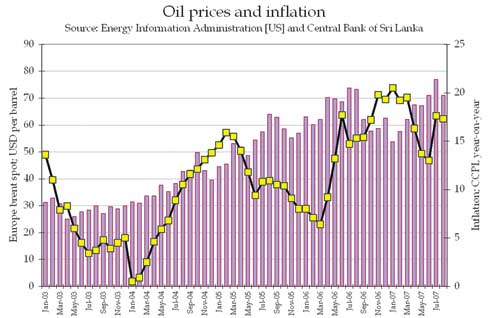
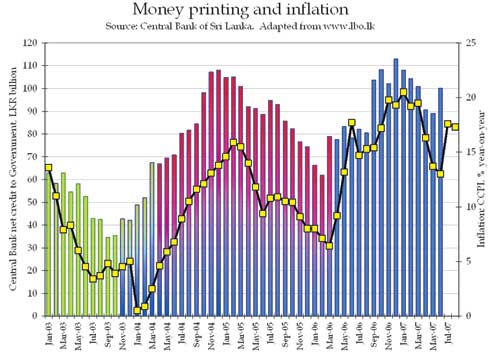
If that isn't proof enough, this graph from LBO/FT, showing the correlation between money printing and inflation and lack of a correlation between inflation and oil prices should really settle it.
 So what can be done about this?
Sri Lankan economists offer two basic solutions. Both of which has to do with Central Bank Independence.
I'd say all solutions must include firing Ajith Nivard Cabraal from his post as governor of the Central Bank. If you are serious about Central Bank's independence you simply can't have the President's former campaign manager at it's helm.
The two dominant views on institutional reforms to central banking in Sri Lanka are the following:
That's it for the dummies guide. It's been considerably longer than I wanted it to be, but I don't have time for a shorter post, hence the longer one. I Hope this has been helpful, I wish some of our politicians and newspaper editors can have a look at the actual causes of inflation rather than ranting on false, long-debunked theories.
Recommended Links :
For the Background of this post, do read my last one. This post is a result of the many frustrating times I spent listening government politicians, the media, and most other people attributing the causes of inflation to increasing of prices in the world market, in particular spiraling Oil prices.
The fundamental argument of Oil-induced inflation, was summarized in a recent editorial in the Daily Mirror:
Obviously, it is the inexorable skyrocketing of the oil prices in the world market – over which the government has no control - that have the ripple effect on prices of all goods and services. Increased fuel prices have its inevitable impact on electricity prices. The combined effect of price hikes in these two items, fuel and power, impact on all activities ranging from transport to production of various consumer items of food. The inevitable result is phenomenal increase in prices. [link : DailyMirror Editorial, March 21, 2008]The argument is elegantly simple. Oil prices rise. All goods are transported using vehicles, which uses oil, costs go up, so does the prices. It seems so reasonable, that the theory has many adherents. So much so, the Central Bankers in Sri Lanka (who now presides over an embarrassing 20% rate of inflation) help perpetuate this theory.
Now, I'm a great fan of peer education. So in my last post, I promised a sort of a for dummies-by-dummies guide on inflation. Looking back now, that was a silly promise to give. You can probably write a book on the subject. So what follows is a basic debunking of the oil-induced inflation myth, it's not unfortunately a complete dummies guide. But I will try to be as elaborate as possible.
The explanations may come across as being overly simplistic, and grossly inadequate. I accept both these charges. This is after all a dummies guide, and a blog post at that.
That thing called money.
As I discussed in my earlier post, Money has no value all by itself. It's just pieces of paper, what gives it value is that people use money to buy goods and services and because of that, there is a demand and therefore a value attached to it. Money also has a different value, than the number that's printed on it.
For example, like I said in my last post, I have a 20 Rupee Indian Note in my pocket. As you know, there is less acceptance (demand) for Indian rupees here in Sri Lanka, than in India. So the 20 Indian Rupee note I have is significantly less valuable here than it would be in India.
It's also true that what was a Rs.20 now in Sri Lanka is significantly less valuable than a Rs.20 in say, 1970.
First lesson in understanding inflation is perhaps realizing that money has different value attached to it than what's printed on the currency notes and thinking of inflation in terms of value of money rather than the prices of goods.
Do-It-Yourself Inflation experiment.
Literally speaking, printing money is quite simple. In Sri Lanka, it's printed in a factory (which I think is) in Biyagama. The Central Bank of a country has the control of much money is in the system, now that is not so simple to explain, but you'll have to trust me on that one. The point is, when I say "Printing Money" it doesn't mean literally printing notes, it refers to any way the Central Bank use to increase the money supply. Whenever you hear the phrases like , The Central bank has purchased Treasury Bills, the CB has lowered interest rates, it means the Central bank has put more money into to the system by increasing the money in circulation, expanding access to credit, so on. So in short, "money printing" is not just printing notes, it's any form of expansion of "money" in the system. Money, as you know, exists in many forms other than notes (credit, etc.) (updated - HT: ddm)
So, how is any of this relevant to inflation? Well, inflation is created by excessive money printing, which in turn is controlled by the central blank. So to put it bluntly, the Central Bank creates inflation. It's as simple as that.
Now, if you haven't heard of this before, this might come across as something between hallucinatory and laughable. So let me run through this thought-experiment I've developed.
Imagine that you are in grade 7. You and a friend of yours (let's call him Tom) want this really cool key-tag I have. I'm a cheeky little you-know-what, that I will only give it to the highest bidder. You have Rs.80 in your pocket, Tom has Rs.90. I start calling for bids at Rs.40. Both of you really like this key-tag.
The bidding starts: Tom starts biding at 50, You raise it to 60. Tom in turn raises the bid to 70. Now, you are in bit of a soup - you have only 10 Rupees left, but you really need Rs.5 of that to go home. If you don't use that 5 you'll have to walk your way home, and your mom would be very very annoyed. This Rs.5 is really valuable to you right now, so after thinking it over, you decide the to raise your bid to Rs. 75. Leaving Tom with Rs.15, to outbid you. But at this moment, there's a little twist in our tale.
Enter: The counterfeiter. Now (for no real reason, totally randomly) let's call this counterfeiter, Cabraal. Now Cabraal has this really cool laser printer which can print currency notes and he wants to test out some of his newly-printed stuff. So he walks over to you, and takes you to the side and hands you what appears to be two bills of Rs.10 notes, he says he's just helping out and everything is cool.
Suddenly, that Rs.5 you had with you doesn't seem too important anymore. The bidding starts again, Tom raises the bid to 80, you bid at 85. Again Tom retaliates by raising the bid to Rs.90, you raise the bid to Rs.95 and poor old Tom, not having the money to out-bid you, looses out and you get to buy the key-tag at Rs.95.
Think again as to what actually happened. The key-tag which would have sold at possibly Rs.80 (and a maximum of Rs.90 - all the money Tom had) was sold at Rs.95. The price increased simply because more money was injected into the process by counterfeiter Cabraal.
This is kind of what happens in our economy, when The Central Bank prints too much money without an increase in productive activity in the economy, all prices go up. This is inflation. It's a result of too much money chasing too few goods, we would eventually attach a smaller value to money and spend more of it, so prices 'sky rocket'.
In fact, most classical economists explicitly defined inflation as the growth of the money supply rather than the overall increase of prices.
Price of a particular item, like Oil, or Soap can increase (or decrease) due to all sorts of reasons and this may indeed contribute in recording a overall higher (or lower, with all other things being equal) value in the Consumer Price Index (which is used to measure inflation nowadays), but this is not the 'cause' of inflation. In fact general price increases are a result of inflation rather than it's cause.
So Why do they get it so wrong ?
If controlling inflation is so easy, Why do Central Banks like that of Sri Lanka and Zimbabwe get it so horribly wrong? Surely, Governor Cabraal and Co. know basic monetary economics? I certainly hope so. But the reason why certain central banks fail to control inflation is that governments (especially like ours) see printing money as a way to pay for their spending.
When you have a massive government set up like in Sri Lanka (100+ ministers and the obscenely large public sector), with a war, failing state enterprises and all other wasteful spending to finance, you end up having to tax, borrow when that's not enough - print money. This is why inflation is high in Sri Lanka.
But wait, why is this inflation thing so bad?
It might seem obvious, but it's a surprisingly good question. If prices of all things rise, then prices of whatever I sell must also be higher, so what's the big deal with inflation? Are we really worrying over nothing? Well, not exactly.
First of all, Inflation is a tax on everyone who holds money. Either in your wallet or a bank (savings/fixed deposit) account which pays less interest than the rate of inflation (which is the case in Sri Lanka). Every cent that you have in your bank and in your pocket right now is melting away as you read this. If you had Rs.100 in your savings account at 5% annual interest rate, and the annual inflation is 24% (pdf link) your Rs.100 at the end of the year is worth only Rs.81. You are literally being robbed of nearly 20% of your money.
Secondly, Incomes doesn't always keep up with the pace of inflation. So your purchasing power goes down. People with fixed incomes like pensioners are seeing their purchasing power plummet.
Thirdly, what makes free-market capitalism work is it's price system. Prices act as signal to producers, consumers and all actors of the market on what to buy, where to invest and how to allocate resources. High Inflation distorts this price signal (with an injection of money without productive activity) resulting in mal-investment, miss-allocation of resource and generally wrong economic decisions.
Additionally, inflation leads to an arbitrary distribution of wealth. When the Central Bank increases the money supply by say, lowering the interest on credit, those who get their hands on the credit first, generally benefit and those who don't, looses out. (Think of Tom in our thought-experiment)
Finally, high inflation creates uncertainty. If inflation is difficult to predict and volatile (a symptom of high inflation) that discourage productive economic activity. For example, a money lender may be reluctant to lend his money because he cannot predict if the interest he charges would be sufficient in face of volatile inflation.
Hmm, but can't the oil theory be also true?
The theory "Cost-Push" inflation, the idea that inflation is as a result of rising cost of things such as oil, was in fact quite a mainstream idea, about 30 years ago. Before Milton Friedman and others showed that inflation is always and everywhere a monetary phenomenon.
Without going into a theoretical argument on why this is not the case, let's say this hypothesis is true. Oil is the cause of (or the main contributor to) inflation.
What should we see? Surely,
1) All oil producing countries should have relatively low inflation. and,
2) All countries mostly importing their oil should have relatively higher inflation.
But none of these propositions are true. Iran, Russia and Venezuela three of the largest Oil producers have significantly higher inflation with Iran and Venezuela having close to 20% of inflation, much like Sri Lanka. On the other hand, countries which imports most (or all) of their oil consumption like New Zealand, Japan and Hong Kong are among the countries with lowest inflation.
If that isn't proof enough, this graph from LBO/FT, showing the correlation between money printing and inflation and lack of a correlation between inflation and oil prices should really settle it.
So what can be done about this?Sri Lankan economists offer two basic solutions. Both of which has to do with Central Bank Independence.
I'd say all solutions must include firing Ajith Nivard Cabraal from his post as governor of the Central Bank. If you are serious about Central Bank's independence you simply can't have the President's former campaign manager at it's helm.
The two dominant views on institutional reforms to central banking in Sri Lanka are the following:
- Bring in inflation-targeting legislation. This involves the parliament passing a law which mandates the Central Bank to stick to a particular level of inflation (say from 1-3%). Countries like New Zealand, Australia, Canada and Great Britain have enacted such legislation and it has proven to be relatively successful. Harsha De Silva, the well-known Sri Lankan economist is an advocate of this type of reform.
- A Currency Board arrangement. This involves pegging the SL rupee against a hard currency such as the US Dollar, which allows Sri Lanka to basically import the pegged currencies' inflation rate, in the case of the USD this would be 4% as opposed to the current 20+% inflation rate. Hong Kong has this type of arrangement with the US Dollar. LBO's Fuss-Budget and international monetary expert, Steve Hanke have recommended Sri Lanka follow a currency board, which we had till 1950 with relatively low inflation.
That's it for the dummies guide. It's been considerably longer than I wanted it to be, but I don't have time for a shorter post, hence the longer one. I Hope this has been helpful, I wish some of our politicians and newspaper editors can have a look at the actual causes of inflation rather than ranting on false, long-debunked theories.
Recommended Links :
- No Escape: Inflation is created in the Central Bank
- Sri Lanka : Slaying the Bogey of Inflation
- Pod Casts : Tyler Cowen on Monetary Policy Competing currencies, Gold Standard, and more. Also, Milton Friedman on Money (Both highly recommended)
Wednesday, March 26, 2008
My Socialist Experiment
When I was growing up, this idea that 'our country was poor' puzzled me. How can we be poor I thought, the government print the money don't they? So how can they have all the money and still be poor? After days of thinking over this, I came to the conclusion that perhaps printing money costs, about the same amount of money that's being printed. That is for example, it costs the value of Rs.10 to print a Ten Rupee note. I remember asking my dad if this was the case, he said no, money is just paper he told me. I Can't remember if I followed up on the question, but I'm pretty sure he did not satisfactorily answer my questions.
This is about the time I invented my own version of socialism (I was really very young, honestly.) Deanist-Socialism was simple. Under my plan, every citizen in the country will receive a fixed amount of money at the end of every month courtesy the government. That way, there's no real need to work and we can live happily ever after.
I can't quite remember what I did with my theory, but finding answers to why oh why governments didn't just print money and distribute lead me to many realizations. First among them - not many people understand 'money'. For a long time, I didn't either.
So in my quest to understand this thing called money better, I began reading by coincidence (now this is much much later) the likes of Friedman, Rothbard, Mises and (eventually) the likes of Mankiw, Cowen and other contemporary practitioners. Having gone through all of this, I feel like I have the basics covered. But seeing media reports, listening to local politicians and even what some of our Central Bankers say, it seems many doesn't even have these basics covered.
So in the near future, (possibly tomorrow, I'm sleepy now) this blog will have Inflation for Dummies by dummies post to dispel some of the myths that's being perpetuated when talking about Cost of Living and particularly inflation in Sri Lanka.
But first, a few more of those realizations..
#2) Wealth is not Money. If it were, my little socialist experiment would have worked, to make it's people more wealthy, all a government has to do was print money and distribute them. Wealth, put it bluntly, is stuff or things we value (some of which could be money) and can be defined as the productive capacity of the economy.
But why doesn't governments do this? why don't they just print the money and distribute? The answer, is to do with the value of money.
#3) Paper-money has no intrinsic value. It's just paper. Turns out dad was right, the kind of money we use is just paper (fiat money). The only reason why you would accept it in exchange for payment for something is because we have the confidence that in the future, some other person would take it to exchange with something we value. If anyone doesn't think they can exchange this paper for something valuable in the future, they would not accept it.
For example, right now, I have with me a 20 Rupee Indian-Note in my purse, signed by a few friends and given to me as a souvenir. In India, this would have bought be breakfast. But here, in Sri Lanka, this would buy me nothing. The Indian rupee has (almost) no value here. (unless at a money-exchanger) The value of money, like any thing else is determined by the forces of it's supply and demand.
Realizing these two things, and the notion of value of money is perhaps the key to understanding inflation.
This is about the time I invented my own version of socialism (I was really very young, honestly.) Deanist-Socialism was simple. Under my plan, every citizen in the country will receive a fixed amount of money at the end of every month courtesy the government. That way, there's no real need to work and we can live happily ever after.
I can't quite remember what I did with my theory, but finding answers to why oh why governments didn't just print money and distribute lead me to many realizations. First among them - not many people understand 'money'. For a long time, I didn't either.
So in my quest to understand this thing called money better, I began reading by coincidence (now this is much much later) the likes of Friedman, Rothbard, Mises and (eventually) the likes of Mankiw, Cowen and other contemporary practitioners. Having gone through all of this, I feel like I have the basics covered. But seeing media reports, listening to local politicians and even what some of our Central Bankers say, it seems many doesn't even have these basics covered.
So in the near future, (possibly tomorrow, I'm sleepy now) this blog will have Inflation for Dummies by dummies post to dispel some of the myths that's being perpetuated when talking about Cost of Living and particularly inflation in Sri Lanka.
But first, a few more of those realizations..
#2) Wealth is not Money. If it were, my little socialist experiment would have worked, to make it's people more wealthy, all a government has to do was print money and distribute them. Wealth, put it bluntly, is stuff or things we value (some of which could be money) and can be defined as the productive capacity of the economy.
But why doesn't governments do this? why don't they just print the money and distribute? The answer, is to do with the value of money.
#3) Paper-money has no intrinsic value. It's just paper. Turns out dad was right, the kind of money we use is just paper (fiat money). The only reason why you would accept it in exchange for payment for something is because we have the confidence that in the future, some other person would take it to exchange with something we value. If anyone doesn't think they can exchange this paper for something valuable in the future, they would not accept it.
For example, right now, I have with me a 20 Rupee Indian-Note in my purse, signed by a few friends and given to me as a souvenir. In India, this would have bought be breakfast. But here, in Sri Lanka, this would buy me nothing. The Indian rupee has (almost) no value here. (unless at a money-exchanger) The value of money, like any thing else is determined by the forces of it's supply and demand.
Realizing these two things, and the notion of value of money is perhaps the key to understanding inflation.
Saturday, March 15, 2008
What Causes Poverty?
Nothing!. ASI has the explanation,
There are no causes of poverty. It is the rest state, that which happens when you don't do anything. If you want to experience poverty, just do nothing and it will come. To ask what causes poverty is like asking what causes cold in the universe; it is the absence of energy. Similarly poverty is the absence of wealth. For most of humanity's existence on this planet, poverty has been the norm, the natural condition. People hunted to survive or lived by subsistence farming, and they were poor. In some parts of the world this is still the case.Read the whole thing.
Wednesday, March 12, 2008
How J.R. Ruined Everything
If you are a socialist, that is.
The chart below from Gapminder shows increasing incomes per person at accelerating rates after president JR Jaywardene liberalized the Sri Lankan economy in 1977. Certainly, this isn't good news for the lefties.
Say what you want about JR's politics, but the fact remains - his (partial) market-based reforms did make a lot of people's lives better. We need more of it, not less.
These stats of course, wouldn't change the mind of people like this commenter to whom I dedicate the title of this post. These are obviously some fake statistics compiled as part of a neoliberal conspiracy initiated by the CIA and planted in Google gapminder.
No but seriously, Gapminder is just awesome, it converts boring numbers into enjoyable, animated and interactive graphics. See it's founder Hans Rosling's talks on TED here and here. Must See videos!
The chart below from Gapminder shows increasing incomes per person at accelerating rates after president JR Jaywardene liberalized the Sri Lankan economy in 1977. Certainly, this isn't good news for the lefties.

Say what you want about JR's politics, but the fact remains - his (partial) market-based reforms did make a lot of people's lives better. We need more of it, not less.
These stats of course, wouldn't change the mind of people like this commenter to whom I dedicate the title of this post. These are obviously some fake statistics compiled as part of a neoliberal conspiracy initiated by the CIA and planted in Google gapminder.
No but seriously, Gapminder is just awesome, it converts boring numbers into enjoyable, animated and interactive graphics. See it's founder Hans Rosling's talks on TED here and here. Must See videos!
Subscribe to:
Posts (Atom)