Wednesday, May 30, 2007

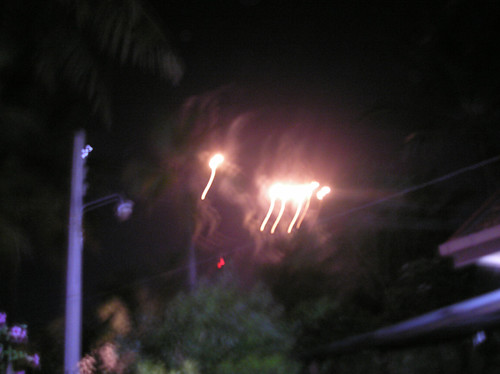
Fake flairs Flares: Air-Tiger simulation


It was about 8 PM today, and I was just going through my normal-day to day stuff when suddenly there was a large noise which sounded like gun fire. I rushed out to see what was happening, as everybody was shouting something to the effect of ‘Attack! Attack!’. The people who were outside told me that two low-flying aircrafts just passed on top of where we were in the direction of the sea. The whole night-sky is now illuminated by yellow flairs Flares seemingly coming from the direction of the Airport.

People started making few phone calls, to get to know what happened, and to see where everybody was. The flares in the mean time just stood there, calmly dropping off. I managed to click a few pictures ( found here)

Apparently thoppigala is under-attack, and everybody was theorizing that the flying tigers have responded.

But soon, the confirmation came from a few ‘highly placed sources.’ it was just a ‘test’. Apparently the boys at the air port were giving the new Minister Chamal Rajapakse a show, of “how everything’s supposed to work” on a Poya day if the tigers decide to fly. The flair Flare-show lasted for about 8-10 minutes.

Yet another day in the paradise isle.

Update 9.45ish : Another flair Flare thing..same story. An early christmas of sorts.

Monday, May 28, 2007

A Market for the poor

Often you'd find free-market proponents counter questions like “so, what about the poor?” by arguing that if the market is free enough it would, given time, service the poor.

The notion is of course true, for most things. A profit seeking company doesn’t mind where their money comes from as long as it arrives. So you’d find cheap version (sachet packets) of common consumer items like soap or washing powder.

It is generally conceded that the so-called ‘luxury items’ rarely compete in this consumer market.

The Mint reports on an interesting scenario where the likes of Microsoft and Intel are cramming for space in the Laptops-for-the-poor Market.

“A programme to provide millions of low-cost laptops to students in poor countries is set to start production in September even as commercial competitors prepare to offer even cheaper models.

The idea from Nicholas Negroponte, a co-founder of the Massachusetts Institute of Technology Media Laboratory, who proposed the project at the World Economic Forum in Davos two years ago, has moved closer to fruition.

..

“OLPC is in talks with Argentina, Brazil, Uruguay, Peru, Nigeria, Thailand, Pakistan, Russia, Rwanda and many other countries—but nothing definite just yet,” she said.
The new computers will not carry the symbolic price tag of $100 (Rs4,100), at least not right away. The first models will cost $175 and OLPC hopes the price will come down to $100 by 2009.

Negroponte wanted to have an innovative, specifically tailored laptop—called the XO— that would be very small, hardy, user-friendly and use the free Linux operating system, not Microsoft’s Windows, which dominates the world market.


The sharpest critic of the project is the world’s leading chip maker Intel Corp., which has dismissed the XO as a “gadget” and launched a rival commercial product.
Intel’s “Classmate,” manufactured in Taiwan, costs $285 and the price will drop to $200 at the end of the year, said Intel spokeswoman Agnes Kwan.

Several thousand units have been shipped to Brazil, Mexico and Nigeria, she said, and the target is 100,000 laptops by December. Pakistan has ordered 700,000 for 2009, she noted.

Aghast at this commercial rivalry, Olpc’s Negroponte said recently that “Intel should be ashamed of itself.” He accused the US microprocessor giant of selling the laptops below cost to destroy the XO, a charge Intel has denied.

Soon OLPC will have to contend with even more aggressive Indian competitors. The group Novatium Solutions Pvt. Ltd, based in Chennai, just brought out a basic “NetPC” for Rs3,280 ($80).

The market for the poor has become so enticing that Microsoft is preparing to launch a scaled-down software bundle of Windows and Office for three dollars for qualifying governments. ”

[Selected Quote: See full Article]

Monday, May 21, 2007

Do we really need bus tickets?

Personally, I just want to just throw them away, but I don’t - for two reasons.

First, it probably affects global warming.

Second, the Western Provincial councilors got bored with debates on which road they should rename next and decided pass this new law which makes it mandatory for all the bus-people to issue tickets to all their passengers, non-compliance would mean hefty fines which I can ill-afford in these days of chintana-inflation.

Quite frankly I have no use for bus tickets. For the simple reason that when they give me the tickets, I’m kind of already on the bus. So what’s the point? It’s just an extra piece of paper I have no use for, except just binning-it. A difficult proposition in it self, because the Colombo Municipality has reached such heights in incompetence that there aren’t a lot of ‘bins’ available.

Now one can argue, there are in fact uses for tickets, after all the conductor-brother can be especially mean and say you haven’t purchased tickets when you already have, and in rare occasions those fellows who check for bus tickets (affectionately known as tikka’s) would get into the bus. Well yes, that could happen. Also theoretically I could get hit by a plane walking on the road, doesn’t mean I should buy myself a mobile radar kit.

The point in this, governments need usability testing. When bringing in new laws the geniuses who draft these laws must consider how people would actually use them and the implications on its users. If it’s too inconvenient, or doesn’t have a good enough benefit, people just won’t use them.

There are plenty of examples, how often have many of us not bothered to use that yellow line (kaha ira) when crossing the roads? Near my college for instance, there are two yellow crossings about 200 meters away on either side, most choose to just not bother and just cross in front of the gate. Now if they bothered enough to put one of those a bit more closer, perhaps people would actually use it.

Make it usable, or it would become irrelevant -something that can be clearly seen in the bus-ticket scenario, where increasingly bus-conductors are not issuing tickets for small rides. Joy.

Tuesday, May 01, 2007

Shall we kiss?

Shilpa Shetti seems to have a knack of getting herself into the spotlight. Previously, she was involved in the infamous ‘big brother’ fiasco; the latest incident involves Richard Gere (the guy from the movie, shall we dance) when he kissed her in public during an Aids Awareness event.

Now I have done my share of Aids awareness, never did anyone have the urge to kiss a female participant. I don’t know what Gere was trying to communicate through the kiss though; perhaps ‘guys, you totally can’t get Aids like this! Allow me to demonstrate!.. smooch..

Obviously the incident is something that perhaps shouldn’t have happened, but if there’s anyone who could top the insanity of the moment, its got to be the local nationalist boys.. yes. Bring out your bazooka’s brothers our culture’s on fire!.

God save, shiv sena!

On this topic, India uncut pointed me to an interesting post in churumuri :

“If fleetingly kissing a woman in public and with the avowedly socially conscious intention of driving home an obvious message against a scourge like AIDS is such an unpardonable affront to Indian ‘culture’, then what is the lurid act of urinating in the full glare of the public, even on busy roads, that most Indian men do, which results in the rather pathetic scene of the women in the vicinity lowering their heads and hurrying past the cheap spectacle with the man standing with his legs spread at a convenient angle?
So this is part of the great Indian culture we shout from the roof tops about, is it? Or is it enshrined somewhere in the inside pages of our voluminous scriptures?
What of the sexual harassment that goes on in crowded buses and trains where perverts thrust their pelvises into the backsides of hapless women clinging desperately on to every available piece of support inside on their way to a hard day’s work? This doesn’t activate the ‘activists’? ……
.. Richard Gere kisses Shilpa Shetty and India is outraged. How much more morally bogus and dubious and counterfeit can we get.
That reminds me of the tag line of India: 5,000 years of history and culture. Or is it culture and history? " [Link]
I don’t know if I agree with everything in the post, but the fake cultural protectionism goes well beyond the territorial borders of India.

Monday, April 30, 2007

So that’s that..

To say the least, it was a weird final.

First, the start was delayed and then the match reduced to 38 Overs, and then that explosive Gilcrist innings followed by a spirited run chase by Sanath and Sanga, during which the LTTE decides to send one of the air-crafts to visit Colombo which sets off spontaneous retaliatory fire by government forces and condemn half of Colombo into darkness.

For those caught in the proximity of the firing, it’s a frightening experience. For the rest of us, the score is 100something for 1, and it’s a great partnership, as Sangakara thwarts one on the offside for 4. But that was about all the excitement we are going to get, as few balls Sanga mis-times the pull-stroke and is caught. Its now up to Sanath and Mahela to pull something off, they keep scoring at a decent pace but the required rate is climbing up, as the drizzle falling in Barbados intensifies, Duckworth/Lewis comes into the picture. Its now a wet pitch, and the game is slipping away as Sanath comes down the pitch to Michael Clark, the ball keeps low and bowled!. End of Sanath, and the end of the match for Sri Lanka…. to fast forward a bit..

Weirdness continues.. its now pitch dark and with 3 overs to go, the umpires offer the light to the batsman who takes it, which sets off a victory huddle by the Aussies, they have won the world cup! but wait, Aleem Dar has other ideas. He kindly informs Ponting, the match might continue tomorrow. Everyone seems confused, Mahela is seen talking to Ponting, and after some more confusing moments later, the Sri Lakan batsman walks in to finish off the game needing 22 runs per over and with the ball no where to be seen, the Sri Lankan tail-enders seem to find it a bit difficult. And finally.. the Aussies have their moment.

Sigh. No wonder people like football.

Its about this time in a blog post, where people say how the better team won and how we are all proud of the boys, and they have done their best, and so on. All of which are true. I just wish we had a different final. Somehow, the occasion deserved something better, something closer to, well, cricket.

It was always going to be a tough game, but all of Sri Lanka hoped. Normally, It would be wrong to call us a cricket-crazy country, we are rather fond of the game, and it’s probably our national pastime (apart from doing nothing and taking holidays) but for the past week or so, you could feel that we were approaching fanatic levels.

So much so, that there were countless religious ceremonies in churches, kovils and temples wishing the cricketers well in the final. But in spite of all that, you’ve got to say that Mother Nature made it a point to be especially unkind to the Sri Lankans, from the reduced overs to bright sun and no-swing when Aussies were batting to the rain and swing when we were batting, to the perfect orchestration of the Jayasuriya dismissal (wet-pitch, duckworth/lewis, heavy-outfield.), the weather certainly played into the hands of the Australians.

But that’s how things go, as people say, what to do. It’s disappointing. Sri Lanka certainly deserves its second place, we played some great cricket, and as Kamran Abbasi from the Blog Pak Spin says, the moments of the world-cup belonged to Sri Lanka.

“...for each over-whelming favorite there is an over-whelming supported underdog. Hundreds of millions of cricket fans will be rooting for Mahela's Magicians simply because it would be great to see somebody other than Australia win. More than that the magic moments of this World Cup--Malinga's four in four and the final-ball defeat of England--have belonged to Sri Lanka. There is a variety in their bowling--slingers, swingers, and doosras--that gives them the best chance of humbling Australia. That's before we get into the poetic justice of Murali triumphing over the country that has brought him most humiliation.” [link]

It wasn’t to be, but perhaps another time.

Saturday, April 28, 2007

Random thoughts on cricket..

I was watching the NZ vs. SL semi-final the other day, Sanath was out but Tharanga was going well, he cracks a four on the off-side and dad mentions “shah.. this tharanga fellow is pretty good ah..” just few hours ago he was calling for tharanga’s head, asking why the hell a batsman who scored a 0 against Ireland is still playing, while Marvan Attapattu is warming the benches. It just took a cover-drive for four to completely change his mind.

That probably epitomizes the typical Sri Lankan fan and most media-men (who are generally no more than fans themselves). Sri Lankan pundit’s analysis seems to be instantaneous derived less from careful analysis and more from spur of the moment reactions. Over the years there have been many media-recommendations for team selections, not very far of I remember some media persons and ‘pundits’ thought fit that Sanath retires, as he was clearly too old for the game.. sigh..

Much has been said about Sri Lankan commentators, one in particular – Ranjith Fernando. It’s true that he’s probably the least creative commentator in the contemporary game, but I couldn’t help but feel sorry for him seeing all the hate-posts online. At least he’s a nice man. I mean if you look at it, the other commentators tend to be equally incompetent. Listening to the ‘Eye channel’ discussions is enough proof of that. how many times do we have to know that ‘cricket is an unpredictable game’ ‘and that if you post a good total and put enough pressure, you’d have a chance..’.

On the bright side though, we didn’t have to tolerate Anarkalai this world cup- Hallelujah! I’d swear I would have thrown a sizable stone at the TV, if I had do to tolerate her again!.. creativity is fine, copying stuff from India is still fine, but seriously Mandira Bedi knows some stuff about cricket, we don’t want a dumb chick who just jumps up and down and talks in that annoying voice. Talking about annoyance, can somebody please shove a petrol pump up De Mel’s ass? What a sonofabitch! The comments he made on selections, were just disrespecting to say the least.

Anyway, the final is upon us, the world it seems would back Sri Lanka, and as Arjuna would have said, ‘the boys have played pretty well’, made some bold decisions and by and large, things have gone our way. Its down to this game now, and its not about just playing it, its about winning! its going to be a cracker of a game. Good luck fellas! And lets have some Kangaroo for dinner!.

Friday, April 27, 2007

Youth, Culture and Globalization

An increasingly globalized, volatile and a growth-oriented world present its citizens numerous challenges – be it in economic, social, environmental and indeed cultural spheres.

As the global economy steams ahead in full speed, geographical borders are becoming less and less significant as people move around, migrating into cities and countries in search of better opportunities and better lives.

Business corporations in both the East and the West are interchanging knowledge and capital in a mutually beneficial exercise. To succeed in this increasingly border-less world one needs to go beyond the familiar and the uniform and embrace the unfamiliar and the diverse, one must tolerate and accept different customs, behaviors, languages, attitudes and values. In other words, one must embrace multiculturalism.

Multiculturalism, however, isn’t simply just good business, but rather something that contributes a great deal in transforming modern day conflicts in the world and indeed here, in Sri Lanka. Roots of most conflicts or at least lack of progress in resolving them, has a lot to do with lack of understanding and lack of space for a different cultures and identities, which leads to marginalization and discontent which sometimes results in violent aggression and cycles of hatred. It is clear then, that multiculturalism is no longer simply a nicety but rather, a dire necessity in the times we live in.

Read the rest of the post in the BB Blog

Thursday, March 15, 2007

The Planet is Warming – We are all dead! Do something!

Yes, it’s no use, we are officially dead. Greenland is melting, Polar bears are dying, and soon we will be under more than 20 feet of water, the planet is warming and it’s all due to inconsiderate humans activities!

So, um.. What else is new? Well, Al Gore won an Oscar, and apparently this time around the Oscars were all ‘green’. Yet another achievement for the hysterical global climate change movement, led by its poster boy, President-not-to-be- Al Gore.

Al Gore’s inconvenient truth won an Oscar for the best documentary; perhaps they should have judged it under whatever category they judged ‘Star Wars’ because that’s what it was, an elaborated piece of science fiction. The inconvenient truth is nothing but a load of convenient lies, and half-truths exaggerated to push an agenda.

There is an excellent article in CATO exposing the sorry-science in the Movie.
The main point of the movie is that, unless we do something very serious, very soon about carbon dioxide emissions, much of Greenland's 630,000 cubic miles of ice is going to fall into the ocean, raising sea levels over twenty feet by the year 2100.
Where's the scientific support for this claim? Certainly not in the recent Policymaker's Summary from the United Nations' much anticipated compendium on climate change. Under the U.N. Intergovernmental Panel on Climate Change's medium-range emission scenario for greenhouse gases, a rise in sea level of between 8 and 17 inches is predicted by 2100. Gore's film exaggerates the rise by about 2,000 percent.

What’s more, the summary for policy makers the IPCC report (full report is expected in May) actually decreased the earlier estimate of sea-level rise by 30%. The summary, for all counts and purposes was actually reassuring, rather than alarming.

But that’s not how the New York Times, or even the local Sunday Times played it. The popular media continues to project a doom and gloom scenario, when nothing can be further from the ‘truth’.

This over-hyping of global warming is entirely intentional, in fact Gore himself is quoted as saying that he believes “it’s appropriate to over-represent how dangerous global warming is” to open up people to the dangers of global warming. The movie is therefore part of his personal project to ‘over-represent’ facts, and perhaps this is why Gore doesn’t seem to believe his own messages, quite evident from the recent unraveling of Al Gore’s own energy consumption which stands at 10,000 kWhs per year!, obviously Gore, like most politicians is a hypocrite.

Ok, enough Gore-bashing.

Now I’m not suggesting the ‘planet is not warming’, or that climate change isn’t real. It is warming, and has been for the last few decades, but the rate in which the planet is warming doesn’t warrant for the sort of radical OMG!-solutions that the climate-change freaks are advocating, nor as far as I know are scientists in complete agreement on the degree of human involvement of climate change among other things.

Ultimately a possible ‘solution’ for climate change is technological, and not political. Policymakers won’t solve the climate change puzzle; they can make only symbolic gestures to that end, at the expense of possible growth. The irony of the fact is that the only way the technological solution can come about is through accumulation of wealth through free-markets and free-flow of ideas.

The state of the world is not bad as the lefties would tell you, in fact by the turn of the century the average life expectancy of the world population stood at just about 30 years, which by now has more than doubled, the infant morality rate has increased and people are richer, better off and in better health across the board.

Science and technology has, in the past, found solutions to problems at were termed impossible to ‘solve’. Nowadays no one hears about the fragile ozone layer, acid rains etc. ultimately it will be down to cost factors which would lead to more focus on finding an affordable forms of renewable energy, there are already few promising technologies which aim to harness the power of wind, ocean waves and solar power. This is definitely where the future lies.

The solutions won’t be found in Koyoto, or any other international agreement or in some green tax on transport, which restricts trade and at breeds poverty. one thing that could work however is ‘voluntary submission’ to green ethics by consumers which in turn would make companies more ‘green’, this is one thing the al-gore types have been successful in doing and they deserve some credit for it (I have to admit an Inconvenient truth is a powerful piece of video advocacy) if the ‘green culture’ takes off, which it has to a degree in the west, then that wont be the most terrible thing in the world.

What cant work is imposing agendas on developing countries citing ‘climate change’ by trying to beat us into agreements that are clearly not in our favor. If you really look at its completely hypocritical, here are a few developed nations saying that, “look here India and china, we grew at the expense of the whole planet, and that’s so not cool, so now that you guys are growing and developing why don’t you develop more ‘sustainably’, and slowly? “

I’d say, go to fucking hell.

Somewhat Related Link:
http://www.greatglobalwarmingswindle.com/

Monday, February 12, 2007

Creative Commons Controversy

Seth Godin’s blog is one of my favorites. His short, concise thoughts and observations in a webby entrepreneurial point of view, makes for a good read most times.

Today though, he has a post on how a one of his books titled “Everyone’s an Expert” available free online , is now published and sold, it’s available on Amazon, without his explicit consent.

The consent however, was implicit. When Seth originally published the book online, he chose a Creative Commons (CC) license (for the unenlightened, this is a form of licensing that allows content creators to giveaway certain rights so only ‘some’ rights are reserved.). Within CC licenses, there are types which disallow commercial usage of CC licensed content, but the one Seth chose makes what the publisher doing -at least at first glance - completely legal.

The publisher is essentially selling the service of making available a book in printed hardcopy. they are not really selling the product per se, but rather selling the service of providing the product, an enhanced delivery system if you will, from online PDF to delivered paperback. At $10, it’s not a bad deal.

A question can be raised as to whether the publisher should acknowledge the book is available online? The answer is no. The publisher is essentially a competing with the free provision of the book, and it doesnt make sense for them to promote the 'free book', much same way Yahoo doesn’t have to acknowledge that Google is the better search engine.

At this point, I would like to skip the part about ethics. Wouldn’t it have been nice if the publisher got permission from Mr.Godin? Of course! But that’s arbitrary. What if, Seth, as is likely to happen in this case, asked the publisher not to publish his work, Should the publisher oblige? I don’t necessarily think so.

This paves way to raise a few pertinent issues, not only regarding this particular case but regarding Creative Commons (and other copyleft) licensing in general.

  • Can a content creator later change his/her mind about the choice of license?
  • If the license is revoked what will happen to the re-used content using the liberties of the previous license? What if for example, a publisher re-published a work previously under CC license without the knowledge that the license has been revoked?
  • Are there, implicit limitations that content re-users are unaware of? For example, Seth in his post hints that by using his name, the publishers may be violating trademark law.

Creative Commons and similar initiatives are necessary instruments for content creators to survive and profit in the integrated world we live in, it is incidents such as this, which would further strengthen the creative copyright model.

At the end of the day what people have to understand is this: Commons are creative, but nobody said they were nice.

Saturday, February 10, 2007

Love is Selfish ?


With the valentine's day around the corner, the capmag has an interesting article on love – I found the following paragraphs somewhat revealing :

Love, we are repeatedly taught, consists of self-sacrifice. Love based on self-interest, we are admonished, is cheap and sordid. True love, we are told, is altruistic. But is it?
Imagine a Valentine's Day card which takes this premise seriously. Imagine receiving a card with the following message: "I get no pleasure from your existence. I obtain no personal enjoyment from the way you look, dress, move, act or think. Our relationship profits me not. You satisfy no sexual, emotional or intellectual needs of mine. You're a charity case, and I'm with you only out of pity. Love, XXX."

The full article can be read here - [What is True Love?]

I believe all individuals are fundamentally selfish whether they’d accept it or not, people who proclaim they’d live for or die for other people are, well, hopelessly romantic to start with, and fundamentally, still selfish.

Perhaps with things like love though, people do not attempt do rationalize it. probably a good thing.

Monday, February 05, 2007

The Real M.C. - How I Pimped my Country

Photo by Indi

The era of big government is over. Introducing, Mega Government…

53 Cabinet Ministers, 33 Non-Cabinet Ministers, 19 Deputy Ministers, 1 President, 2 brothers, 100s of Advisors, over 6000 self-hailing billboards, all this on a carefully calculated scientific basis.

Ladies and gentlemen, welcome to the Mahinda Chintana.

Yes it is indeed a new Sri Lanka under King Rajapakse, we now have:

A vibrant representative democracy –1 Minister per every 0.2 Million people– India can manage only 1 per every 14 million. No wonder there are bombs in Bombay!

A visionary economic plan spanning over 10 years of planned economic brilliance, all the soviets ever managed was 5 years.

A creative national security policy, 1 person disappears every hour. A truly home-grown solution to menace of terrorism.

All world leaders are now looking up to the chintanaya for answers to their present day crisis. So much so, the king has decided to publish his own book titled the ‘The Real MC: How I Pimped my country’.

Following is an extract from chapter 2: problem? what problem!

“..Is corruption a problem? Why not abolish the investigation body? Getting bashed in the media? Try arresting the editors. Your astrologers fear bad times? Change the time, stupid!. Miss your homies? Build the chaps an airport. Yes now they can fly into parties hosted in your official residence courtesy of the good people in The World Bank, the ADB, and of course your faithful tax payers. ..”

and chapter 4: Mihin-theroy

“..If you are the king, you really got to own your turf. So first, is the multimilliondollar marketing campaign. You have to make your homies feel you are with them; your figure must be visible from every street corner, roundabout and lamppost. Billboards are they way to go, statues are so Soviet Union. Every thing you do, have to scream it was done by you, launching your own Airline? Call it Mihin-Lanka, building a housing scheme? Name it mhindu-sevana, air purification project ? mihin-air…”

and Chapter 5: the Magic Word

“..if you learn only one phrase, let that be - ‘National Security’, now dig that. This is a life saver, yes it is these words that would justify anything and everything you do, it will justify inflation, abductions, shutting down your capital city, crooks in cabinet, yes absolutely anything!. The moment you or your merrymen utter these magic words, your peeps will start nodding. That’s right, time for some big time pimping..”

Many more chapters would be made available at a later date.

All proceeds would go into the ‘Helping Hambantota’ account for safe keeping on behalf of the good people in hambantota.

Thursday, February 01, 2007

Karu Vateyta Horu


Gone are the days when the UNP was shouting slogans like ‘Awoth Karu, Payayi Hiru’,
Nowadays the party loyalists are shouting (or rather squeaking) along the lines of ‘Giyoth Karu, Penei Tharu’ while others, at least the sirikotha faction have settled for the slogan ‘Karu Vateyta Horu’. Sighting the alleged corruption charges found during a COPE investigation, against the likes of Milinda Moragoda and some say even Mr. Jayasuriya.

In the wake of the mass jumbo exodus, to what is essentially now, a UNP government headed by Mahinda Rajapakse many have speculated as to the fate of what remains of the Grand Old Party. The answer is – quite a lot.

As one Sunday newspaper claimed some time back, most people in Sri Lanka is inherently UNP. The party can command quite easily, at least 35-40% of the electorate regardless of whether there’s a split, or who’s in the Leadership.

Given this fact, Some say, that the crossovers are in fact a blessing in disguise for Wickramasinghe and the mainstream UNP. I’d beg to differ. Lets be honest, this is a HUGE set back for the UNP, one from which they will have a tough time getting over. Especially, in the reality of having your own parliamentarians against you and given also the possibility of yet more UNPers joining the government, to the point where the opposition leader post could be handed over to the JVP, things does indeed look bleak for the UNP. But even so, it would be premature to pass definite judgments.

The motives of the so called reformists (crossover faction) could be diverse; For some, it could be escaping corruption charges, the others it’s just a matter of sheer lust to become a Minister.

It’s not however, like Rajitha Senarathne proclaims an attempt to promote ‘good governance and peace’ if these were the motives, the act of joining the jumbo cabinet itself is the greatest deterrent for ‘good governance’ in the country.

In any case, there is now, a redrawing of political equations. The JVP after at years of avoiding the programme now participate in the ‘Jana Handa’ the programme hosted by TNL, both UNP and JVP participants were seen in close conference with each other trying to bully poor Tissa Vitharana representing the government. It is clear that the UNP will try to go into a common cooperation with the JVP, similar to that of the pre-2001 era.

Another element of the changed equation is the dissident SLFP members, led by Managala Samaraweera and the Bandaranaike’s. Whether these dissidents are as dissenting as the Morning leader would tell you, remain to be seen.

Saturday, January 27, 2007

Politicos 2.0

Using the internet for political activism is nothing new, it is used almost extensively in many so called ‘developed’ world, where it truly makes sense as where there is a significant internet population.

Recently there seems to have been a surge in politicians using the net for PR. John Edwards announced he’s running for president on YouTube, and if successful (god forbid) he will be America’s first YouTube President. Others have followed suit with people like Barrak Obama teaming up with Brightcove to announce his presidential bid. The 2.0 politicians are not limited to the US, it is said that Iranian president Ahmednejad maintains a blog, recently the Indian president Dr Abdul Kalam posted a question on Yahoo Answers, and there are reports of a Minister in Britain now starting her own blog.


In the US, there is an estimated 210 Million internet users (68% of the population) and as the 2008 presidential election gets closer people are wondering whether then net can be used not merely as a tool for fundraising or a campaigning tool for politicians to further strengthen the top-down campaigning but whether the netroots movements can in fact change the playing field. Sri Lankan situation, as always remains starkly different.


Political commentaries are common on the Sri Lankan Webosphere but there doesn’t seem to be any concentrated effort by politicians or political parties to encapsulate the power of the web. The last presidential election saw both candidates having a reasonable web presence, there were no space for donations or any of the sort but at least it figured somewhere in the election strategy, Sri Lankans Bloggers got into the act with almost all backing the loosing candidate.

As of now, the Presidents site still seems to update, albeit somewhat unwillingly. The JVP can boast a decent web presence which has been consistently updated for quite some time. The UNP site is now, perhaps like the actual party is now defunct. Online, It can only claim to a supporters group in Hi5 with a reasonable membership.


Sri Lanka can officially claim to about 300,000 internet users (2005 Est.), I presume that number to have grown up to about half a million by now. Come next election, presumably in 2010, there could well be a significant amount of people online which could be exploited especially by Colombo politicians.

Thursday, January 25, 2007

Stripping Sherawat


I recently discovered that some dude in India has sued Mallika Sherawat for an apparent show of obscenity; she pulled down some guy’s trousers at a New Year’s Eve party. Rediff covers it here [Mallika will strip all men], a clip from the dance is on YouTube, photos are here.

I would understand if the person whose trousers got pulled off sued Ms. Sherawat, after all dancing without your trousers in public can’t be all that fun (or is it?). Especially if you are sporting a hard-on which is a definite possibility with Sherawat shaking-it about.

But why would a total stranger unconnected to the whole episode, wants to sue Sherawat?

A similar incident Happened to Anarkalli Akarsha when some government official accused Ranjan Ramanayake of forcing Anarkalli to strip down during the shooting of One Shot. Now everyone likes Anarkali, her long list of admirers includes the president, his sons, the foreign minister, and apparently business tycoons. Hell, even I don’t mind her as long as she doesn’t speak. That’s one part of her that hasn’t developed much from her preteens or even earlier. Now Anarkalli is apparently suing a certain newspaper who came up with the story.

What would it take for subcontinent creatures to mind their own business I will never know.

Monday, January 08, 2007

Bus Bombs

I guess we are back where we started, even worse off. The LTTE have abandoned their targeted attacks and moved on to civilian killing mode. Perhaps this is because of their military set backs, or because their ‘targeted’ killings have miserably failed in recent times, perhaps it’s a case of GoSL and the so called International Community has simply run out of ‘carrots’ to tame the tigers. LTTE is already a banned organization in many countries of influence and they don’t have a whole lot to loose by doing basically anything.

There can be no justification for these things, there’s no doubt that the current administration has a poor human rights record, and the situation in the NE is unspeakably bad. But to say this was a reprisal attack on behalf of the Vahari Tamils is a bloody joke. LTTE uses the Vahari civilians to provoke attacks from the GoSL for International propaganda, and probably great pictures to extort diaspora cash.

Due to the mental instability of prabhakarn and the extensive intake of Viagra by Mahinda the situation in the country is a bit fucked up. Getting on a bus in Colombo is now that much more dangerous, I take comfort in the fact that statistically I still have a better chance of getting run over by some drunk IOM chief driver rather than getting blown up.

The ID-checking on buses was intensified yesterday; they check whether you are Sinhalese. I am, so it’s all good. To be honest though, they check whether you are from NE and if you’re Tamil, then you got to explain what the fuck you are doing here, for how long, and what your father does for a living. Some Army buggers are not disrespectful, they just do their job. Others try to mock; Police seems to be worse in this department. Of course the law-abiding Tamils are supposed to understand, some of them seem to, but if I was subjected to the same treatment, I’d be pretty pissed, I know they are too. It tends to be a vicious circle.

The great tragedy in all this is that the government doesn’t seem to have a coherent strategy to bring about progress in the resolution of this conflict, Sarath Fonseka and the Mihin-government seems to think they can win this war, and ‘liberate’ first the east and then the rest of the country. I hope for the sake of everyone, that their optimism is based on facts on the ground rather than advice of venerable war-monks and the red-clan.

I, as always have my doubts.

Thursday, January 04, 2007

Brith, Death and the resurrection of Saddam

It is said that President Bush is hailed by some as kind of a messiah, and it is alleged by some that ‘America’ likes to play god. They could be right, at least in the case of Saddam Hussein. When Saddam was handed down the death penalty I thought he, or the persona of ‘Saddam Hussein’ had been dead for a long time, the once majestic dictator appeared out of a rat hole looking like, to put kindly, a rather deprived Arabic version of Santa clause. After that incident those were the images that one associated Saddam Hussein, but not anymore. After his televised and youtubed hanging, Saddam has been proclaimed as a martyr.


The ‘America’ who created Saddam and who killed him has now, it seems have aided in his resurrection. His persona is now heroically celebrated all over the Sunni-Muslim world including here in Sri Lanka. The very event is hailed here as a moment of unity of all political parties, historic perhaps in its own right. The JVP has put out posters in support of this great man, and the likes of Asaad Sally are organizing bush-bashing, flag burning exercises in front of the U.S. Embassy. All’s well, freedom of expression (despite the Rajapakse administration) is still a constitutional right.


But perhaps everybody needs a reality check.

Saddam Hussein was a brute, a murderer and a ruthless dictator. He was no hero. This so called partisan unity on the issue is not coming from genuine sensitivity to Muslim sentiments here, but rather out of sheer necessity and a range of other ulterior motives. For the JVP, it’s a chance to poke at the Americans and play ‘hero’ after a while, for the UNP it’s a necessity, Muslims are its most consistent vote base, for the P.A. and the rest of them - well they got to be in the show somehow.

Lot of people, not just the Sri Lankan politicians seems to be using the Saddam hanging as an excuse to attack the U.S. and the opposition sometimes seems to stem from the general opposition to the Iraqi war. I think there are more genuine reasons to oppose the hanging, one is that Saddam never faced trial for all the crimes he committed, another is the trial process was flawed (although it’s difficult to see how he could not be found guilty had the trial been fair), and thirdly it would, as it has done now, would induce further sectarian divide Iraq.

Apart from that personally my opposition to the hanging also stems from my fundamental opposition to the death penalty but perhaps the real shocker for me was the fact that it was televised. That was just atrocious, any man, brute or not, deserved better treatment than that. Strangely enough, none of the newly united Sri Lankan politicos gave prominence to the video, that’s hardly surprising since we all remember how Wimal Weerawansa used his mobile phone camera to record Mervin Silva crunching the JHU monks’ testicles in parliament.

Thursday, December 28, 2006

For a Sri Lankan Nationalism


Initally posted at Groundviews.

From time to time at various forums and speeches the idea of promoting a single Sri Lankan identity has been put forward as a factor in finding a solution to the conflict in Sri Lanka. Rarely though, these sometimes passionate pleas to build a common Sri Lankan identity have proven to be anything more than lip service, or speech enhancers. Given the historic context of the evolution of the post-colonial Sri Lankan state, and its monumental mistakes of the post-independent era, there is a need to institutionalize or at least put in place institutional enablers which could prosper a common identity.

For lessons in cultivating a common national identity we need not look much further than across the Palk Strait and into the multicultural India. The Indian freedom struggle led by Gandhi and the Indian Congress managed to induce a form of Indian nationalism it seems out of nothingness. India at the time was nothing but a country put together by the British, and therefore the primary source of agitation the congress cultivated was based on ant-colonialism, not religion, ethnicity or language. The congress managed to put together sort of a Noah’s Ark nationalism which glued together India’s diverse population. Unlike in Sri Lanka, where whatever pre-independence multicultural cooperation was soon replaced by Sinhalese chauvinism, the Indian congress went on to create pluralist constitution in India despite the partition and the creation of Pakistan.

Mukul Kesavan, the author of secular commonsense and an opinion writer for the Culcutta Telegraph goes on to great detail on the topic here. I would take the time to just post a relevant extract when he goes on to deduce what would happen had India taken the majoritarian route :

The violence that India as a majoritarian state would have generated can be estimated by looking at a south Asian parallel in miniature, the example of Sri Lanka. In terms of social indicators, Sri Lanka, like Kerala, represents the best of south Asia. Yet, even in this oasis of literacy, female emancipation and all-round loveliness, the absence of a pluralist nationalism led directly to Sinhala chauvinism, Tamil disaffection and chronic civil war. And this in a small island nation with just two substantial ethnic communities: the violence that majoritarian politics would have created in a country as diverse as India, even a divided India, is unimaginable. [link]

It’s worth exploring some of these pluralist characteristics as well as the fallacies of the Sri Lankan state both in its structure and its being which hinder the formulation of a pluralist Sri Lankan nationalism.

Unlike in India the ideological premise for nationhood in Sri Lanka is and has always been Sinhalese Buddhism; and therefore Sinhalese Buddhists are made to feel that they are the sole proprietors of the nation, something which almost naturally results in the alienation of all other minority communities. This supremacy is both constitutionally guaranteed and practiced in earnest by the state and its various branches. Government officers, police stations and most other state institutions operate (for all practical purposes) in Sinhala, the spirit of Vesak is enforced by law, and the most visible monument built for the 2004 tsunami is a Brahmin Buddha statue. This of course is to say nothing of the more violent expressions of the ideology displayed so nakedly in the ’83 riots.

If one thing is clear, the Sinhalese-Buddhist ideology to carve out a Sri Lankan statehood is a failed experiment; to repeat it means to aspire to fit the very definition of insanity. If Sri Lanka is to build a sustainable pluralist nationalism, the state must be made secular. The state should not give precedence to any particular religion or any other cultural, ethnic or linguistic identity.

Another necessary condition is of course, is devolution of power. The current steps in that direction is encouraging, but these efforts should be backed by solid political will which so far has not been forthcoming.

These may not necessarily be pre-conditions for building a true Sri Lankan identity but something which goes hand in hand to formation of such. What may be a pre-condition to induce a true Sri Lankan nationalism is perhaps a ‘national grievance’; almost all nationalist movements was based on such a common grievance; the Indians found it in British colonialism, the Tamils in Sinhalese majoritarianism, and the Nepalese in undemocratic monarchism.

What is then, the truest most universal Sri Lankan grievance? I have no obvious answer. I can only wonder, perhaps if the state can be more accommodative to the minority communities, especially the Tamils, then such a grievance could be borne out of the ‘war’ and the current conflict itself.

The minority communities of this country, especially the ethnic minorities need to see a change of attitudes and practices of the state, and its institutions. They need to see real steps in a direction which ultimately results in equal citizenship and institutional protection both in word and in deed. Only then can we perhaps even speak about creating a true and a sustainable Sri Lankan nationalism.

Without these things, I’m afraid all pleas for a Sri Lankan nationalism or an identity would merely be cosmetic.

Friday, December 22, 2006

How to change the world


If there ever was a book on the subject you would think it would be a best seller, there is one – and it isn’t a best seller. Partly because no one wants to change world, and partly, because the book is about social entrepreneurs; a set of stories of people who have used entrepreneurial spirit to solve social problems. This post is not meant to be a review of the said book but to just put down a few thoughts on social entrepreneurship and a couple of trends which I thought were wonderful.

No doubt, the term ‘Social Entrepreneurship’ is a buzzword, but a bit more than that. Ashoka - whose founder Bill Drayton is credited for coining the term - defines social entrepreneurship as “individuals with innovative solutions to society’s most pressing social problems. They are ambitious and persistent, tackling major social issues and offering new ideas for wide-scale change.”

Around the world hundreds, If not thousands of people and organizations are engaged enterprising initiatives which benefits not only themselves but many more people around them. They are in every imaginable sector from education, health care, environment, finance and more. From Florence nightingale to Muhammad Yunus and Bono they have lived through the ages. Due to advances in technology, globalization, freer and more open societies, these social entrepreneurs along with the rest of the ‘citizen sector’ is getting more mainstream and more prominent. I wonder whether we are seeing a new phase of socially oriented capitalism. This may or may not be the case.

I would not take the time to go much further into whole concept of social entrepreneurship for more intensive exploration on the subject and an extensive collection of stories on different social entrepreneurial initiatives I’d recommend the book by David Bronstein of the same title as this post.

For the purpose this post I would just touch on two initiatives, or rather phenomena’s that I’ve found interesting.

One is the (Red) initiative designed to harness the power of consumerism to combat AIDS and other ills which plague the African continent. The initiative is led by Bono, the U2 lead singer and has support of people like Opera and Kanye West; it was also featured on the Google home page in recent the International AIDS day. The model works by companies creating specific (red) products such as iPods, phones, watches and Amex Cards, etc where portion of the profit is given to the global fund to combat AIDS in Africa. The campaign has so far raised more than $10 Million in Europe alone. The model itself is easily replicable and overcomes problems of similar models by having solid products that can’t be easily ‘pirated’. There is even room for it to be replicated for local causes within the Sri Lankan context. Will any Sri Lankan be that enterprising and committed remains to be seen.

The second phenomenon I’d like to touch on is Microfinance. The concept is nothing as new and has been around, it seems, for ages. Nobel Laureate Professor Muhammad Yunus pioneered the concept of micro-credit in which his Grameen bank gave out loans for groups of poor people (mostly women) where each member is responsible for the due repayment of the others in the group, failure to make repayments in time would mean the whole group loses access to further loans, thus creating a sort of a social pressure in the absence of hard collateral, like say land, which is necessary in the case of traditional lending institutions.

Grameen is by no means alone, there are many other institutions offering similar programs elsewhere in the so called, developing world, especially in places like Africa where lack of formal property rights makes it impossible, for poor people to access traditional loans and thereby alleviate themselves from poverty. The key ingredient in all these initiative is localization, just because it worked in Bangladesh doesn’t mean it will work in Ethiopia, or Monaragala. Diversification is an another critical element, it may be the case that the need for a particular community may not be credit per se, but other financial needs such as insurance, or leasing. Microfinance institutions (MFI’s) have therefore developed microinsurance, microleasing and other innovative schemes to address the needs of that particular community. A good report on the subject is available at the Globalisation Institute, which is well worth a read.

I’m not sure of any Sri Lankan Microfinance initiatives, I suppose ‘grameeya’ Banks which are quite prevalent in some (somewhat rural) areas serve a similar purpose, but they are state-run and therefore inherently impotent, and I’m not sure of the extent they could be termed as microfinance institutions. There may be others, but I’m not aware. Perhaps the Sri Lankan situation is different that there may not be a dire need for Microfinance, for the uninformed inquirer (I confess I have no clue as to the proper numbers) it seems that Sri Lanka has comparatively stronger property rights and therefore have access to more traditional forms of credit and other financial services. This of course is a guess, in any case though, microfinance will have its place, and it has proven to be more effective and dignifying than traditional charity.

No one, including the very pioneers of Microfinance claim that it’s a silver bullet solution to poverty. It’s not. Roots of poverty fundamentally lies in ‘bad governance’, lack of property rights, over-regulation, corruption, I think we are familiar with the list. Addressing these issues is a must if any country seeks to ‘alleviate’ its citizens from poverty. But a more economically empowered ‘poor’ are best placed to demand more from their governments in terms of getting out of the way, as opposed to queuing for handouts of free-milk, or subsidized pohora (fertilizer). In most occasions people just need a hand-up rather than a hand-out.

Muhammad Yunus appreciates the fact when he says:

Grameen believes that charity is not an answer to poverty. It only helps poverty to continue. It creates dependency and takes away the individual’s initiative to break through the wall of
Poverty. Unleashing of energy and creativity in each human being is the answer to poverty.
The message could not be clearer – traditional charity, handouts and most other governmental or indeed nongovernmental good intentions sustain poverty. The best help therefore that anybody can give is not to throw the ‘poor’ scraps, instead create or help create systematic mechanisms which let people help themselves. As can be seen by many examples of social enterprise, given the right conditions, and structural requirements there are many individuals ready and willing to help themselves, their communities and others - at a profit.

Merry Christmas
Deane.

Related Links/Reads

Gift of Giving
Microfinance Report - Globalisation Institute
How To change the world
The Mystery of Capital: Why Capitalism Triumphs in the West and Fails Everywhere Else By Hernando De Sato
[Any person feeling particularly charitable this Christmas are most welcome to donate this book to me ]

Sunday, December 03, 2006

To Delhi and back


I’ve been back for more than a month, but had this half-done blog post lying around, so I thought I’ll just blog it anyway, I’ve let these little things go without really penning keying my thoughts on them, it’s a worthwhile exercise to do, for my own recollection more than anything else.

If I find time, I might dwell on some of those past experiences, but that’s just a big ‘if’, ‘cos despite having this blog for about a year now, I’ve never really got in the habit of blogging. Which might actually be a good thing, but I’ve always had plenty of things to say, and not nearly as many people to listen to. So perhaps I would blog more.

Anyway..

The reason for the visit was a Beyond Borders Camp, perhaps the last major gathering of BB members before we wind up next year.

Delhi

The UL flight we were supposed to be on, was Usually Late taking off from Katunayake and as such, our arrival in New Delhi was somewhat delayed. The Delhi Airport was all right, without being really great; you could probably rate it alongside the BIA.

Once the annoying paperwork was done, (btw, Airport procedures, worldwide - are crap. I just can’t understand why I have to fill in the same info a million times, within the same trip– it’s the 21st century for haven’s sake) we were greeted first by our chauffeurs then by a bald headed man, in a Ghandi-like suit carrying a fair sized rock who in no kind words asked us to bugger off to where ever we came from. Apparently there are some, ahem.. ‘Nationalist elements’ roaming about the airport. I found the whole thing funny, but a few of my female companions were a bit shaken. Obviously this man was a bit mentally handicapped (perhaps like most nationalists).

Our destination was about a forty minute drive from the airport. Delhi certainly has its own flavor, but bits of it reminded me back home, most of it is a mix between pettah and Flower road. Sometimes you’d see boutiques, sometimes gardens. The cars on the road were mostly Indian, Tuk-tuks are painted green and yellow, you could hardly see a Mercedes or a BMW, but they tell me it’s more common than it used to be. Cable TV means most of the Indian brands and even products, are familiar. I could even hum the Airtel tune if I wanted to. The roads though, are invariably better than back home.
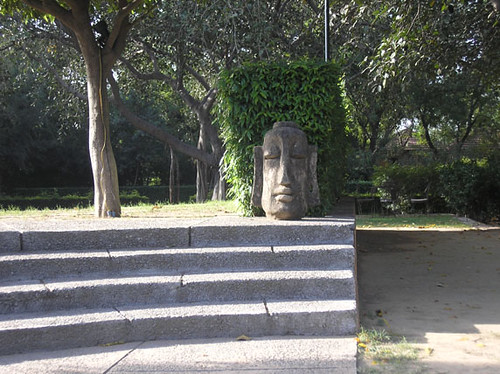
The Sanskiriti Kendra, the location of our residential camp was situated at the very outskirts of Delhi, the Kendra a very calm sort of place, a sanctuary for artists and the likes, wonderfully landscaped with cottages, trees and ponds. The place serves 100% vegetarian food, now this was an experience I’m going to remember. Thankfully though the food was good, and I liked the change.

Food-aside, I was looking forward to meeting the BBites. Some of whom I’ve met before. Beyond Borders worldwide is a one big family of sorts, I’ve never met a bunch of people who are as vibrant and accepting as these ones. Sadly, BB Bangladesh, and Pakistan were not in attendance for the camp. This was pretty much a Delhi-Mumbai-Colombo affair.

The Sessions

Beyond Borders, as a project under the British council was initiated under the themes of Identity, Diversity and Active Global Citizenship. Abstract nature of these themes, means there’s room for much exploration within these concepts, and the sessions at the camp dealt with these concepts, some times in an abstract sense and mostly in their practical manifestations. Some of the sessions were on topics such as secularism, social entrepreneurship, public policy, gender stereotypes, media for social change, faith, and many more. A thorough treatment of all these would mean a kind of a report on this blog, something I’m not prepared to do. Therefore I would touch on a few sessions I really liked, and perhaps blog about the rest in more detail later.

I most enjoyed the session titled Public Policy, conducted by Dr. Parth J Shah from the Centre for Civil Society, a leading think tank and an advocacy group based in Delhi. Part of the workshop involved coming up with policy solutions to common problems. Our subgroup focused on the problems of the Indian three wheeler (or auto-rickshaws as they call it) industry, I was ecstatic since I was finally given a chance to put my tuk-tuk observations to the test. Sri Lankan three-wheeler industry is a shining example of the how industries without regulation can prosper, compared to the Indian scenario, where the industry faces heavy regulation, which serves neither the drivers nor the consumers.

Dr. Shah has is the founder and president of CCS is an organization which promotes freedom, both in people and in markets. I was truly inspired by the work of CCS and Dr. Shah, and the amount of minds their advocacy can change. It made a believer out of me, change truly is possible. I only wish they could do some of their seminars in Colombo.

Another wonderful person I met is Mukul Kesavan, a professor of history from the Jamia Millia Islamia (National Islamic University), in New Delhi who led a session on ‘Secularism, Religion and Conflict’. This was one of the most thought provoking discussions I’ve had for along time, as well as being a more than a relevant topic to the times we live in.

The discussion touched on conflicts around the world from religious to ethnic, we discussed at length about religious secularism around the world, from the form of secularism practiced in India, to the separation of church and the state in the US to the French model of secularism, to various comments made by Inzamam, Dean Jones, Jack Straw and of course the Pope. The discussion also focused on the types of nationalisms, based on linguistic, ethnic and religious identities and the formation of nation states purely on the said identities, he discussed at length about the Indian partition and the creation of Pakistan, to a fruitful discussion on the Jewish state of Israel, as well as the conflict in the Middle East. In particular he kept referencing with ease and at length to the Sri Lankan conflict, and the Tamil demand for self-determination.

This was refreshing as I’ve never met a foreigner having such deep understanding about the Sri Lankan conflict. Later over lunch in a conversation which touched on Kumar Sangakara as well as Mangustine, Mukul explained that ‘Sri Lanka’ is in fact, a quite a frequent topic in Indian academic circles.

There were few more interesting people and sessions worth extending this already extended post. One was a bloke called Arijit Roy of Jagran who led the session on Media for Social Change, blogging was mentioned in passing, but it would be stretching the imagination a little to suggest that blogs can be considered a serious tool for social change. Surely it would come along, but certainly its not there yet, not in the developing world at least.

Arijit’s choice of media was the mime theatre, where Arijit’s organization, - Jagran - uses it to explore difficult issues such as rape, sexual health and HIV. It was encouraging to note that Jagaran work with the Delhi police, who have taken a keen interest in the theatre as a medium to communicate with the general public, especially in cases of rape (sometimes by family, and extended family) which rarely gets reported.

We ended the sessions with a wonderfully colorful BB alumni night, where all of the BBites from past to the present was invited BB, I even had to dress up in the Mahinda Chintana outfit…ahh.. the things I do for my country..

Delhi Shopping

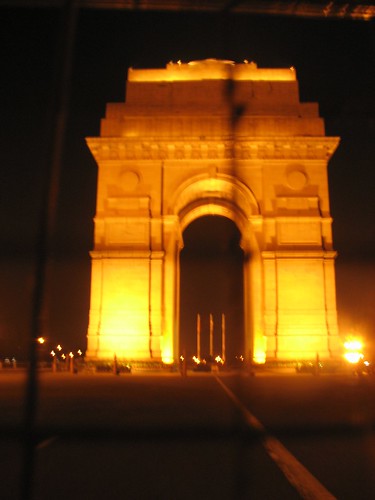
After winding up in Sanskirti Kendra we returned back to central Delhi, where we had a day and a little more for whatever we want to do. We haven’t done a whole lot of sight seeing except, a evening visitto the India gate. But my companions wanted to just shop.

Shopping in Delhi (like most places in the world) is more of a ‘woman-thing’, there’s the posh kind of malls you’d expect from a city and then there are like literally hundreds of boutique kind of shops which sells anything from pajamas to perfume and everything in between. In addition there are dozens of street-hawkers trying to sell stuff like socks, handkerchiefs and even books. Most buggers were annoying, they just don’t go away, so much so, that I felt like buying some of the stuff just to send them away. Stuff they have, of course are dirt cheap, but obviously inferior in quality. There are some useful ‘hawkers’ though, I managed to find a cheap copy of seven habits by Covey. Something I always wanted to pick up. All in all, Delhi’s probably not exactly my kinda place for shopping, there’s not a lot of electronic stuff, and the malls are kind of spread out. But it’s all right, especially if your after sarees, jewellery, cotton and traditional sort of stuff; I was obviously not, so while all the women were having a field day at these boutiques, and Saree shops I headed off to Ansal Plaza, the only sort of proper mall I had time to drop into, the mall is home to most international brands, like Lacoste and Marks & Spencer. There are also some music stores and watches and whatnots you’d also get the food outlets, with all the usual suspects and stuff like Subway, which you don’t get here.

All good things, as they say, have to come to an end. When all the good byes, and the hugs were done we had to fly back home. It was a wonderful experience; I’d never thought I’d actually miss India. Most of all I miss the Indians, and the sort of kick you’d get from being with like-spirited people. One moment you’re just singing some Hindi song, and the next you could be having a passionate debate on religion or language homogeneity. Good times.

Deane.

Saturday, November 18, 2006

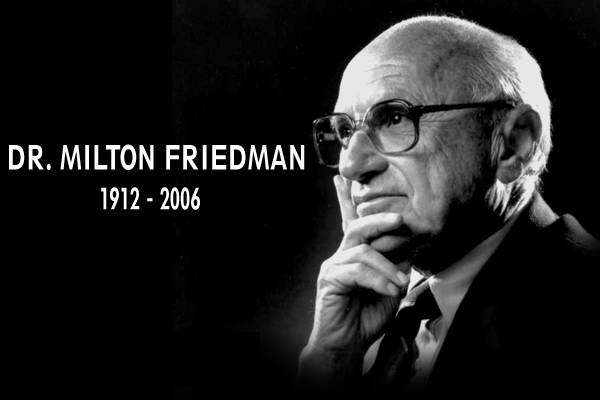
Good bye Friedman


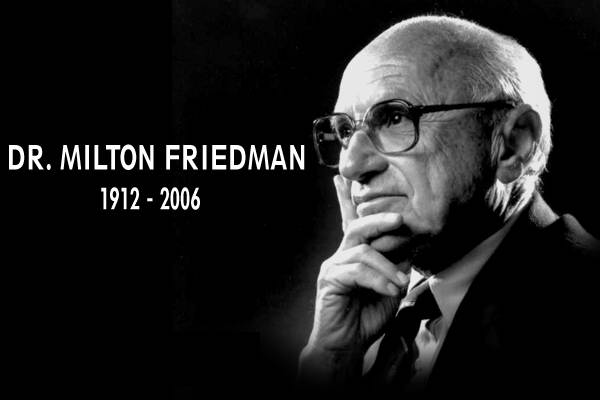
Its not often you hear a loss of a person whom you’ve never met, and feel such a sense of deep grief, as I do now. Not many people have that ability, that effect on people. The 20th century’s leading economist, free-market theorist and Nobel laureate- Milton Friedman is no more. Loss of Friedman, to me, is a loss of an idol, one who confirmed and solidified my capitalist leanings. His writings such as the Capitalism and Freedom provided me with the intellectual foundation for much of what I hold true in economics.


Milton Friedman will leave behind decades worth of intellectual firepower that could bring down yet another soviet empire. He could very well claim a stake in the first one as he is seen as someone who heavily influenced both the Reagan administration as well as Lady Thatcher’s government. I do not know how many Sri Lankans have read Friedman, or know of him but I could distinctively remember sometime back, Sirasa Tv screened a series documentaries titled, Commanding Heights which prominently featured Friedman.


Achievements of Milton Friedman are plenty but there would be little point in repeating them here, since that has been readily done by many others. One thing I wish for on behalf of this country is that someone would take the initiative and translate some of his works into Sinhala and Tamil so as to liberate Sri Lankans from its current leftist retardness.


Let me end with the words of Edward H. Crane, President of the Cato Institute, (whose emailed informed me of Friedman’s demise)

“Here's a guy who won the Nobel Prize in economics for his work in monetary theory and he was a great Chicagoan, a great empiricist and theoretician of economics. But ultimately, what Milton believed in was human liberty and he took great joy in trying to promote that concept....Milton would say, 'Maybe I did well and maybe I led the battle but nobody ever said we were going to win this thing at any point in time. Eternal vigilance is required and there have to be people who step up to the plate, who believe in liberty, and who are willing to fight for it.' ...In my view he was the greatest champion of human liberty in my lifetime, certainly in the 20th century. And he didn't slack off in the 21st century.”

May he rest in peace.
Related Links

Wednesday, November 08, 2006

Dead Man Walking


Much has been written about the death sentence of former Iraqi president, Saddam Hussein. Some say it’s a good thing, others say its not, and some others like me, are stuck somewhere in between. For now though, Saddam may still be walking, But the Saddam to a lot of people is dead; he has been for a quite some time.

The Saddam Hussein the world knew in pre-occupation Iraq was a different man from the court-house maniac that he has become, from the days of his military salutes to his one-handed shooting antics; the public persona of Saddam Hussein was one of strength, control and obedience from his people. Weather anyone would acknowledge it or not a tyrants induce a sort of admiration by at least some people of this globe if not most people. Their very existence is based on their image of respect and absolute unquestioned power. Stalin, Mao, and even Hitler are still adored by their supporters (and sometimes by non-supporters) for their god-like personas. When Saddam Hussein appeared from a rat hole in December 2003, looking like a pre-Christmas Santa clause, appearing on TV in hand cuffs and being examined by an American medic, he gave up membership of that elite club of dictators. He was no more the great Saddam, he was dead then and now we are just having the ceremony.

That said, ceremonies conducted by the US-backed Iraqi court seemed to be somewhat flawed, and genuine concerns whether or not the justice in its purest sense was served is an open question. I do think some justice was served, but I have reservations as to the way it was served - Including the invocation of the death penalty, something which I’m fundamentally opposed to. Much of the reaction from the world over seems to follow those lines, opposing the death penalty imposed on Saddam whilst upholding the fact that he was a brute.

In this vein, I read with amusement, a small box story in the front page of the Daily Mirror on Monday (Nov 6, 2006) with the title ‘Muslim leaders condemn verdict’ in which the body of the story goes on to say Alawi Moulana (Governor, W.P) has told the Mirror that the ‘entire Muslim world would rise up’ against the sentence. Obviously Mr. Maulana was unaware of the fact Iran has already come forward in support of the verdict, and called for Saddam’s execution. Its interesting that Maulana would use the term ‘Muslim world’, because the Baath Party, or should is say The Baath Arab Socialist Party which provided the political foundation for the Saddam-dictatorship was not terribly Islamic, in fact it was more fascist, in both philosophy and operation also inspired by the JVP-like Arab nationalism and European socialism. Iraq then, (contrary perhaps to the reality on the ground which we now see) was seen somewhat more secular societies in the Arab world during the Saddam regime; probably due to the fact that Saddam favored guns over religious clerics for obedience. So it’s a bit surprising to me, why the so called Muslim World would ‘rise-up’ against this decision. It must also be said, however, that conduct of Muslim leaders of this country deserves a lot of praise, and I would not exclude Mr.Maulana from this list. They seemed to have managed to attain the correct balance and not let things slip into religious fanaticism like some parts of the world. If statements like this one, and some limited action (like burning up bush-dolls and American flags) is part of what keeps things in check, then so be it.

Coming back to Saddam’s case, there has always been conspiracy theories thrown about with regard to the case it self, and the capture of Saddam. Some claim the Santa-like figure who appeared from the rat hole is an impostor and the real Saddam is either in exile or dead ( as in physically). Some others believe the court’s decision to announce the verdict was to cushion a Republican defeat in the mid-term elections that are currently under way in the US. I’m usually not so big on conspiracy theory, for I would reject both these claims.

But whatever said and done at the end of the day, a Saddam execution may have little impact on the situation in Iraq, but a GOP defeat, which is now certain in the US House of Representatives and possibly even in the Senate might have a bigger impact on the Bush policy, and therefore the lives of people in Iraq.

Deane.

Wednesday, November 01, 2006

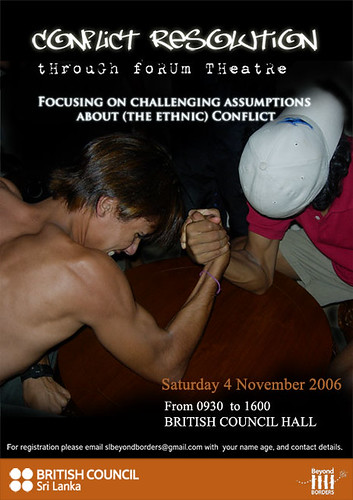
Conflict Resolution through Forum Theatre


Core group members of the Beyond Borders, a project attached to the British Council is organizing a one day workshop on “Exploring ways to tackle assumptions about (the ethnic) Conflict through Forum Theatre” at the British Council on Saturday 4 November 2006.

The project members believe that the process to dismantle the protracted nature of the ethnic conflict in Sri Lanka should involve concentrated advocacy for greater inclusion, recognition of diversity and promoting the need for greater critical analysis of our assumptions and prejudices relating to the conflict.

As a tool to explore and understand these prejudices more clearly and as means to explore conflict in general we propose the use of forum theatre- A form of theatre where scenarios are designed to stimulate and encourage audience participation through discussion, interactive role-playing and shared experiences.

The event is divided into two main sessions; the first session would be on acquiring key skills relating to Conflict Resolution. Mr. Sanjana Hattotuwa (Coordinator/Media Unit, Centre for Policy Alternatives and Head of the ICT and peacebuilding at Infoshare) would be conducting this workshop.

The second session would involve a discussion on forum theatre led by Mr. John Martin (Artistic Director, Pan Centre for Intercultural Arts, UK.) and a Model Forum theatre presented by the Beyond Borders Core Group.

Date : Saturday 4 November 2006
Time : 09.30 a.m. – 04.00 p.m.
Venue : British Council Hall, 49 Alfred House Gardens, Colombo 03

For registrations, please visit the following link and fill in the necessary details. http://bb.wufoo.com/forms/a-one-day-workshop/

You may also email your registrations to slbeyondborders@gmail.com with your name, age and contact details.

Please note:

- All participants are expected to be in the ages from 16 to 25.
- The deadline for registration is Friday 3 November 2006.
- Admission is free but registration is mandatory since only limited places are available.

Related Links :

Event Flyer
Further information about the event and its objectives.
More on Beyond Borders

Wednesday, September 27, 2006

Whores, Brothels and the JVP

Photo by indi

The JVP and the SLFP has accused each other of engaging in ‘the world’s oldest profession’, a somewhat politically correct way of saying both parties act like a bunch of whores.

The first ‘blood’ of the now unraveling saga was drawn by the JVP leader Somawansa Amarasinghe, evidently upset that the SLFP is engaging in a dialog with the UNP accused the SLFP of acting like a prostitute waiting to be picked up by anyone who comes along the way. A somewhat honest statement, but a one that perhaps his supporters wish was never made. The Rebuttal came a bit later at another public rally by the SLFP general secretary, Maithreepala Sirisena who said that the JVP would have had to engage in the “world’s oldest profession” had the president called for general elections after the pathetic showing by the JVP in the Local Council elections. The marriage, or rather the ‘living-together’ era of the SLFP and the JVP has never seen such troubled times in recent years but no one should speculate a permanent rift as long as the President Mama is in office.

If the two main players in this rather unexpected but highly entertaining drama is the SLFP and the JVP, the third player is none other than Sirasa TV or rather the whole Maharajah network who for past few days has given extensive coverage of the issue and added some fuel to the fire by getting interviews from other leading SLFP men including Anura Bandaranaike.The keen interest taken by the Sirasa seems to stem from a larger, multi-facet battle fought between the Maharajah group and the JVP. In recent times the battle has intensified with the JVP-run ‘Lanka’ newspaper accusing the Maharajah boss of having links with the LTTE, claiming that his brother in London is a LTTE-funder (or something to that effect).

In a strange twist to this already twisted tail, the authorities have cracked down on a Brothel with links to a member of a ‘certain political party’. Sirasa, promptly carried this news item two days on a trot, right after it traditionally reports the Amarasinghe-Whore story. In its report Sirasa virtually threatens to give out the details of the member which fuels speculation that this ‘certain political party’ could well be the JVP. The Sirasa-JVP media battle can be seen as a type of a David vs. Goliath battle but the story might not quite end as in the bible.

Deane.

Tuesday, September 19, 2006

BlogCamp - Sri Lanka ?


Recently India had their largest ever blogger ‘unconference’ in Chennai, TamilNadu which apparently is the home to the largest number of Indian Bloggers. An ‘unconference’, is type of a conference driven mainly by the attendees rather than the speakers which supposedly generates to a lot of creativity and new ideas.

The event, named 'BlogCamp' took place on the 9th and 10th of September and seems to had an attendance of about 200 Indian Bloggers discussing various topics related to blogging, documented in detail here in the BlogCamp site. All in all the unconference seems to have been a success. So, why not a Sri Lankan version of it?

A Colombo BlogCon, or UnCon as the case maybe, is not a too distant reality. My guess is it’s an eventuality, someday someone’s going to have the idea of having a ‘BlogCon’ and most of us would flock in. The question is, are we ready now? Is the community sizable enough? These questions are worth examining. Undoubtedly the core of Sri Lankan blogging can be found at Kottu.org which currently tracks 150 or so Sri Lankan Blogs. But it’s a mistake to equate the size of kottu the SL Blogosphere. There is a good number of other blogs (the exact number is hard to guess) not syndicated at kottu, due to either, not knowing that Kottu exists, not knowing how, or simply not wanting to get their content syndicated. There is a great deal of SL blogs in MSN spaces in particular which are hardly ever syndicated at kottu or any of the other kottu spin-offs.

Quite apart from blogging, the general population of SriLanka-Online is reaching sizable proportions. Hi5, arguably the most popular social-networking site among Sri Lankans hosts about 86,000 profiles of Sri Lankan residents. Shihan Mihiranga included.

With numbers like that, its possible to envision something along the lines of a Bloggers Conference, even if it is to.. ahem.. ‘raise awareness’.. among the general public about the whole blogging phenomenon. How, and who would take the initiative is another matter. Ultimately there has to be enough commitment within the community for something like this to happen. Maybe this post will serve as a viral injection of sorts to get things started. maybe it won’t. Who knows these things.

Cheers
Deane.

Related Links : [http://www.ibnlive.com/news/chennai-a-melting-pot-for-bloggers/19636-3.html]

Wednesday, August 30, 2006

A National Government?


It’s one of those things that have always had much ‘public support’ in this country, but many times when such an opportunity has presented it self, Sri Lankan politicians has shied away. It remains to be seen whether this latest opportunity will be examined in earnest or paid only lip service. I am quite expecting the latter.

A potential ‘National Government’ has many benefits, one being the possibility of a much eluded national consensus (and not necessarily a ‘southern’ consensus) on the ethnic conflict; another of course is the availability of expertise and skill currently idling in the opposition from Prof. GL Peris, to Milinda Moragoda to the big fish himself, Ranil Wickramasinghe. Yet another advantage would be the annihilation alienation of the obstructive JVP/JHU parties.

The request itself by His Excellency, much like most things in his administration, is not without its ambiguities. The official word seems to be the president requested the UNP, and other parties to ‘Support’ the government in its efforts to solve the ethnic conflict. Now, ‘support’ can be tendered in various ways and not necessarily through the potentially dramatic step of a ‘National Government’. The local press though, seems to be of the view that the request is along the lines of a National Government.

Whatever the case, the country and its government are in need of clear and direct action along the avenues a negotiated settlement to the present crisis situation. The Rajapakse administration has proven that it’s incapable of handling the situation anything short of all out war. In this light, Ranil Wickramasinghe as the Prime Minister may offer hope in breaking this spate of violence and forcing the LTTE into negotiations once again. His methods might not be terribly inclusive, but he - at least when in government, has proven to be a GTG (Getting-Things-Done) politician, very much a breed in demand. After all these supposedly ‘inclusive’ initiatives like the APC (All Party Conference) and that advisory council of experts has achieved nothing much tangible. Their very existence, particularly of the APC, seems to be for mere cosmetic purposes than for any honest effort to solve the larger or the immediate conflict.

Despite these facts, the UNP is likely to demand the government spell out its parameters for solving the ethnic conflict before saying anything remotely closely to ‘I Do’. It’s always safer to get a concrete compromise out of the President than to just commit blindly for the sake of greater good. Additionally I’m sure, like any ‘good’ party, they would consider factors like the number of cabinet portfolios in the offering, and the bigger picture of the war situation Mahinda has created, which in time may be beneficial for the UNP.

The ‘war’ may be popular and even easier to start but is not so easy to sustain, both in itself and in terms of its popularity. When the heat of the war enters Colombo and the surrounding suburbs, and when the prices of everything from petrol to peppermint inflates, and when the government tries to squeeze for every penny, rupee and dollar to save itself from bankruptcy, and when the ‘masses’ who voted in favor of the present president find that the fertilizer subsidy is no more, they will think twice, thrice and many times and may heed to a future UNP plea to make things right, once again.

The above thinking of course, is along extreme partisan lines and hopefully the UNP is above that. If in fact this offer from His Excellency is to form a National Government, and is genuine, and if (and only if) the government is willing to compromise on some its positions and drop its fake nationalist rhetoric, and if it is genuinely willing to solve both the immediate and the larger conflict, then I think the UNP has a duty to accept it.

However, His Excellency and his government must realize they cannot have all things their way; it’s a pipe dream to think of a National Government if they still wishes to be in bed with the JVP. The government must make a solid decision on which way it wants to take this country. If the government decides to take the JVP route, then it will be a matter of time before they strangle themselves.

Deane.